

Here’s how to evaluate the redistricting plan offered by New York Democrats: The same way you’d evaluate the lines drawn by Republicans in other states and, for that matter, by New York Republicans when they dominated the State Senate: It’s all about improving your odds of winning.
Clearly, that’s not how it should be. It may benefit parties, but at the long-term expense of the country. New York – and all states – should draw legislative district boundaries without regard to political advantage, though that’s a little like expecting a lion to go vegetarian. The once-every-decade task, mandated to preserve the concept of “one person, one vote,” should aim above all to keep communities together irrespective of party membership. That would make elections more competitive and dull the allure of the kind of extremism that now pollutes our politics.
Welcome to nirvana.
People are also reading…
The sad fact is that the U.S. Supreme Court washed its hands of the gerrymandering problem in 2019, when it ruled that redistricting controversies are the province of legislatures, not the federal courts. It was an unfortunate decision, in that it tacitly authorized states to draw lines in ways meant to make some votes less influential than others.
“We are in Mad Max territory now; there are no rules,” Justin Levitt, an election law professor at Loyola Law School, told National Public Radio after that ruling. “I think you’ll see more legislators in more states [where there is unilateral control] taking up the mantle of extreme partisan aggression against people who disagree with them.”
It’s a version of what Democrats are doing today in New York, drawing districts that are bound to give them an electoral advantage. It’s also what Republicans are doing in states they dominate, including Texas and Alabama. And disregard the crocodile tears of New York Republican Chairman Nick Langworthy: Republicans here did that and worse as they used every trick they could think of to retain control of the State Senate, going so far as increasing the number of senators in their efforts to cling to power. Eventually, that didn’t help, as Democrats took over the chamber in 2018 and claimed legislative supermajorities two years later. With that clout, Democrats are driving redistricting.
But there’s an asterisk, possibly a significant one: In 2014, New York voters approved a constitutional amendment that was supposed to drain at least some of the politics out of redistricting. The amendment included language to prohibit drawing district lines meant to favor candidates or parties though, predictably, there is an asterisk to the asterisk: Existing district lines should be respected. That opens avenues for mischief.
Even with that change, redistricting was never going to be a truly independent undertaking. Still, it was meant to reduce – if not eliminate – the ability of skeptics to christen misshapen districts with names like “Abraham Lincoln Riding a Vacuum Cleaner,” “The Splattered Bug of the Bronx,” and “The Long Island Lobster Claw.” And that’s not to mention Western New York’s infamous “Earmuff District,” drawn after the 2000 census to connect parts of Erie and Niagara counties with the Rochester area by means of a strip along Lake Ontario.
That district went away after the 2010 census, but there was a real prospect that Democrats would try to bring it back this year. To their credit, they didn’t, though the congressional lines produced last week would almost certainly increase the number of Democrats New York sends to Congress and possibly enough to keep the chamber in Democratic control. Some, especially downstate, are oddly configured.
In this proposal, as always, there are some gigantic districts. That’s impossible to avoid in more sparsely populated areas, especially as overall population loss reduces the number of congressional districts. New York is losing one district this go-round. Thus, under the Democrats’ plan, the 27th District occupied by Rep. Chis Jacobs, R-Orchard Park, would stretch for 256 miles, from the Niagara River in Lewiston all the way to Watertown, but not including Rochester. Jacobs will have to move to continue representing the district. He says he will.
Meanwhile, the 23rd District, represented by the soon-to-retire Tom Reed, R-Corning, would run east from Chautauqua County’s Lake Erie shoreline, across the Southern Tier into Chenango County.
Significantly, both districts would include parts of Erie County, whose dense population would largely remain in the 26th District, represented by Democrat Brian Higgins of Buffalo. With that – and this has potential benefits – Erie County would have three members representing it in Congress.
Republicans say they will go to court over this plan, so outraged are they that Democrats did what they wish they could have done. The legal question may hinge on whether the lines so benefit Democrats that they violate the 2014 constitutional amendment. As Politico has reported, it may not work.
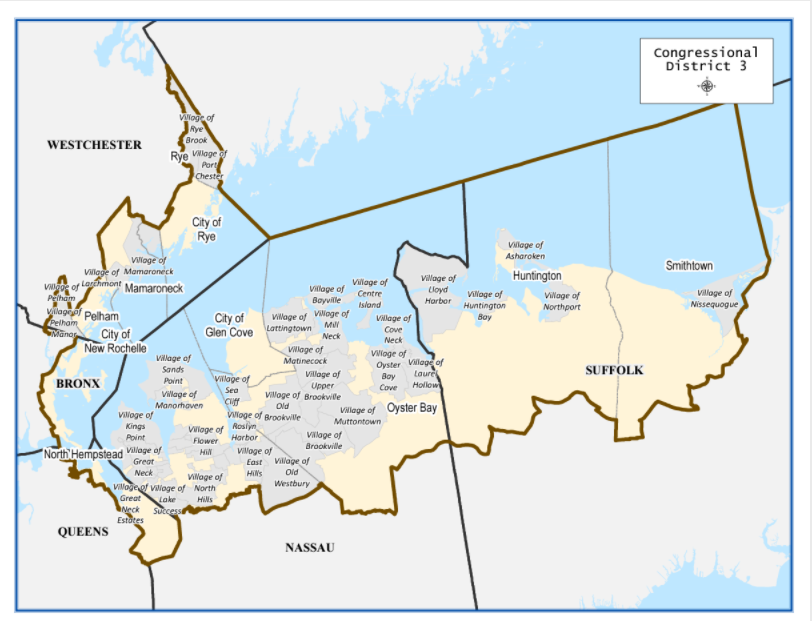
This much is true: The plan includes few districts so grossly misshapen that they cause the eyes to bulge. The notable exception is the proposed 3rd Congressional District, which would link Suffolk and Nassau counties on Long Island with parts of the Bronx and Westchester County on the mainland. Democrats insist it will pass muster and maybe they’re right. Smaller needles have been threaded.
Still, New Yorkers and all Americans would benefit from a truly independent redistricting model that produces competitive elections within adjacent communities. But why would any party in any state willingly lay down its redistricting arms unless they all do? New York Democrats certainly didn’t. For that, there is room for criticism but, in a realpolitik way, also comprehension.
So, here’s an idea: Langworthy should join with a similarly overmatched Democratic leader from a Republican dominated state – Texas, say – and begin a national campaign for a federal constitutional amendment requiring actual independent redistricting. That would send a useful message to all Americans, regardless of party, that they – and the country – are being misused.
• • •
What’s your opinion? Send it to us at lettertoeditor@buffnews.com. Letters should be a maximum of 300 words and must convey an opinion. The column does not print poetry, announcements of community events or thank you letters. A writer or household may appear only once every 30 days. All letters are subject to fact-checking and editing.


