

Are some sugars healthier than others? Should we be avoiding them altogether? These are frequent questions, so I decided to give you the dietitian-nutritionist lowdown for this month’s article.
Humans like sweet things, so you can forgive yourself for enjoying them. To understand if you need to establish guardrails when it comes to foods with sugar, you need to know that there are different types.
Free sugars are a result of industrialized processes. Manufacturers and food preparers add them to food and drinks. Free sugars include agave nectar, syrup, and granulated sugar (brown, white, coconut). You will find free sugars in flavored milk and yogurt, cookies, cakes, frosting, pastries, condiments and salad dressings. Though honey is considered a free sugar, research indicates that it may be superior to other added sugars, but for health’s sake, consider it part of your added sugar allocation.
Bound sugars are found in fruits, vegetables, plain dairy, nuts, seeds and grains—and humans did not contribute them. These nutrient-dense foods contain fiber, which binds the sugars. Because your body must work at releasing the natural sugar, the chance for a spike in blood sugar is low. Forget the “fruit contains too much sugar”; enjoy a couple of fresh and dried fruits daily, but minimize juice intake because though 100 percent natural juice contains no added sugar, the natural sugars are free—they are no longer bound to fiber.
The American Heart Association recommends limiting added (free) sugars to no more than 6 percent of calories each day. For most American women, that’s no more than 100 calories per day or about 6 teaspoons (24 grams) of added sugar. This recommendation contrasts with women’s average daily consumption of 15 teaspoons (adult men consume 19 teaspoons).
Added sugar provides few nutrients, and these empty calories may contribute to nutritional deficiencies. Excessive intake of free sugars may also be one reason people consume too many calories. Excess fat contributes to inflammation, leading to type 2 diabetes and cardiovascular disease.
I invite you to examine the free sugar in manufactured foods, which you may not perceive as overly sweet. These include ready-to-eat cereals, catsup, BBQ sauce, prepared meals, baked beans, snack bars and flavored yogurt.
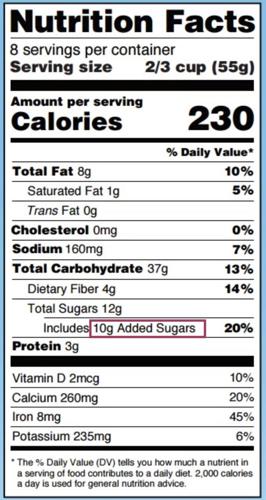
Analyzing the ingredient list may present a challenge since there are over 60 different names for sugar. You might easily recognize high-fructose corn syrup as an added sugar. Still, others, like malted barley, may not look like “sugar,” so you must also review the nutrition facts panel (see adjacent example). In the carbohydrate section, you will see total sugar—that’s all the sugar in the product, bound and free. As mentioned above, bound sugar is not a concern, but free sugar is. So, pay attention to the grams of added sugar; if you are a woman, keep your daily intake below 24 grams. Men, your upper limit is 36 grams. I recommend you ignore the %DV column for sugar as it is based on 50 grams per day.
The labeling requirements differ for single-ingredient sugars and syrups such as table sugar, maple syrup, or honey. These products list the percent Daily Value for added sugars within the Nutrition Facts label, and the gram amount per serving and %DV may be included in a footnote. Single-ingredient sugars and syrups are labeled this way so that it does not look like more sugars have been added to the product and to ensure that consumers have information about how a serving of these products contributes to the Daily Value for added sugars and their total diet.
Many people tell me they feel compelled to end a meal with something sweet. While the reason for sweet cravings is complex, the most common factor is habit and the need to change the lingering flavors in your mouth from savory to sweet. If a piece of sweet fruit won’t do it, then get up from the table and brush your teeth. However, changing our relationship with food can be difficult, and emotional attachment to food is frequent. Though it’s not impossible to break habits, you may find a health coach valuable.
 Tucson to get a Teso Life store


