

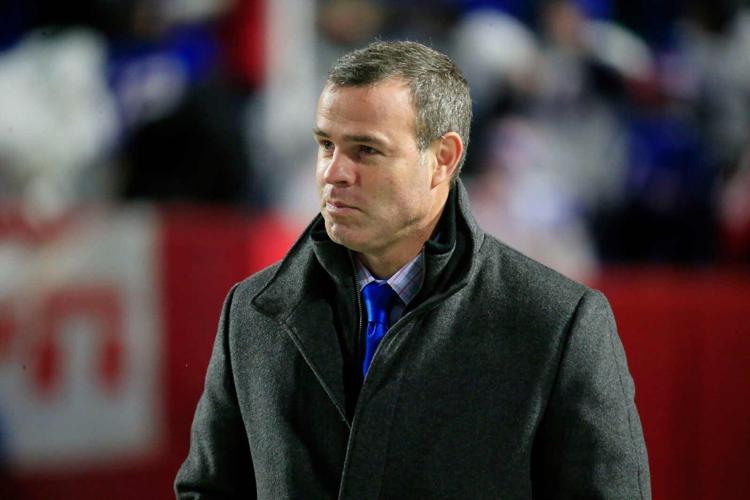
Brandon Beane’s job isn’t getting any easier.
The Buffalo Bills’ general manager has built a team that has won back-to-back AFC East championships, establishing itself as a bona fide Super Bowl contender in the process.
Staying there, however, is going to take some work.
One of Beane’s biggest accomplishments last year was working out a contract extension with franchise quarterback Josh Allen. That gives the team stability at the most important position in professional sports.
Along with that, though, comes extra pressure. The real big money in Allen’s extension kicks in during the 2023 season, which raises the stakes in 2022. Although the salary cap will increase from $182.5 million to $208.2 million (the Bills’ adjusted cap when taking into account rolled over money is $210.545 million) for the upcoming season, it’s still not back to where it was before the Covid-19 pandemic.
People are also reading…
That led to a record number of contracts being restructured last year in order for teams to be cap compliant. A repeat might be in order this year.
“I still think you’re going to see a lot of those,” Beane said at the NFL scouting combine. “We may have to do that. We’ll be creative, whether it’s extending guys, restructuring.
“We’re going to try and reload this thing and see if we can get over the hump.”
That’s where I come in. In my sixth annual “GM for a Day” column, I offer my advice to Beane, free of charge.
As in years past, Beane has given me a head start on my work. The Bills have already released linebacker A.J. Klein and guard Jon Feliciano. Those two moves saved about $8.6 million in cap space. Beane said Tuesday that the Bills were about $6.6 million over the 2023 cap, so after those two moves, the team has about $2 million in cap space.
Teams can begin negotiating with the agents of impending free agents at noon Monday, the start of the NFL’s so-called “legal tampering period,” ahead of the official new league year, which begins at 4 p.m. Wednesday. Obviously, $2 million in cap space isn’t enough, so that’s where our work begins.
Freeing up more space
There are five ways a player’s salary can be reduced by teams. The first, as in the case of Klein and Feliciano, is an outright release. The second is a trade.
The other options involve the player staying with the team.
The third option is a straight pay cut.
The fourth involves restructuring a contract, which usually takes the form of converting a base salary into a guaranteed signing bonus, which then is prorated over the life of the deal.
The fifth is offering a player a contract extension, which provides a similar benefit to restructuring.
I’m going to utilize all five in my quest for cap space.
Let’s start with the chopping block. Klein and Feliciano were the easy moves, given their bloated salaries to be backups. The rest aren’t as easy.
Guard Daryl Williams signed a three-year contract extension last year that carries a cap hit of $9.925 million. That deal was signed, however, with the expectation that Williams would be the starting right tackle. With Spencer Brown taking over that job as a rookie in 2022, Williams became an expensive guard. He did lead the team in offensive snaps, at 97.8%, and started all 19 games.
While the line hit its stride late in the year and keeping it together would be ideal, the savings if Williams is released of $6.325 million are too big to pass up, so he goes. The decision has to be made quick, too, because $4.3 million of Williams’ salary guarantees March 20.
A quick note here about “post-June 1 cuts,” which you might hear about in the coming days. When a player is released after that date, the remaining “dead money” on his contract – bonus money already paid out that still needs to be accounted for on the salary cap – is split over two years, in this case the 2022 and 2023 salary caps. In Williams’ case, if he were released as a “post-June 1 cut,” the Bills would save $8.125 million against the 2022 cap, with “dead money” charges of $1.8 million in 2022 and 2023.
The key here, though, is that Williams’ savings wouldn’t actually be realized until June 1, which does the Bills no good right now, when they need cap space to participate in free agency.
“That’s another formula for kicking it down the road,” Beane said at the combine. “I'm one of those guys – in my life, I've never really had credit card debt. I just don't like operating like that. The less that I can push down the road and keep us competitive (the better). I'm not going to sleep at night unless I've got a roster that I think we can win the whole thing. Beyond that, I don't want to just, again, give up, go for it this year or go for it for two years, and then all of a sudden we're sitting here in two years and you're going, 'Brandon, you're $92 million over the cap. Where are you going to get started? Are you cutting everybody except Josh Allen?' "That's what I'm trying to avoid.”
Next on the list is linebacker Tyler Matakevich. He’s the unquestioned leader of the special teams, leading the Bills in snaps in that phase of the game. However, at a cost of $3.25 million, that’s an unaffordable luxury, given the team’s cap situation. Matakevich’s release saves $2.5 million in cap space.
It’s also time to say goodbye to punter Matt Haack. Beane was direct in saying Haack had an uneven first year with the Bills. Even after agreeing to a reworked contract that included a pay cut, the Bills could still save $785,000 by releasing him. That isn’t all that much, but this move is as much about finding an upgrade as it is the cap savings.
Those three cuts provide a shade more than $10 million in cap space, which brings me to about $12 million. That’s still not enough.
Next up, I’m honoring Cole Beasley’s trade request. The veteran receiver turns 33 next month and is headed into the final year of his contract. Beasley has been a big part of the Bills’ offensive explosion since signing with the team before the 2019 season. He’s made 82 catches in back-to-back years, but there were concerning signs in 2022. His yards per catch of 8.5 matched his rookie year of 2012 as the lowest of his career. According to Pro Football Focus, his yards per catch after reception have decreased from 4.93 to 4.33 to 3.72 during his time in Buffalo. Beasley is still effective against zone coverage, but with a cap hit of $7.6 million, he’s overpriced.
Trading Beasley by March 20, when he’s due a $1 million roster bonus, would save the Bills $6.1 million in cap space.
Jacksonville looks to be an ideal trade partner. Beasley can be a reliable safety valve for young quarterback Trevor Lawrence, and the Jaguars have ample draft capital (12 picks) and cap space (sixth-most in the league, according to contracts website spotrac.com, at $40.139 million) to swing a deal. Jacksonville sends pick No. 179 overall in the sixth round to the Bills for Beasley. It’s not a huge return, but it’s better than cutting him outright.
After initially saying at his end-of-season news conference that he anticipated Beasley would be back in 2022, Beane walked back those comments at the combine a good deal, saying the team had some “tough decisions to make.” Parting with Beasley in a trade is one of those. Doing so brings me to a bit more than $18 million in cap space.
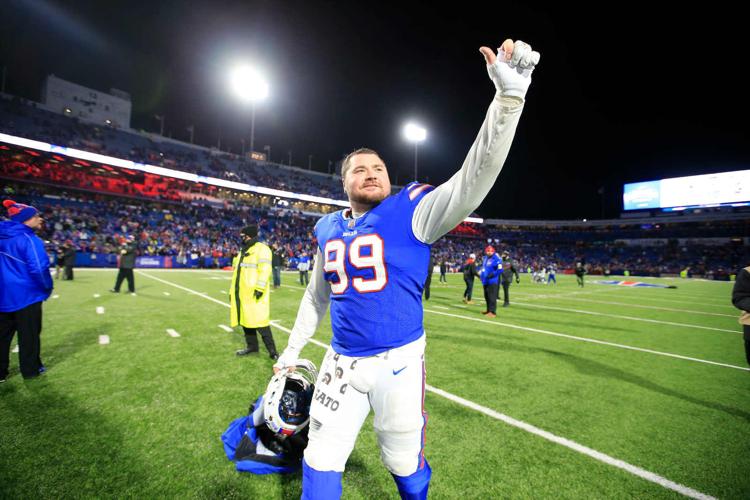
Next up is pay cuts. To Beane’s credit, the Bills don’t have a lot of players who are clearly overpaid. One of them, however, is defensive tackle Star Lotulelei. By the end of last season, Lotulelei was passed on the depth chart by Harrison Phillips, who is set to become an unrestricted free agent.
Lotulelei is scheduled to count $9.226 million against the cap in 2022. That’s way out of line for a player who played less than 30% of the defensive snaps last year. The problem is, an outright release saves just $1.526 against the cap, and cutting him simply opens up another hole on the roster.
If Lotulelei were designated as a post-June 1 cut, the Bills would save $4.126 million against the cap on that date. Lotulelei holds the negotiating power here, but perhaps the Bills can incentivize him to take a $3 million pay cut by offering to guarantee the remainder of his base salary and giving him the opportunity to earn back $1 million through playing-time incentives. That would drop his cap hit to a more manageable $6.226 million, taking me to $21 million in cap space. Lotulelei would be smart to accept it, because if the Bills bring him to camp and cut him then, he’d miss out on his $6.15 million base salary.
Next up are the restructures. This is not an area Beane likes to utilize often.
“It’s a necessary piece to operate and stay competitive, but the more you do, the more money you kick down the road,” he said. “A dollar you save today is a dollar you pay tomorrow. It’s truly the credit card philosophy, you’re just pushing it off. We’ve got to be creative, but cap strength is very important to me.”
Left tackle Dion Dawkins’ contract is one that can be restructured with minimal future damage. If the Bills convert $6 million of Dawkins’ $8.13 million base salary into a signing bonus, his cap number decreases this year to $8.71 million, while bumping up the last two years on his deal by $2 million in each season, to $15.45 million and $15.895 million, respectively. That’s manageable for a starting left tackle. That takes me to $25 million in cap space.
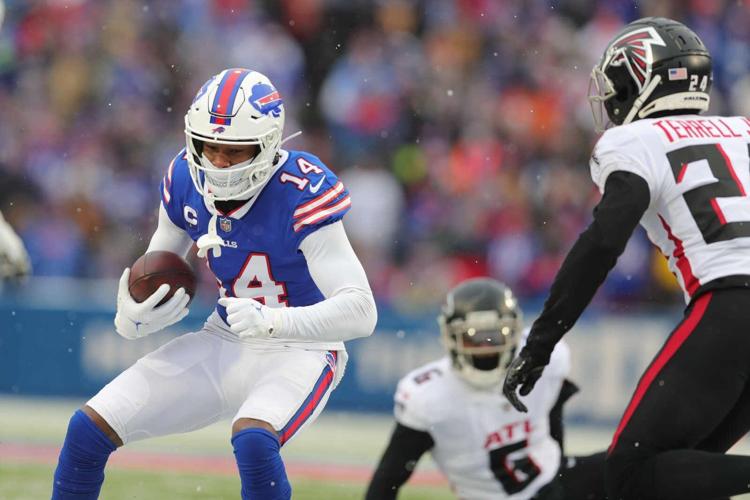
Next on the list is a contract extension for Stefon Diggs. The Bills’ No. 1 receiver is on the books for a cap hit of $17.917 million in 2022 and $18.006 million in 2023, the final year of his deal. He turns 29 in November, and has been durable, playing in at least 14 games the past five seasons and not missing a single one since coming to the Bills in 2020.
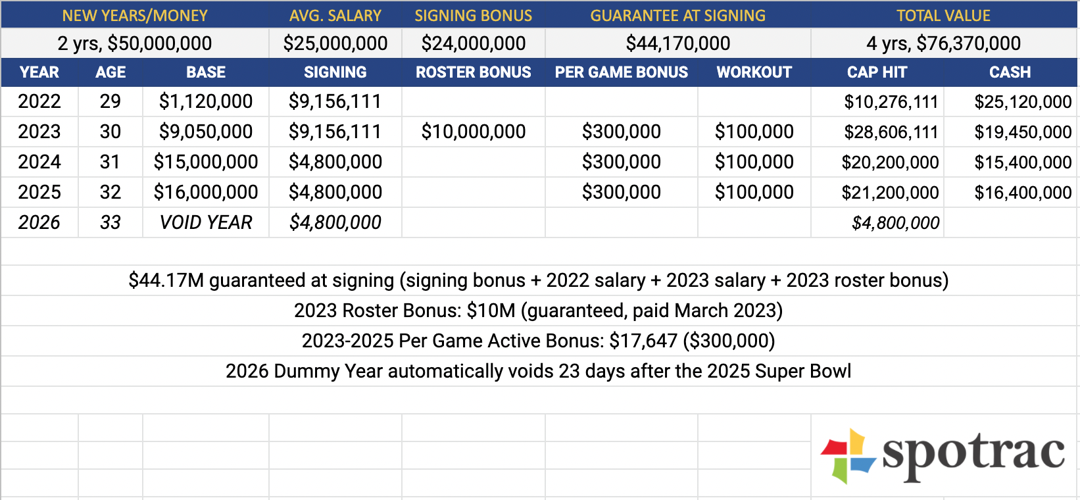
Still, the Bills will want to be careful here. A two-year extension taking him through the 2025 – his age-32 season – looks right for both sides. For this, I enlisted the help of Spotrac founder Mike Ginnitti. Together, we came up with a two-year, $50 million contract extension that includes a $24 million signing bonus and would guarantee Diggs $44.17 million at signing. Over the first three years of the extension, Diggs would make nearly $60 million, while giving the Bills some wiggle room to get out of the deal before the 2025 season if needed.
The complete details can be seen in the chart, but the main takeaway as it pertains to 2022 is this: Diggs’ cap number would drop to $10.3 million for 2022, a savings of about $7.6 million for the upcoming season. That gets me to $32.6 million in cap space this year.
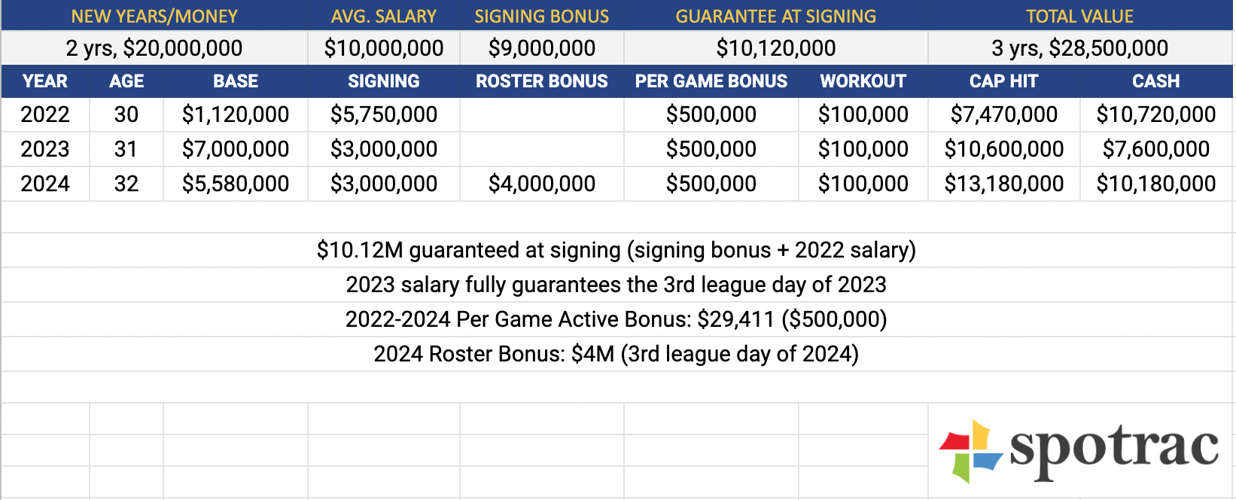
Last up for a contract extension is center Mitch Morse. He’s due to count $11.25 million against the cap in 2022. A two-year, $20 million extension with a $9 million signing bonus takes Morse through his age-32 season. It would lower his cap hit to about $7.5 million in 2022, giving me about $36 million with which to approach the business of the offseason.
A big swing
A lot has been made about the Rams’ approach to building a Super Bowl roster – basically saying “forget about it” to the draft and trading those picks for established veteran players. It’s hard to be critical of that approach, because they won a ring last month.
Beane, however, has never come across in any of his public comments as if he’s going to try to copy that method of roster building.
Still, he has shown he’s unafraid to make a big move when he determines the price is right, as evidenced by the trade for Diggs.
Coincidentally, I’m going to look back to Minnesota for a move that lands somewhere between the Rams’ approach and the methodical roster building the Bills have generally used.
Vikings edge rusher Danielle Hunter has played just seven games over the past two seasons. He missed the 2020 season following neck surgery and played in seven games last year before a torn pectoral muscle again landed him on injured reserve. In those seven games, though, Hunter had 6.5 sacks.
He has an interesting contract with the Vikings. He’s due a massive, $18.5 million roster bonus March 20. The Vikings are inching toward a potential rebuild – especially if they trade quarterback Kirk Cousins.
The Chargers swung a deal for Bears edge rusher Khalil Mack, by giving up a second-round pick this year and sixth-rounder in 2023. Mack likewise played in just seven games last year, and, at 31, is three years older than Hunter.
My offer to the Vikings is second- and sixth-round picks for Hunter. As for his contract, I’ll turn the roster bonus into a signing bonus of a two-year extension and guarantee his base salary of $2.4 million. That, along with a workout bonus of $250,000 takes his cap hit to a bit less than $9 million for 2022, which is affordable for me and gives Hunter more than $21 million guaranteed – more than he was scheduled to earn from Minnesota.
As part of the contract, Hunter also gets a $10 million roster bonus for the 2023 season, which basically means that 2022 is a trial run for both sides. It’s a calculated risk, but one worth taking for a player who, before his injuries, had back-to-back seasons with 14.5 sacks.
Keeping my own
After the above moves, my active roster consists of just 48 players, so it’s time to go shopping with about $27 million in cap space. My first priority will be to deal with my own free agents.
Beane gave me an assist Thursday be re-signing wide receiver Jake Kumerow, ensuring another key member of the special teams returns. I still have 14 unrestricted free agents to deal with. That list includes defensive ends Jerry Hughes and Mario Addison, cornerback Levi Wallace, defensive tackle Harrison Phillips, wide receivers Isaiah McKenzie and Emmanuel Sanders, quarterback Mitchell Trubisky, running backs Matt Breida and Taiwan Jones, offensive linemen Ike Boettger and Bobby Hart, and defensive linemen Vernon Butler Jr., Efe Obada and Bryan Cox Jr. Defensive tackle Justin Zimmer and guard Ryan Bates are restricted free agents.
I’ll start there by offering Bates a two-year, $6 million contract with a $2 million signing bonus. That puts his cap hit at just more than $2 million and leaves me with $25 million.
I will let Zimmer, who is rehabbing a torn ACL, become an unrestricted free agent but hope to retain him for a contract near the veteran minimum.
Among the unrestricted free agents, Phillips is my top priority. Spotrac estimates his average annual value to be $5.4 million on a new contract. A three-year deal worth up to $15 million would provide a bit of a hometown discount, and the Bills could entice Phillips by guaranteeing more than half of it with a $6 million signing bonus and fully guaranteed $2 million base salary in 2022. My cap space is now at $21 million.
Next up is Efe Obada, who has a history with defensive line coach Eric Washington from their time together in Carolina. Obada finished with 3.5 sacks last year in a part-time role and provides versatility to shift inside when needed. One year and a modest raise to $2 million should be enough to bring him back.
Boettger is recovering from a torn Achilles and if I can also retain him for around veteran minimum, my cap space is about $17 million.
The toughest call in free agency centers on what to do with McKenzie. If Sanders retires and Beasley is traded, the Bills will have just six wide receivers under contract. McKenzie showed last year against the Patriots he can be a weapon on offense when utilized correctly. He can also return kicks and punts, although that job won’t automatically be his.
He played last year on a one-year, $1.127 million contract. The Bills drafted a player who looks to be McKenzie’s replacement last year when they selected Houston’s Marquez Stevenson. Because of that, McKenzie walks away … probably to former offensive coordinator Brian Daboll with the New York Giants.
Also departing are Sanders (to retirement), Butler, Addison, Hughes, Jones, Wallace, Trubisky, Breida, Hart and Cox. In the case of Trubisky and Wallace, it’s economics at work. The Bills have all but conceded Trubisky will get more on the open market and a chance to be a starter than they can pay him to be Allen’s backup, while Wallace is in line for a deal that pays up to $9 million annually, according to Spotrac. In that case, the Bills are best to tip their cap to him and thank him for his service.
Hughes is the longest-tenured member of the team, and his departure will mark the end of an era. He saw it through several rough years in Buffalo to become a part of a team that is among the Super Bowl favorites, but the Bills drafted three defensive ends in the first two rounds the past two years for a reason. It’s time to let them play.
After dealing with my own free agents, my active roster is at 53 players. It’s time to look outside the organization.
Going shopping
In this scenario, the Bills have glaring holes in the projected starting lineup. Specifically, I need to acquire a starting guard, No. 2 cornerback and slot receiver – all without a lot of cap space. I also need to acquire depth at tight end and a backup quarterback.
I told you Beane’s job was hard.
Let’s start at quarterback. Provided he wants to continue playing and has received a clean bill of health after a hip injury ended his 2021 season, old friend Ryan Fitzpatrick makes perfect sense. That position demands an intelligent player who can pick up the offense – did you know that Fitz went to Harvard? – and a willingness to help Allen on the sideline during practice and games and in the meeting room. Fitzpatrick is universally loved by his teammates and would have absolutely no trouble meeting either of those requirements. Fitzpatrick’s deal should come in at about $3 million, leaving me $14 million in space.
Next up is a move that might be somewhat controversial – bringing home tight end Rob Gronkowski. I get there’s a segment of the fan base that has never gotten over the cheap shot Gronk put on Tre’Davious White in 2017, but arguably the greatest tight end of all-time can help this offense, even at 33 years old. I’ll certainly call White to make sure he’s on board with the idea, but adding Gronk opens up the possibility of running two tight end sets with Dawson Knox, giving offensive coordinator Ken Dorsey more options.
The chance to finish his playing career in his hometown has to have some appeal for Gronkowski, as does playing with Allen. A one-year deal worth $6 million could include a $4 million signing bonus that is split over a dummy year in 2023, dropping the cap hit in 2022 to $4 million and leaving me with $12 million in space.
Next up is the thinnest position on the roster: cornerback. Beane in the past has favored giving one-year deals to veterans at the position, having done so with Josh Norman, Kevin Johnson and Vontae Davis.
The Bills mostly run a zone-based defensive scheme. With that in mind, Casey Hayward makes a lot of sense. Hayward, 32, played the third-most coverage snaps in the NFL last season and allowed just 1.5% of passes in his direction to go for completions of 15-plus yards.
Hayward played last season on a one-year, $2.5 million contract. The chances of getting him to take a similar deal are small since he did so well, but the opportunity to join a contender could be enticing. Let’s slot him in at one year and $4 million. That drops me down to $8 million, so space is getting tight.
Depth at wide receiver and a player who excels as a returner is next on my list. He’s also somewhat of a known commodity playing in the division for the Jets. Braxton Berrios led the NFL in kick-return average last season at 30.4 yards per attempt – nearly 5 yards better than anyone else in the league. He also averaged 13.4 yards on 15 punt returns, which would have ranked second in the league if he had enough attempts to qualify.
As a slot receiver, Berrios finished with 46 catches for 431 yards and a pair of touchdowns. Spotrac pegs his annual value at $6 million per season. A three-year deal worth $18 million that includes a $9 million signing bonus allows the Bills to bring him in at a cap hit of $4 million for 2022 (adding in his $1 million base salary) and leaves me $4 million to take into the draft.
The draft
After trading away my second-round pick and the sixth-rounder I acquired from Jacksonville for Beasley, I own picks 25 (first round), 89 (third round), 128 (fourth round), 167 (fifth round), 183 (sixth round, from Carolina), 202 (sixth round), 229 (seventh round) and 244 (seventh round, from Atlanta).
The team will need about $4 million of cap space to sign rookies who will factor into the top 51 salaries.
Projecting what to do in the draft requires knowing who is on the board when my turn comes up. Picking at No. 25 overall in the first round, that’s awfully tough to do. For assistance, I used the mock draft machine available at thedraftnetwork.com.
No. 25: Treylon Burks, WR, Arkansas – Adding weapons for Allen is never a bad thing. Adding Burks to Diggs and Gabe Davis? Woo boy.
No. 89: Alontae Taylor, CB, Tennessee – It seems like every year, depth is a concern at cornerback. Taylor addresses that while also getting a chance to learn behind Hayward.
No. 128: Tyrese Robinson, G, Oklahoma – Robinson provides depth inside and can challenge for a starting spot opposite Bates.
No. 167: Matt Araiza, P, San Diego St. – A punter?! Yes, a punter. Come on, Araiza’s nickname is “The Punt God.” That alone makes him worth the pick here.
No. 183: D’Marco Jackson, LB, Appalachian State. With Klein released, the Bills could use more depth behind Tremaine Edmunds and Matt Milano.
No. 202: Pierre Strong Jr., RB, South Dakota State. There are jobs to be won behind Devin Singletary and Zack Moss, so this is a good spot for Strong to land.
No. 229: Jack Coan, QB, Notre Dame. After Davis Webb departed, the Bills could use a quarterback to run the practice squad.
No. 244: Jeffrey Gunter, DE, Coastal Carolina. Rolling the dice on another pass rusher.
Remaining orders of business
It’s a formality, but I’ll pick up Ed Oliver’s fifth-year option, guaranteeing my emerging defensive tackle will be with the team at least through the 2023 season.
With that, I’m at 65 players – and totally out of money. I’m going to leave it to Beane to troll the free-agent pond for veteran-minimum contracts to fill out the 90-man roster. He’s also in charge of bringing in the class of undrafted rookie free agents.
Hey, only so much can be accomplished in one day.
With that, here’s a look at the Bills’ potential starting lineup, along with key backups:
Quarterbacks: Josh Allen, Ryan Fitzpatrick.
Running backs: Devin Singletary, Zack Moss.
Tight ends: Dawson Knox, Rob Gronkowski.
Wide receivers: Stefon Diggs, Gabriel Davis, Treylon Burks, Braxton Berrios.
Offensive line: Dion Dawkins, Ryan Bates, Mitch Morse, Ike Boettger, Spencer Brown.
Defensive line: Danielle Hunter, Star Lotulelei, Ed Oliver, Greg Rousseau, Boogie Basham, Harrison Phillips, A.J. Epenesa, Efe Obada.
Linebackers: Matt Milano, Tremaine Edmunds.
Secondary: Tre’Davious White, Casey Hayward, Micah Hyde, Jordan Poyer, Taron Johnson.
Specialists: Reid Ferguson, Tyler Bass, Matt Araiza.


