

If a how-to manual existed on collecting the best talent in major college football, Rich Rodriguez would own it.
He’d highlight the key passages, take detailed notes and follow it all the way to the Rose Bowl.
But that’s not how it works.
In this game, the rich usually get richer. The top high school players move on to the top college programs. Traditional powers Alabama, LSU, Ohio State, Florida State and Texas A&M owned the top five recruiting classes last year.
Rodriguez knows going toe-to-toe with those schools is a bad idea.
“We don’t have 25 5-stars who we can sign every year,” Rodriguez said. “I’d love to have that. Who wouldn’t?”
But there’s more than one way to win. In fact, Rodriguez has made a career out of doing things differently.
People are also reading…
The UA’s third-year coach changed college football in the 1990s when he went to a spread, no-huddle offense that defenses couldn’t adjust to. His teams lit up the scoreboard and filled up the win column.
He interacts with his players differently than most coaches, runs practice at a breakneck speed and promotes his program in a way few coaches ever have.
Rodriguez the innovator has built his 2014 team in an uncommon way.
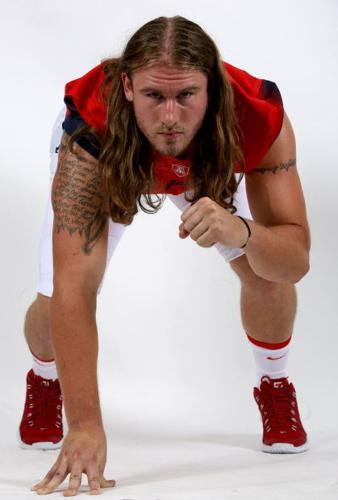
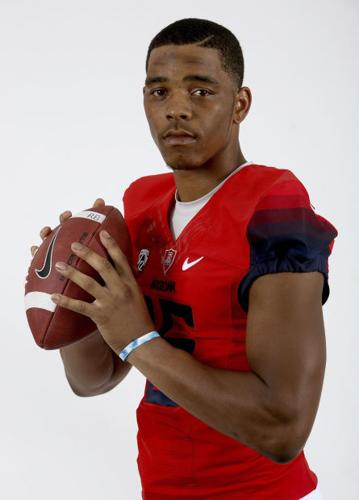
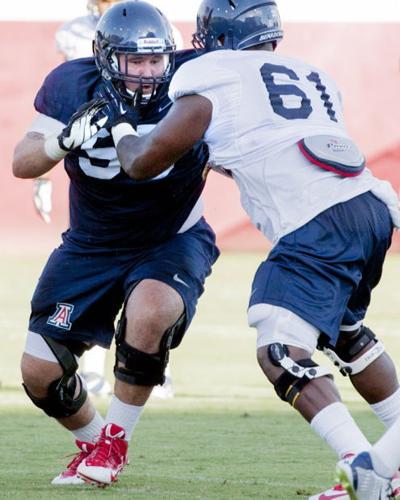
Arizona’s roster features 13 players with prior Division I football experience. No other Pac-12 school has more than seven. The UA has transfers from all five power conferences, plus Notre Dame and BYU. No other school in the country can claim that.
If Rodriguez can’t get the best players out of high school, he’ll take them later — when they’re humbled, more physically developed and have a chip on their shoulders.
He calls them bounce-back players, and Arizona’s 2014 season will hinge on how they perform. Three of the Wildcats’ four top quarterbacks, the team’s most dynamic wide receiver and a handful of projected defensive starters all began their college careers somewhere else.
“To see it’s not just me, and that other people have run into bumps and hiccups, it’s inspiring,” said UA defensive end Jordan Allen, a transfer from LSU. “What’s even more inspiring than that is they all come to a place where they know they have a chance to do something. Now that we have something in common, it’s just a stronger bond. That’s what I really love about it here.”
•••
Rodriguez has a soft spot for bounce-backs for a simple reason: He’s one of them.
The coach came to Arizona after going 15-22 in three seasons at Michigan. Like most transfers, he sat out a season, and then got back into the game.
UA athletic director Greg Byrne hired Rodriguez on Nov. 21, 2011. He arrived in Tucson that night with a chip on his shoulder the size of Ann Arbor, Michigan.
“I think I’ve always had that chip,” Rodriguez said. “From when I walked on at West Virginia 30 years ago, to coaching at Glenville State and not getting an interview anywhere to what happened at Michigan.”
Rodriguez compares his team to the Island of the Misfit Toys, the place immortalized in the 1960s television special “Rudolph the Red-Nosed Reindeer.” There, unwanted toys live alongside King Moonracer while they wait for a new home.
“I’m one of them. My whole staff is,” Rodriguez said.
“I think the bounce-back guys can help me win. It’s not like they come in the program and it’s easier. A lot of times it’s more difficult because of the way we practice and play.
“I do like the guys that have the chip on their shoulder.”
Rodriguez was described as “embattled,” “underachieving” and “out of place” at Michigan. His 60-26 record and four Big East championships at West Virginia were suddenly forgotten.
The scoop on Rodriguez was that he couldn’t win at the highest level.
His staff saw it wear on him.
“No one wants to fail,” said quarterbacks coach Rod Smith, who is entering his seventh season as a Rodriguez assistant. “No one wants to be deemed a failure. No one wants to lose their job. We know we’re good coaches. We know what we can do. That absolutely fuels him, what happened there.
“All you can do is come to the next place and make it home and do what you do best and hope you can play those guys at some point in time.”
•••
Rodriguez and his staff court transfers, even though they can’t actually recruit them. NCAA rules prohibit coaches from tampering with players on other teams.
Rodriguez heard about many of his transfer candidates from his current Wildcats.
“Most of the transfers, the first contact is from somebody on our team that says, ‘Hey I have a friend of mine who wants to transfer,’ ” Rodriguez said.
“That’s how a lot of them get started. They have to get a release and all that before we can go through the process and talk to them, but that’s usually how it starts.”
Once the common interest is exchanged, Rodriguez does his homework.
He talks to their former coaches, teammates and even family members. He visits their homes and their schools and makes sure they are the right fit for Arizona.
“We don’t talk about third strikes as much as we talk about, ‘Hey, this is your last opportunity, and you can’t screw this up — both on and off the field,” Rodriguez said. “That’s one of the first things we talk about in the recruiting process. It’s, ‘Hey, if you’re looking at us, and we’re looking at you, this is what is on the table.’ ”
The players’ reaction?
“ ‘This is it,’ ” Rodriguez said. “ ‘I have to make it happen here.’ ”
Rodriguez has a soft spot for transfers because he enjoys giving players a second chance. Sure he’s been burned by a few in the past, but if he feels good about a guy after doing his research, he likes beginning the redemption process.
“You have to sort it out,” Rodriguez said. “Did the guy make a bad decision, or is he a bad guy? Sometimes you’re wrong. Sometimes you think he just made a wrong decision, and then he ends up being a bad guy.
“But most of the time we try to vet them as much as we can, and I’ve been pleased with it so far.”
The coach has taken all kinds of transfers in his three seasons with Arizona. He’s plucked players directly from other Division I schools. He has taken guys who began at a big-time school before going to a junior college, and he’s open to taking walk-ons from other programs who are willing to pay their way for a second shot.
“It’s a beautiful experience here because you’re allowed a second chance,” said quarterback Jesse Scroggins, who began his career at USC before transferring to a California junior college. “If you can bounce back and pay attention to what you’re supposed to do, that’s what humbles you. You think you’re going to be this big-time person, and then you’re back at square one.
“I think it’s easier to get back up here at Arizona.”
•••
Arizona’s misfit toys don’t have any single thing in common. Well, maybe one.
“We all have our tales,” Allen said. “All of us are coming from different situations. It’s just amazing when you hear the stories.”
Defensive tackle Jeff Worthy is just one of many Wildcats to take the back road to Arizona.
A highly touted recruit out of Whittier Christian High School in California, Worthy chose
Boise State over offers from Arizona State, Nebraska, UCLA and others.
His stay in Idaho was filled with trouble. Worthy was suspended during the 2012 season, and ultimately dismissed in February 2013. He transferred to Santa Ana Community College to rebuild his image.
“When I left Boise, I felt like a disappointment,” Worthy said. “I came home to a lot of supporters and friends who were like, ‘What the heck happened?’ What happened was I thought I was the next big thing. I was that guy that went out and partied all the time and did the wrong thing. When it all gets cut down to it, when I got kicked out of Boise, you just tell people, ‘I messed up, and I’m trying to make things right.’
“It’s night and day from Boise to here. I feel a lot better as a person, and I’m very grateful for that.”
Whereas Worthy is hoping to make the best of his second chance, running back Adonis Smith is on his third.
Smith, a northern California native, began his career at Northwestern and played two seasons there. He then transferred to UNLV and played in 12 games last year, scoring two touchdowns.
He spent the spring with the Rebels and was in contention to be the team’s starting running back his senior season. But then Smith, who graduated in May, decided to transfer to Arizona. The Wildcats didn’t have a scholarship to offer, so Smith is paying his way as a walk-on. He’s eligible to play immediately.
An odd move for sure, but Smith said it was worth it to join the Island of the Misfit Toys. Now, he’s in line for serious playing time.
“I have the biggest chip on my shoulder,” Smith said. “It’s huge. That’s why I don’t care about the whole walk-on thing. I know I’m good enough to play anywhere. I know I haven’t done what I’m capable of doing.
“So when I say the lights are on and it’s time for the show to begin, that’s what I mean.”
Others have simpler reasons for transferring.
Receiver DaVonte’ Neal, a two-time Arizona Gatorade Player of the Year at Scottsdale Chaparral High School, signed with Notre Dame in 2012.
He went for a season and played as a true freshman. Notre Dame didn’t ask him to leave, and he wasn’t looking to.
But when his girlfriend got pregnant and gave birth to a baby girl, Neal wanted to be closer to his family.
Rodriguez aggressively recruited Neal out of high school and finished as the runner-up in the sweepstakes. When it was time for Neal to find a new school, he sought out the UA coach.
“Some people call me a bounce-back player; some people say I have a chip on my shoulder. I’m just looking to play football,” Neal said. “I don’t view myself as all that. I view myself as a football player at the U of A.
“I came here for two reasons — my daughter, and to play football. Now I want to contribute any way I can.”
Whatever the reason, Rodriguez is confident he’ll get production from his bounce-backs.
Arizona’s success depends on it.
“They have their last chance to prove themselves, and there’s a lot to be said for that,” the coach said. “It’s like an NFL player in his contract year. You’re going to get a pretty good effort, I bet.”


