

Editor’s note: This summer, Star columnist Greg Hansen is counting down the top 10 of just about everything related to Tucson sports. Today’s list: the top 10 sports venues in Tucson.
Bill and Doby Hillenbrand spent their honeymoon in Phoenix in 1962. That’s about as close as they got to Tucson until historically cold winters near Indianapolis in 1978 and 1979 put them on a search for a winter home in Prescott, Yuma or Tucson.
The Hillenbrands chose Tucson, sight unseen. By 1980, Bill Hillenbrand bought season football tickets at Arizona Stadium. A year later he donated enough money to sit in the stadium club underneath the east side’s upper deck.
Over the next 15 years, the bass-fishing, pistol-shooting, former military policeman from Batesville, Indiana, would become the largest financial donor to the UA athletic department in the 20th century, supporting capital projects in softball, swimming, football and basketball.
People are also reading…
Few knew that Hillenbrand’s century-old family business, the Batesville Casket Company, was America’s largest manufacturer of caskets and cremation-related products sold to more than 16,000 funeral homes in North America.
In 1992, he agreed to pay between $600,000 to $1 million for construction of the UA’s new softball facility, then the best of its kind in college softball. (Bill Hillenbrand died in Tucson in 2003; he was 64).
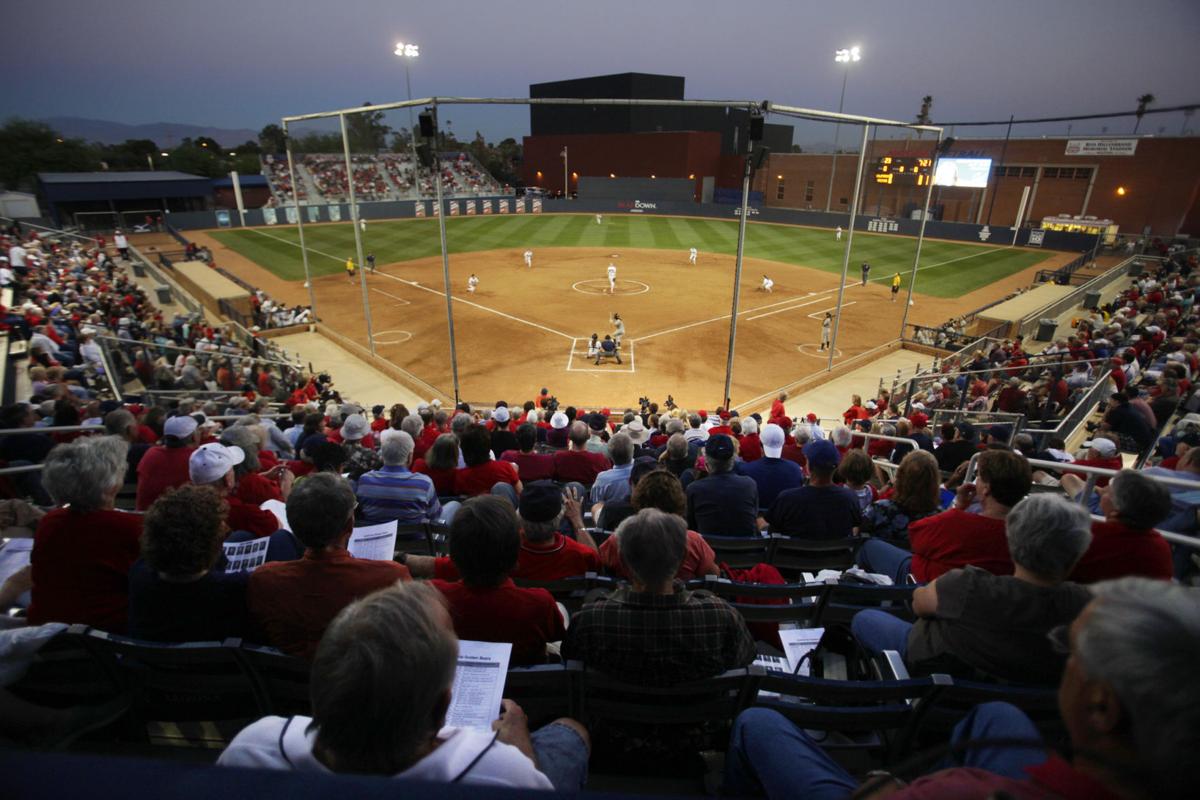
Hillenbrand Stadium opened Feb. 13, 1993 and 1,272 people attended a doubleheader sweep over Texas-San Antonio, although temporary bleachers for the first season offered seating for just 850. Since then, the UA has drawn about two million softball fans, the most by any school in the game’s history.
Architects had to squeeze the softball stadium onto a small plot on the campus, but in doing so provided intimacy, charm and an on-top-of-the-action vibe most ballparks, in any sport, cannot duplicate. It soon became the most fan-friendly venue in all of Tucson sports, amplified by what has been one of the most successful athletic programs in UA history.
Hillenbrand Stadium is my clear choice as Tucson’s top sports venue. Here are the rankings:
1. Hillenbrand Stadium. Arizona All-American Susie Parra pitched a no-hitter in the first game ever played at Hillenbrand. UA coach Mike Candrea’s first public analysis of the facility: “I don’t know how much more you could ask for.”
2. Rillito Park. The historic race track, now in its 75th year, opened on Nov. 14, 1943 with an overflow crowd of 1,500. It replaced old Moltacqua Race Track near Sabino Canyon, which was about 10 miles from “mid-town” in the 1940s and had no electricity. A winter afternoon at Rillito is a step back in time; the historic (ancient?) clubhouse sometimes makes you wonder if it’s 1963 or 1977, and the diverse crowd is always abuzz with possibilities.
3. Dell Urich Golf Course. Rebuilt in 1996 as a water detention basin, the city-owned golf course on the south half of the Randolph Golf Complex is the busiest golf course in Southern Arizona. Once on the course, you’d never know you’re smack in the middle of the desert. I once tried to count all the trees on the beautiful course and lost count between 300 and 400. The views of the Catalina and Rincon mountains, and its proximity to Hi Corbett Field and the Reid Park Zoo, give it a singular, peaceful feeling.
4. Bundrick-Enterline Field, Canyon del Oro softball. For my two cents, CDO’s softball park is the top high school venue in Tucson. It is almost hidden behind a grove of trees far behind the school’s main compound, which requires taking a circuitous road, separated by a wash and sounds of traffic. The outfield fence is a handsome green-and-gold tribute to dozens of ex-Dorados who have gone on to play college softball. Views of Pusch Ridge are dynamic.
5. McKale Center. When the lights dim and tension mounts, McKale is the West’s most feared (and dramatic) college basketball arena, going strong into its fifth decade.
6. Cienega High football stadium. In 2005, the Vail School district approved construction of indoor bathrooms, artificial turf and an enclosed press box. That alone made it the top high school football facility in Southern Arizona; but the Friday Night Fever in Vail – an isolated, only game in town setting, with routine capacity crowds — and a train chugging along the nearby railroad tracks, sets it apart.
7. Reffkin Tennis Center. Built by the city in 1961 with 10 dimly-lit tennis courts, the Reffkin Center now has 25 lighted courts, is surrounded by greenery and in 1993 was honored by the USTA as the “Facility of the Year,” one that regularly hosts USTA and college championships. Its so-called “Center Court,” is named for the late TV star Michael Landon, who played host to charity events there for more than 15 years.
8. Cherry Field. When Kino Parkway was built, the 50-year home of Tucson High sports was rebuilt as a $20 million flood detention basin. Now, with an intimate below ground-level and away-from-traffic-and-noise character, Cherry Field is the top all-purpose (soccer, softball, baseball) facility in Southern Arizona.
9. Salpointe Catholic basketball arena. It’s old, but I prefer historic. It’s got charm. On game night, when the Lancers are rolling and the old bleachers are full, you can almost picture some of the top players in Tucson history, in crewcuts and short-shorts, from Jay John and Dave Mills to Fern Tonella in the same place as Majok Deng today. Salpointe opened in 1950 but its gymnasium wasn’t built until the school could raise $83,000 in 1960. Money well spent.
10. The Stone Canyon Club. You’ve got to know somebody, or own property, or be fortunate enough to play in a charity-based scramble event to gain access to Tucson’s most exclusive golf course — now owned by Phil Mickelson’s group. The views of the Catalinas and the Tucson valley are unmatched at a Southern Arizona golf venue.
Contact sports columnist Greg Hansen at 520-573-4362 or ghansen@tucson.com. On Twitter: @ghansen711

Greg Hansen
Columnist


