

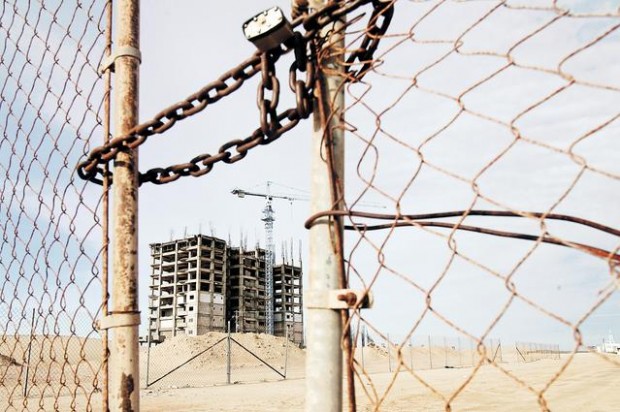
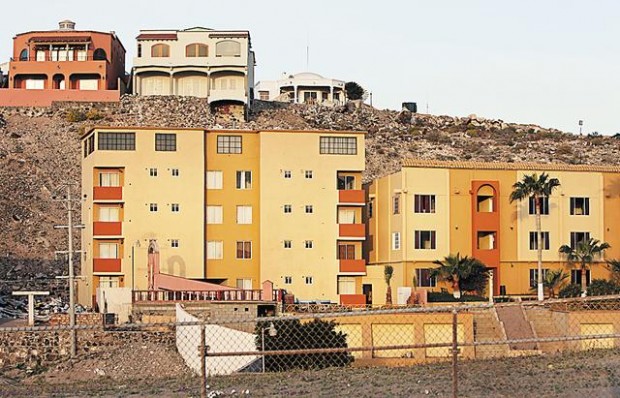
Rocky property deals in Puerto Peñasco, Sonora — if left unresolved — could cripple future development in the seaside city.
Arizona investors, who have lost millions of dollars in now-defunct properties, are demanding intervention by officials in both Arizona and Sonora.
Mexico is heeding the warning and scrambling to resolve land disputes in at least four developments in the city, also known as Rocky Point, where investment has already slowed because of the downturn in the U.S. economy.
And Arizona regulators are crafting a carefully worded advisory to make potential buyers aware of the situation and offering tips on how to safely invest in Sonora.
That all offers little comfort to Tucsonan Marty Wallace, whose entire retirement is tied up in two beachfront condominiums that have yet to be built, five years after he purchased them.
People are also reading…
"If I don't get my money back, I will have to work for the rest of my life … and be bitter," the 55-year-old said.
Sierra Vista investor Rita Durfee, 64, mortgaged her home to buy a two-bedroom condo. After her husband's death, she asked for the property's title in order to sell it. Two years later, she is still waiting.
Last week, more than 100 people packed into a Phoenix hearing room to address Arizona and Sonora officials and demand federal intervention from both countries.
Phoenix investor Howard Israel said lack of action will result in Puerto Peñasco returning to the "sleepy, little fishing village it used be."
Puerto Peñasco real estate broker Rick Ramirez said the growing brouhaha has developers and real estate agents nervous.
Thousands of people have made problem-free condo purchases, and the questionable developments represent fewer than 3 percent of projects in the city, he said.
Still, Ramirez acknowledged that even a small scandal can discourage new investors.
"It's a black eye to all of us," he said.
Payments on condos
More than $550 million in foreign investment is made in Sonora each year — predominantly from Arizona, according to Mexican tourism officials. Sonora ranks third out of 31 states and Mexico City for foreign investment.
In Puerto Peñasco, most of that money comes in the form of payments on condos in the high-rise towers, proliferating along the beaches.
Representatives for Sonora Gov. Eduardo Bours are working closely with Arizona officials and Mexican authorities to investigate the problems, said Sam Wercinski, Arizona Department of Real Estate commissioner.
He encouraged investors to pen a letter to both Gov. Bours and Arizona Gov. Janet Napolitano outlining their losses.
Wercinski and Epifanio Salido Pavlovich, director of the Sonora Office of Tourism, promised to hand-deliver the letters to each governor.
"The governor understands that this should have happened a long time ago," Wercinski said of the public hearing. "We are trying to help."
Time-share deal
Thomas and Barbara Wilson dreamed of spending their retirement between their Tucson home and a Puerto Peñasco condo, so they snapped up the opportunity to invest in a time-share condo at Fiesta de Cortez, near Old Port.
As spelled out by the seller, Eduardo R. Chavez, the return on the investment would be a boon.
The Wilsons invested tens of thousands of dollars and were told they would earn $500 a month for five years from profits of renters using the property, Thomas Wilson, 72, said.
After the five years, the couple would own the condo free and clear and could sell it, likely making a tidy profit as real estate prices climbed.
In addition, Chavez, whom the Wilsons considered "like a son," asked for a loan to help pay for upgrades on the property. He offered the penthouse as collateral.
The repayment terms, according to the contract signed and notarized in Tucson, were for 60 monthly payments beginning Dec. 15, 2003.
Subsequently, the penthouse was sold to a different investor and 14 months ago, both the time-share profit payments and the loan payments stopped. The Fiesta de Cortez was partially closed.
The Wilsons have since been in a game of phone tag with property owner Ignacio Chavez Moran and his representatives. They have not seen or heard from Eduardo in months.
Requested the title
When Rita Durfee's husband died a year after they purchased an $80,000 condo, she informed Ignacio Chavez Moran that she wanted the title in order to sell the property.
Because it was purchased with money from mortgaging her Sierra Vista home, Durfee is eager to get that mortgage paid off and be done with the ordeal.
As of last week, Chavez had yet to provide her with the title.
Durfee filed a lawsuit in July, charging Chavez with breach of contract, consumer fraud and racketeering. The suit in Cochise County is pending.
Durfee's friend, Donald Anderson, 71, also invested in Fiesta de Cortez, has waited more than a year for resolution and is owed about $100,000, he said.
"They will promise anything, and they have no intention of keeping their word," he said.
Anderson is planning to file a lawsuit in Pima County, where his contracts were signed and notarized. He is also filing a consumer fraud complaint with the Attorney General's Office.
Ignacio Chavez Moran took control of Fiesta de Cortez two years ago and is sorting through the contracts his son made, said Josephine Work, Chavez's Phoenix-based human-relations manager.
He recently secured a condo regime designation from the state of Sonora, which authorizes him to sell the individual condos. His hope is to sell the 32 condos and repay investors with those proceeds, Work said.
Last fall, the Fiesta de Cortez corporation was dissolved, and Chavez filed for a name change to Golden Hill Boutique Resort. The complex is undergoing a face-lift and expansion, Work said.
The slowing market in Puerto Peñasco is not expected to pose a problem in selling the condos, she said.
"Everyone will be paid in full by the end of the year," Work said last week. "Ignacio is a decent man."
Larger dispute brewing
The dispute with Fiesta de Cortez involves about a dozen Arizona investors. Down the beach from the property, a much larger land dispute, involving hundreds of investors and millions of dollars, is percolating.
A legal challenge to the ownership of beachfront property known as North Beach has left at least three large-scale projects in limbo.
The Playa Azul, Playa Dorado and Riviera Real developments are halted as a lawsuit makes its way through the Mexican court system.
Marty Wallace was one of the investors in Playa Dorado. The Tucson man paid a deposit for two lots in early 2004; he declined to say how much he invested.
After several months had passed with no signs of construction, Wallace began inquiring.
"I was told it would be soon," he said. "Soon has now turned into four years."
But Wallace said he hasn't lost hope that he will get his property and believes pressure on the Mexican government will help resolve things in investor's favor.
"At what point do they come to the realization that they're going to ruin the market in Rocky Point?" he asked. "It's so crooked."
Filing a complaint
Investors who bought property in Puerto Peñasco but completed the transaction in Arizona can file a consumer fraud complaint with the state Attorney General's Office. The number in Tucson is 628-6504. Outside of Tucson, call 1-800-352-8431.
To get a letter to governors of Arizona and Sonora, send two copies to the Arizona Department of Real Estate, 2910 N. 44th St., Phoenix, AZ 85018.
Consumer information on investing in Mexico can be found online at www.re.state.az.us/AZ-MEX/AZ-MEX.html