

Mall kiosks and carts are a popular way to start a new business, even in this economy.
Nationally, a growing number of people who have been laid off or are out of work are getting into the $12 billion-a-year specialty-retail industry, which includes gift shops and kiosks, said Patricia Norins, publisher of Specialty Retail Report magazine.
Locally, Park Place mall has many people interested in starting up, said Jim Heilmann, its senior general manager.
Both Tucson Mall and Park Place have 30 kiosks and are 100 percent committed for 2009 with a waiting list, he said. Heilmann said he has noticed the waiting list seems to be longer this year than in the past three years.
Foothills Mall has room for fewer kiosks than Tucson and Park Place malls because of county restrictions on spacing, but it is also seeing an increase in the number of people looking to begin new businesses, said Mary Stahl, marketing and sponsorship manager there.
People are also reading…
She said the mall is a great place to start because there is guaranteed traffic, and malls are trying to work with their tenants in the rough economy.
One reason kiosks tend to be able to stay afloat in a tough economy, Norins said, is the ability retailers have to change products with the trends and seasons.
Heilmann said beauty products and cell phones typically do very well in Park Place.
Some trends that are popular now with kiosks everywhere, Norins said, are iPod accessories, mineral makeup, hair straighteners and children's toys, especially if products can be demonstrated.
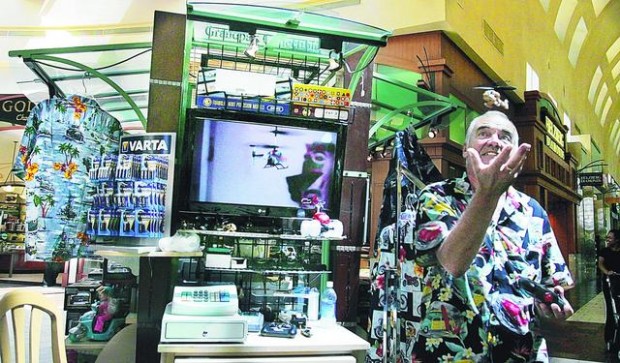
Brian Moore, who opened the Grandpa's Collectables kiosk last month in Park Place, is using just that technique. Moore said his biggest sellers are remote-controlled helicopters that he flies around when children walk by.
Moore had been retired for a year when he decided he wanted to take a chance and start his own business.
"I looked around, and there wasn't anything for men," he said. "It was all for women, or cell phones."
Moore sells toy helicopters, cars and gliders as well as collectables from The Franklin Mint and Hawaiian shirts with boats and airplanes on them.
He said he has been profitable since Day One. He has been able to hire three part-time employees, he added, and has been asked to open in two other locations.
After originally investing $20,000 into starting up his business, Moore said he is not getting rich, but he's doing well.
Among the reasons kiosks are a popular field to get into, Norins said, are that it's possible to start a business for less than $10,000, and the leases can be monthly.
Heilmann and others would not discuss the dollar amounts and conditions of leases at the malls, but Heilmann said leases for a kiosk are similar to a standard lease. A lease for a kiosk, though, can be anywhere from a weekend for an event to a year, he said.
The impacts of the recession have been felt everywhere, Heilmann said, but Norins said kiosks and carts have an advantage over other retailers.
They have generally lower prices and can switch products easily to follow trends, she said. They do not need a large staff.
Danielle Dewald, common- area coordinator at Park Place, said she has not seen any increase in business turnovers in the last year.
"It's a tremendous amount of retail in a small space, and they get a lot of foot traffic," said Melinda Burke, director of the Terry J. Lundgren Center for Retailing at the University of Arizona.
Boston Cottle, who works at the AT&T kiosk in Park Place, said it has been doing well, but the larger AT&T store across the street from the mall still gets three times more business.