

PORTSMOUTH, R.I. — "Fire in the hole!" shouts Raytheon Co. senior engineer Mike Tollefson, switching on a recording of a ship's bow gun that startles several software programmers from their work. "I only wish I was looking up to see how high you jumped," he says with a laugh.
At a nearby workstation, software engineer Dave Amaral hunches over a bank of computer monitors with flashing colored icons hovering over a coastline image. "Red indicates hostile, yellow's the friendlies, and green's neutral, like a Spanish fishing fleet," he said.
The team's in a room called the "ship's mission center" at a secure site overlooking Narragansett Bay. It looks more like the set of a sci-fi movie than the nerve center of what may be the most important program for the company. But don't be misled by all the blue jeans and sneakers; these young engineers aren't playing video games.
People are also reading…
They are designing combat systems for a new class of naval destroyers that will shape the future of Raytheon — and the U.S. Navy.
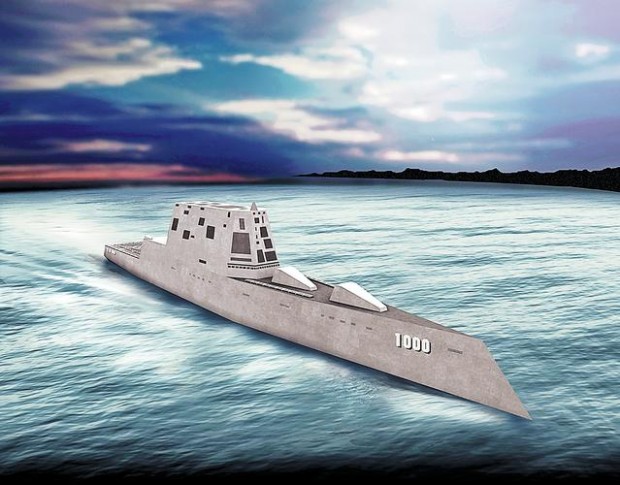
Much is riding on the capabilities of the new DDG-1000 guided-missile destroyers, called the Zumwalt class in honor of the late Admiral Elmo R. Zumwalt Jr. Raytheon is a primary contractor for systems and electronics on the ships, which, at more than $3 billion apiece, are meant to drive technological and cultural change throughout the Navy and its far-flung supplier network over the coming decades.
For the Navy, this is the ship that will launch a leaner fighting force and will pioneer 21st century technologies, from a more powerful radar developed by Raytheon Integrated Defense Systems in Tewksbury and Andover, Mass., to a stealthier hull co-produced by General Dynamics Corp.'s Bath Iron Works in Bath, Maine.
Executives at Raytheon, the fifth-largest Pentagon contractor, see their work on the 14,000-ton destroyer as key to catapulting the company into the top echelon of American weapons builders.
And the ship will mark a transition to a new generation. Navy commanders and officers reared on computers, science fiction, and video games will wage war on the high seas from a control room designed by Raytheon developers with the same sensibilities.
"One of the drivers for the design was 'Star Trek,' " noted Tollefson. "That's shaped the mind-set of these young engineers."
The Navy is expected to award Raytheon a billion-dollar contract that will move the Zumwalt program from development into production by this fall, and the first ship is scheduled to be delivered in 2013. But how many of these vessels are ever put to sea will depend on whether the company can control the increasing costs of the ship's advanced technologies.
The destroyer, redefined
The lean-and-mean management wave, which rolled through businesses in the 1990s, has finally broken across the Navy's bow.
Like their counterparts in the private sector, Navy officers today are under pressure to improve operations while cutting costs. They're expected to take risks, adapt to new technology and do more with less — "optimized manning" is their term for smaller crews — as they vie for funding with other services that have been more taxed in Iraq and Afghanistan and with civilian programs. For the Navy brass, the new Zumwalt destroyer class is viewed as an agent of change.
It was conceived in the early 1990s as a land-attack ship that, like Cold War-era predecessors, would fend off Soviet-style threats. But in late 2001, in response to the Sept. 11 terrorist attacks and a Pentagon campaign to upgrade its technology, it was recast as an all-purpose vessel. It would be capable of operating independently in "blue water," accompanying a carrier group against conventional enemies, or launching special operations to thwart terrorists close to shore.
"There's threats this ship is designed for that haven't been invented," said Capt. James D. Syring, the Navy program manager.
The new destroyer will be 58 percent larger than the current DDG-51 class, carry as many as 80 Tomahawk cruise missiles, and cruise at 30 knots. It will deploy new technologies, ranging from the dual-band radar developed by Raytheon to perform superior search and target tracking to an advanced gun system being fashioned by BAE Systems to shoot precision-guided shells up to 100 miles.
Zumwalt innovations extend to the program's two shipbuilders, Bath Iron Works and Northrop Grumman in Pascagoula, Miss., which are planning a "tumblehome" hull form with a low radar profile and a low acoustic signature that will help the ship avoid detection. With all of these new systems and designs, the risks of running over budget, falling behind schedule, and encountering technical problems will be high. "You're talking about some of the riskiest development efforts we've ever undertaken," Syring conceded.
Moving up the food chain
Even as it helps to design the Navy warship of the future, Raytheon's own future is being defined by its work on the program.
In the spring of 2005, the Navy awarded Raytheon its first big milestone contract for the program: a $3 billion prime contract to develop radar, combat systems, electronics, and command-and-control gear — in essence, to build the "brains" of the behemoth destroyer.
Raytheon has assigned about 2,000 workers to develop these intertwined systems. They work here at its maritime mission center, at its integrated-defense-systems plants in Tewksbury and Andover, Mass. and at other company sites across the nation.
The company's chief executive, William H. Swanson, has been pushing to transform Raytheon from a supplier of autonomous defense products into a "mission systems integrator" with responsibility for assuring that multiple weapons and communications systems built by itself and others work together smoothly.
The multi-mission DDG-1000 is already the largest of the Raytheon's thousands of military programs, and company executives hope it will get much bigger. But the service now officially plans to buy just seven, down from its original plan for 32, and so far Congress has approved funding for only the first two.
If Raytheon succeeds, it could join its larger rivals Lockeed Martin and Northrop Grumman as a one-stop shopping bazaar for defense systems on future weapons platforms.
"Raytheon's management recognized that if it wanted to control its fate, it had to move up the food chain," said Loren B. Thompson, chief operating officer at the Lexington Institute, an Arlington, Va., think tank. "Their role on the DDG-1000 could be an identity-changing breakthrough. That ship is sort of a floating test-bed for technologies that will be used across the Navy's future fleet."
LOCAL ANGLE
Although Tucson-based Raytheon Missile Systems is not the primary Raytheon business unit involved in development of the DDG-1000 destroyer, the local company is the primary supplier of missiles to the U.S. Navy, including the Tactical Tomahawk cruise missile, the Standard Missile-3 and the Evolved SeaSparrow Missile.
Missile Systems also may draw interest from the Navy with a proposed laser weapon, the Laser Area Defense System, or LADS, which is designed to destroy incoming ordnance like mortars and rockets with high-energy laser bursts. Though Raytheon won't say which military agency it is aiming to sell the system to, its prototype was mounted on the carriage of the Phalanx Close-In Weapon System — a ship-defense system.
And one analyst reasoned that the LADS would be a good fit for the DDG-1000, which features all-electric drive motors with an integrated power system capable of producing the kind of energy needed for the high-energy laser system. Raytheon Missile Systems is Southern Arizona's largest employer, with more than 11,000 Tucson-area employees.
— David Wichner

