

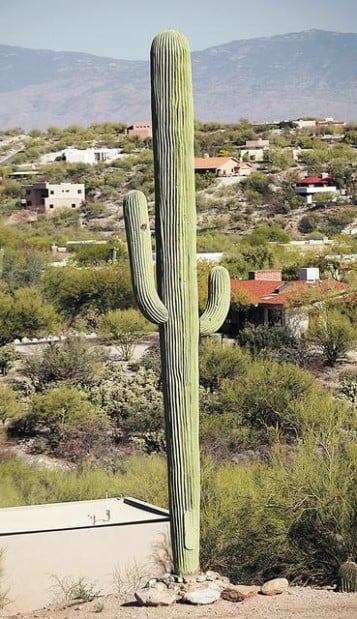
It's a modern-day dilemma: getting the convenience of good cell reception without the blight of an ugly antenna.
Cell-phone provider T-Mobile apparently found a palatable solution for desert-dwelling mobile users by putting the antenna inside a fake saguaro.
The hills and valleys of the Catalina Foothills can wreak havoc on cell-phone coverage. But residents — many who chose to live in the Foothills to enjoy pristine desert views — don't relish the idea of staring at antenna prongs pointing skyward.
"The neighbors didn't want an ugly tower," said Bob Kramber, a commercial real estate salesman who lives in the area.
Kramber said he likes the design of the phony saguaro, pointing out that for authenticity it even has a few holes that look like the ones woodpeckers and other birds dig into real cacti.
People are also reading…
Jeff Oranski, who lives right across from the cell site, agreed that the antenna was cleverly disguised.
"If I'm looking at it, I can tell the difference," he said. But it can be tough to distinguish it from the real thing if you only give it a quick glance while driving by, he said.
T-Mobile worked with public officials and the community to determine what design would work best for its cell site on North Craycroft Road just south of East Territory Drive, said Rod De La Rosa, a company spokesman.
"It depends on the area, but we definitely try our best to blend with the landscape," De La Rosa said.
In urban areas, the towers blend in with buildings. They can also be built to emulate pine or palm trees, he said. But the saguaro design is unique to the Arizona desert.
Other cell-phone providers have added cell sites to improve their coverage in the hilly terrain of the Catalina Foothills.
AT&T recently activated 37 new cell sites for its third generation — or 3G — network there.
That service provider also had to address concerns from residents who didn't want what they consider unsightly antennas in their community.