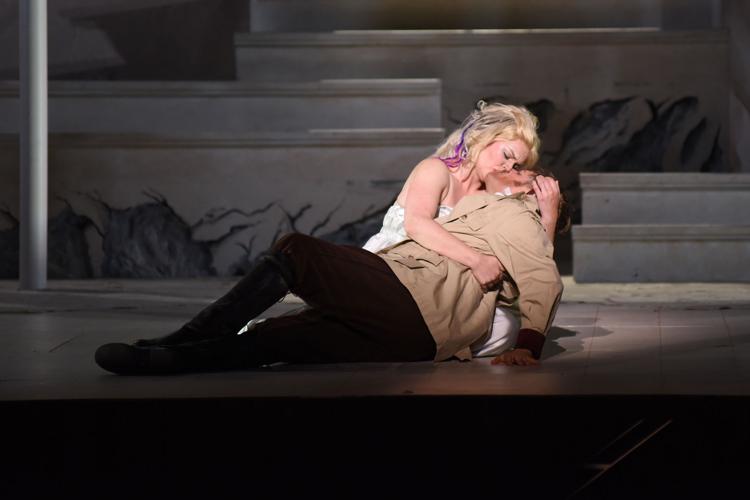
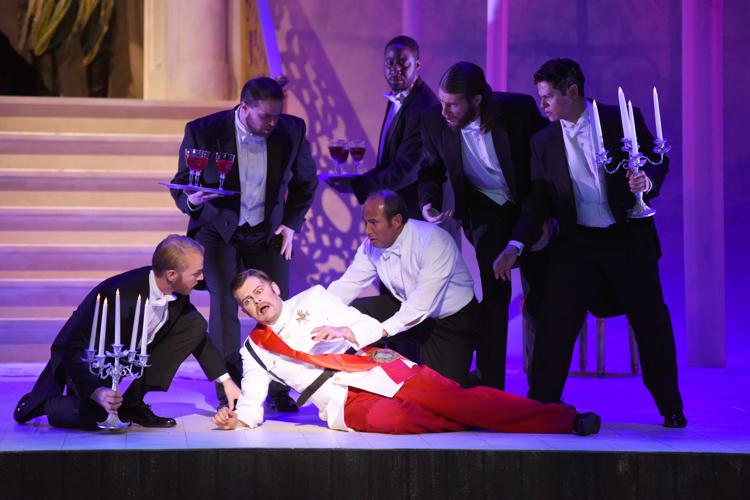
Arizona Opera is mounting Dvorák’s “Rusalka” this weekend — a first for the company and the first time it has done an opera in Czechoslovakian.
Here are a few things you need to know about the production before you see it on Saturday, Nov. 19, or Sunday, Nov. 20, at the Tucson Music Hall:
It’s a fairytale: “Rusalka” takes its cue from Hans Christian Andersen’s 19th century fairytale “The Little Mermaid,” who gives up her identity as a sea creature to become human.
“What we’ve decided to do is look at the piece through the lens of Rusalka herself and to distill the piece down to its most essential relationships and most essential storytelling,” explained Joshua Borths, Arizona Opera’s resident stage director.
Silence and silhouettes: The stage is set with the “human” world hidden in silhouette and the sea world clearly visible. The human world is silent until Rusalka crosses the threshold connecting the two worlds, and then the human world comes out of the shadows.
People are also reading…
“These giant doors open to let the human world in, which highlights what the piece is about, what happens when we make irrevocable decisions and have to bear the consequences, either living happily ever after or living with the tragedy,” said Borths.
Girl gets boy and then ... : Rusalka is a water spirit who falls for an earthly prince. She convinces the witch Ježibaba to turn her into a human so she can be with her prince. But the transformation has consequences: As a human, she can’t speak, and if the prince rejects her, she’s damned, the witch warns her.
Turns out Ježibaba isn’t too fond of humans.
“There is obviously a hidden storyline there of her hatred for humans,” said mezzo-soprano Daveda Karanas, who sings the role of the witch Ježibaba. “I just love how multifaceted she is. Any day I can play a witch is my favorite day. I love it.”
Rusalka takes the chance, crosses over and finds her prince. And, pretty much as Ježibaba warns, the prince turns a blind eye on her on their wedding day, turning his attention to a princess at the party.
Here comes the “girl loses boy” part: Prince makes a move on princess, Rusalka returns to the sea, then the princess ditches the prince. And here it gets fairytale quirky: Rusalka can have her cake and eat it, too, if she kills the prince. Of course she can’t, so the prince, feeling pretty lonely and lousy, comes begging for forgiveness and one last kiss, knowing that kiss will mean his death.
Don’tcha love fairytales?
Singing in Czech: For the first time in its 45 years, the Arizona Opera will sing in Czech. What will it sound like? Probably Russian, said Karanas.
“It’s fun. I’ve sung in many languages, so I would definitely compare it to Russian,” said Karanas, a Louisiana native and Arizona State University graduate. “It kind of feels like Russian with Italian vowels.”
This is Karanas’ first “Rusalka,” although she did a children’s version of it while she was in graduate school. The company took that version — “a little more Disney than not,” Karanas said — to schools around the state in conjunction with the performance, which played in Phoenix Nov. 11-13.
Borths, the company’s education outreach and community engagement director, estimated 60,000 kids statewide experienced the performance.
Dream come true: Borths has never directed “Rusalka,” but he said it is one of his favorite operas.
“This is just a dream come true to work on this piece, as well as work on it with this specific cast who have been incredible from day one,” he said.