

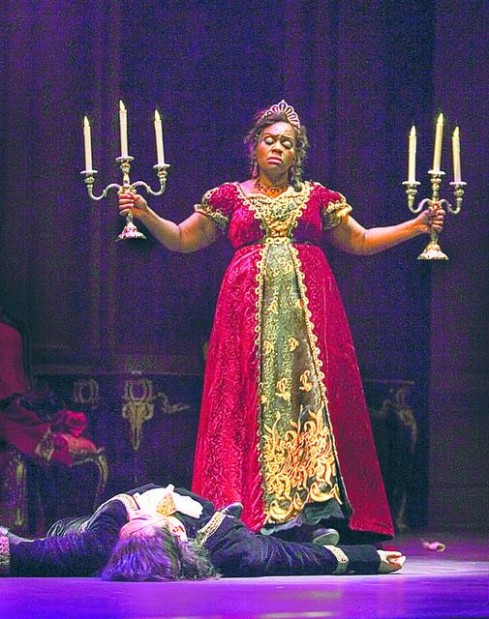
Soprano Lisa Daltirus was barely a year into her full-time professional career when she was plucked from the audience at a prestigious New York City fundraising gala and thrust onto a national stage.
Luck? Or divine intervention?
Daltirus believes it was the latter.
"Nobody could have known or planned it, so I think certainly some other power had to be in play in order for that opportunity to have lined up," she said during a phone interview Monday to chat about her appearance this weekend in Arizona Opera's season-finale, "Tosca." "The fact I happened to be in the audience, that's too coincidental to be by chance."
She is referring to her chance of a lifetime to step in for Aprile Millo at the 2003 Richard Tucker Foundation benefit. It came a year after Daltirus launched her full-time opera career.
People are also reading…
Daltirus believes much of what has happened in her life was driven by a higher power. Straight out of college, she married and ended up pregnant. It wasn't her plan, but it turned out to be her destiny, to put her career on hold while she raised her children.
"It was God's plan. I did not plan it that way; it happened that way. . . . It was just the way my path played out," she explained. "I always wanted to be a mother, so I'm certainly happy that it happened."
While raising her children — her son is now 13 years old, her daughter is 15 — she sang part time, much of it unprofessionally. In 2002, with the blessing and support of her family, she made a play for a full-time singing career.
Critical acclaim has come swiftly, particularly for her "Tosca."
The New York Times, in a review of her 2002 opera debut, said Daltirus possessed the stage with an "intangible electricity." "She has a big, rich lower register, smooth melting notes in the middle and a top that, while sometimes delivered with violence (the singer perhaps a little carried away by the melodrama of the piece), was generally solid and in tune. She also ran the full dynamic gamut, from floating pianos to a blood-curdling 'Avanti a Dio!' at the end, as she prepared to leap to her death, delivered in vintage diva style."
In a phone interview, Daltirus chatted about "Tosca" and how her career is going.
"Tosca" has quickly become your signature role.
"I've done it quite a bit and I really do enjoy it. It fits me very well."
How does it fit you?
"I like very strong women characters, and I like characters that take you on a journey emotionally through time, through situations. It suits me as an artist."
How do you define this character?
"Tosca is a diva of that day. She is a performer on the stage, a singer and actress. . . . She is temperamental/ moody in that she goes out of her emotions very quickly, but she is extremely passionate and very committed about her love for Mario and about her religious beliefs. She's not afraid to stand up for herself. She's just a strong woman. That's the way I interpret her."
Do you see her in yourself?
"Being a strong woman? Being very committed and stand up for her loved ones and do everything she can do to affect a positive outcome? Yes. She's perhaps a little more naive than I would be in that she spilled the beans about where the escaped prisoner is and, therefore, ultimately causes Mario's death. And naive in thinking that Scarpia would let him go. But in terms of her strength and standing up for what she believes in, and even in her religious beliefs, yes."
What roles would you love to tackle?
"I'm continuing to explore both Puccini and Verdi. There's many more heroines there that I haven't had an opportunity yet to (portray) on the stage. Manon Lescaut in terms of Puccini would be on the top of the list. . . . I really have a great desire — this almost sounds like a backward step — but I have a desire to sing Mozart and Strauss in terms of the German repertoire."
If you have to define the career you're thirsting for, what would it be?
"I would like to be recognized as one of the top sopranos in the field. That would be the star, if you will, that I'm reaching for. . . . You find contentment and happiness along the way and you continue to reach for that star."
If you go
Puccini's "Tosca."
Sung in Italian with English surtitles.
• Conducted by: Joel Revzen.
• Directed by: Bernard Uzan.
• Presented by: Arizona Opera.
• When: 7:30 p.m. Saturday and 2 p.m. Sunday.
• Where: Tucson Music Hall, 260S. Church Ave.
• Tickets: $25-$100 through www.ticketmaster.com
• Synopsis: A beautiful diva, Floria Tosca, inadvertently betrays an escaped political prisoner, Angelotti, in a bout of jealousy. She suspects her lover, Mario Cavaradossi, is fooling around after discovering him in the church painting a picture of a woman who looks nothing like Tosca. She hears her Cavaradossi speaking with someone and assumes it is the woman in the painting. In reality, it is the escaped prisoner.
Tosca's jealousy backfires when it lands her lover behind bars. In an attempt to spare Cavaradossi, Tosca blurts out Angelotti's hiding place. The police chief, Baron Scarpia, agrees to spare Cavaradossi if Tosca will take him as a lover. She agrees, and Scarpia arranges for a mock execution and pens the couple a safe-conduct letter that will let them leave the country.
While she is waiting for Scarpia, Tosca discovers a knife on the table and decides she would rather kill Scarpia than kiss him.
With Scarpia's letter in hand, she joins Cavaradossi, who is awaiting execution. She tells him he will be spared and then waits for the mock execution. But Scarpia had no intention of sparing Cavaradossi. The execution is very real, and Tosca's lover ends up very dead. Rather than be caught herself, Tosca jumps from the castle to her own death.


