

In the process of watering my orange tree, I found a termite tunnel about 2 feet long. I do not want termites to destroy this tree because the fruit is so good but do not know how to treat it for termites. Please help me to determine what insecticide I can use that will not hurt the tree or its fruit.
Termites are common in our area but they generally do not attack live wood. It is possible to find them on the bark of trees where there is dead wood. The tube-building termite Gnathamitermes perplexus, our “true” desert termites, can be found on a variety of desert plants and materials such as fences, cow-chips, dead grass or weeds. They construct wide thin plaster-like earthen coatings on saguaro cacti, palm trees or wooden fences, where they feed by scraping dead wood off the exterior. As a homeowner you might see dead grass or a twig covered with the thin layer of mud that if disturbed, may cause these termites to scurry underground. In general, these termites are not pests and should not be treated for unless found inside a structure.
People are also reading…
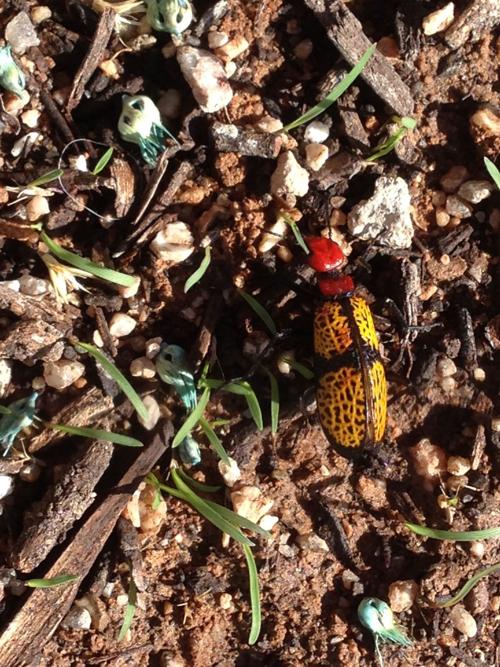
What is this bug I found in my garden?
The insect is commonly called an Iron Cross blister beetle and its scientific name is Tegrodera aloga. They are called blister beetles because they have the ability to secrete cantharidin from their body joints if squeezed and this chemical can raise a blister on sensitive skin. In nature the red and yellow coloration means danger — so you have been warned. Needless to say, you shouldn’t eat them either, but some animals might accidentally consume them if the insects are in a food crop such as grasses and that can be harmful or fatal. Adult blister beetles will eat foliage and sometimes cause damage to plants in areas where they are numerous, although they are not considered a pest mostly.
I would like to grow a persimmon tree here in Tucson. The kind of persimmon I’d like to grow is the one that is round and can be mistaken for a tomato. We had them in Iran in a village near Tehran. The summers were very hot like here in Tucson. Also, the climate was dry, and I don’t think the trees got a lot of water. The persimmons were more the size of grapefruit than tomatoes. Also, they tended to be soft, but perhaps that was just because they were very ripe when we ate them. Can this fruit be grown in Tucson? I’ve seen figs and pomegranates grown here so I should think persimmons could be grown, too.
Yes, persimmons can be grown in Arizona from the deserts up to higher elevations where temperatures do not go below 10 degrees F. They tolerate a variety of soils, but poor drainage and/or standing water can cause fruit drop or a decline in vigor. Mature trees may reach 20-30 feet in height so make sure you have enough room for them before you plant. Persimmon trees have an attractive growth form, make a nice landscape tree, and have few pests in Arizona. Persimmon trees may take seven years to begin bearing so that may affect what age trees you purchase. The fruit ripens in the late fall or early winter. They can be harvested while still firm and allowed to soften indoors.
Peter L. Warren is the urban horticulture agent for Pima County Cooperative Extension and the University of Arizona. Questions may be emailed to plwarren@cals.arizona.edu

