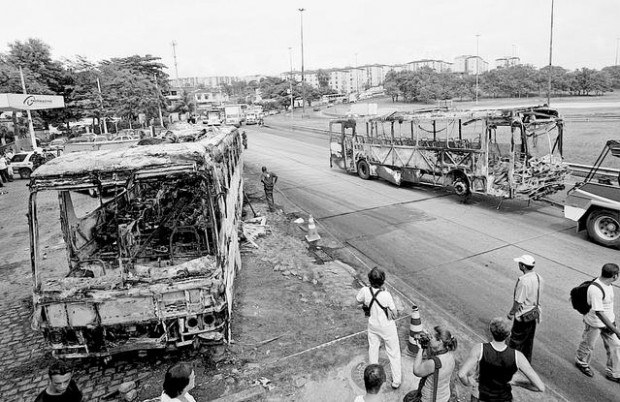
RIO DE JANEIRO, Brazil — Drug gangs set fire to buses and opened fire on police stations and posts around Rio de Janeiro early Thursday in a wave of violence that killed 19 people and wounded 21, the state's top law enforcement officer said.
The victims included seven who burned to death in one of six torched buses and three policemen, said Roberto Precioso, head of Rio's Public Safety Department.
Two other civilians died, including a street vendor caught in the crossfire of a shootout in Rio's Botafogo district, and seven gang members were killed, he said.
Fourteen civilians and seven police officers were injured, he added.
Precioso said gang members used handguns, machine guns and grenades in 12 attacks on police stations and outposts that began in the early morning.
People are also reading…
The attacks were apparently a show of force staged before a new governor is sworn in Monday, Precioso said. Police intelligence had warned that gangs were planning attacks for some time.
"It is very difficult to prevent these types of attacks that were practically kamikaze," Precioso said at a news conference. "Police action prevented the situation from getting much worse."
He said the attacks had apparently been ordered from inside one of the state's prisons, but he did not elaborate.
Rio's governor said gangs intended the attacks to be far bloodier.
"The idea was to kill hundreds of police and dozens of innocent people," Rio de Janeiro State Gov. Rosinha Matheus told reporters.
Most of the violence occurred on Rio's poor north side, although a policeman was killed in the upscale Lagoa district and a woman died during an attack on a police booth in the Botafogo district near downtown.
Mayor Cesar Maia said gangs appeared to be retaliating against militias — reportedly run by off-duty police officers — that in recent months have been battling drug gangs in slums and charging residents for protection.
"The reason for what's happening is that militias have grown and the drug gangs are leaving," Maia told reporters. "To maintain their income, the gangs are increasing crime on the street."
 Japanese company invests in mine near Mount Lemmon