

Summer is starting to fade into fall here in the Pimería Alta, and it’s time to start up my blog again. As many of you know, I write about the history and folklore of southern Arizona and northern Sonora. When I started out, I viewed what I was doing as a means for giving recent arrivals some idea of where they are in a cultural and historical sense. I then discovered that a lot of long-term residents read the blogs as well. Welcome to you all! I write about what still excites me after fifty years of living and learning on both sides of the border. I prefer a good story to facts and statistics any day, and there are a lot of great stories to tell. So let’s go!
We’ll start in Sonora’s Altar Valley. To get there we cross the border at Nogales, get our papers in order, and drive south through Magdalena to Santa Ana. There we head west on Mexican Highway #2 to Altar, about an hour’s drive away. Altar was the site of a presidio in the 19th Century; it was from Altar that the relief column came to end the Battle of Caborca that I wrote about last spring. It’s also the jumping-off point for people trying to walk north across the border — a trip that has proven fatal for too many. Here is where we leave the highway to drive north up the Altar Valley, passing a mural which mourns the hundreds of deaths on the migrant trail.
People are also reading…
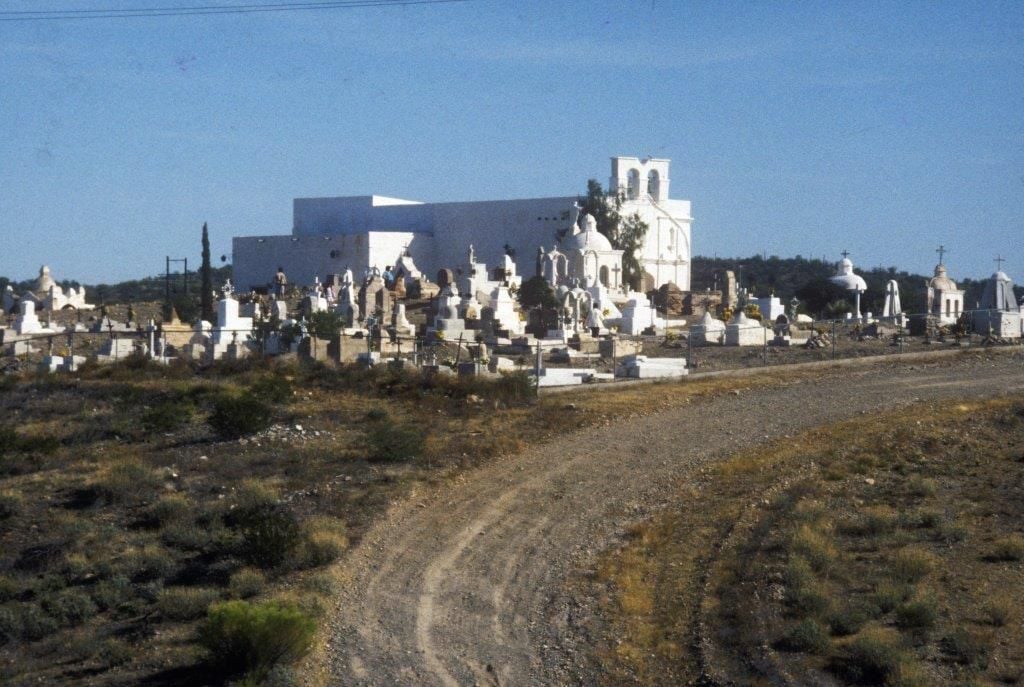
The mission community of Oquitoa is a few miles northeast of Altar, on the south side of the road. Its church stands on a hill just west of the village, surrounded by a cemetery. In November, on the Day of the Dead, this becomes a sea of light, with multiple candles lit on or beside each grave. The next morning, many candles are burned out, but the entire space is brightened with hundreds of flowers.
The church of San Antonio de Padua is a simple hall church with the door at one end and the altar at the other. It is the only mission church in our region that survives from the Jesuit period (pre-1767), though the later Franciscans added some architectural details. As you enter, look up at the ceiling, which still has most of its original mesquite vigas or beams. See if you can find the decorated one.
In the sanctuary you can see several Colonial-period paintings depicting the life of Christ. These had formed part of the original Colonial retablo or altarpiece, which long ago fell prey to termites. There are also several colonial-period statues. A church and village well worth the visit. And just wait…the stories come next!


