

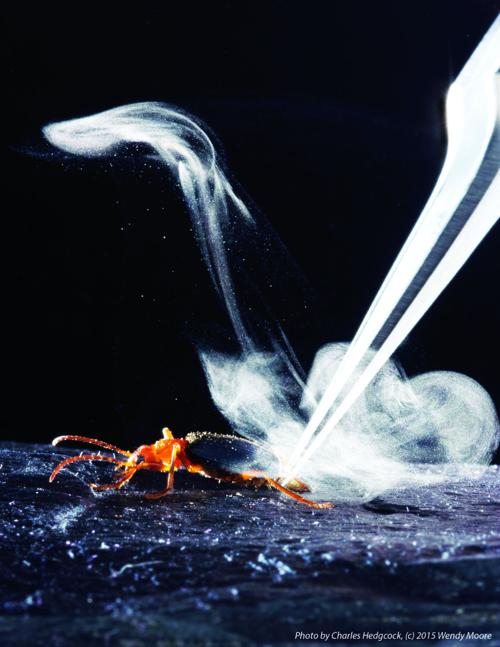
A beetle common to riparian areas in the Southwest has a dual combustion chamber that allows it to mix chemicals and release pulsed explosions of boiling, hot toxins from its abdomen.
A group of scientists at MIT, the University of Arizona and Argonne National Laboratory, including UA entomologist Wendy Moore, X-ray imaged the internal process of the bombardier beetles and reported its findings in the journal Science.
The beetle’s ingenious system could lead to new techniques for blast mitigation and propulsion, they say.
The beetles used in the experiment were collected in Madera Canyon by Moore, who has made carabid beetles the focus of her research.
Eric Arndt, a doctoral candidate in materials science at MIT, said he selected the bombardier beetle for study for a simple reason.
People are also reading…
“Here you have beetles that have explosions inside their bodies and they don’t die.
“Maybe the beetle has come up with better ways to deal with explosions and we could apply that to armor. That was the far-out, long-term goal, but in the process we found some pretty interesting biology.”
Moore and other entomologists knew, from observation and dissection of the carabid beetle family known as bombardier beetles (Brachinini), that they use a dual chamber system to produce and emit their toxins, but the mechanism had not been internally imaged.
They took the beetles to Wah-Keat Lee, a synchrotron X-ray scientist then working at Argonne National Laboratory in Illinois, for an experiment that was the usual scientific mix of high-tech tools and MacGyver-style improvisation.
To secure the beetles in place between a high-speed camera and the X-ray beam, Moore devised a “seat belt” made from Play-Doh.
The resulting images clearly showed the beetle’s defense mechanism at work, said Moore.
The beetle’s glands feed an elastic reservoir chamber with the precursors of the chemical reaction, which are fed, drop-by-drop into a hardened combustion chamber, where they mix with enzymes to create an explosive reaction that expels a chemical irritant (benzoquinone) while simultaneously closing the valve between the two chambers.
The reaction occurs in pulses at speeds of up to 1,000 times per second, though the entire process last only about 20 milliseconds, said Arndt.
“The beetle is really this intricate, complex mechanism using chemical energy to do work, and doing it with a single part. That’s pretty remarkable,” said Arndt.
Arndt said all of the parts — the glands, reservoir, combustion chamber and valve are made of “a single, contiguous piece of cuticle” with varying degrees of sclerosis or hardening.
That’s another amazing piece of information to Arndt, who is a materials scientist. Arndt said the pulsed series of reactions are probably the primary reason the beetle’s abdomen doesn’t blow apart.


