
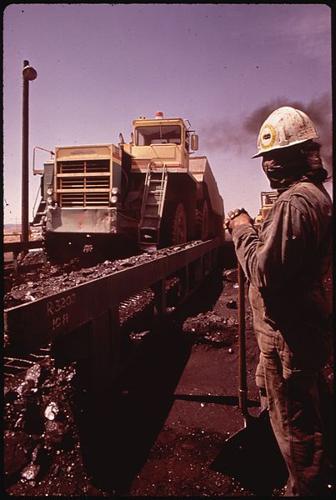
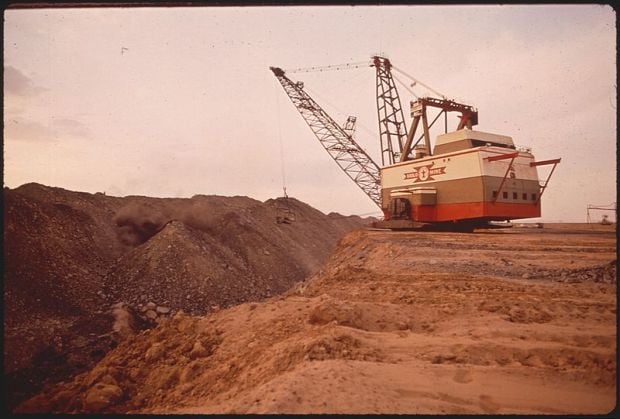
People have mined coal in Arizona for at least 700 years, but today the only active mine in the state is the Kayenta Mine at the Black Mesa field on the Colorado Plateau in Northeastern Arizona.
Located within the boundaries of the Navajo Nation and Hopi Reservation, the coal-bearing rocks of Black Mesa cover 3,500 square miles, including the major coal-bearing formations of the area: the Wepo, Toreva and the Dakota.
The earliest miners in the area were the Hopi, who mined 100,000 tons of coal between 1,300 and 1,600 A.D. for firing pottery and heating fuel. The Spanish explorer Agustín de Vetancurt described the mission at a village called Awatobi in 1697, noting that the Hopis burned coal, giving off noxious fumes.
Another noteworthy coal deposit discovered in Arizona was the Deer Creek coal field in eastern Pinal County, found by prospector David Anderson in 1881. Digging for a water source in a wash, Anderson discovered a black band of dirt that he determined to be decomposed coal.
People are also reading…
Soon, many claims were staked in the area of the coal-bearing rocks. Two years later, the Army, led by Gen. George R. Crook, removed the miners from the area because their claims were on land under the jurisdiction of the San Carlos Indian Reservation.
By the early 1900s, the reservation’s boundaries were changed to exclude Deer Creek, but by that time further surveys conducted by the U.S. Geological Survey concluded that the Deer Creek coal deposit lacked commercial value due to the thinness of the beds, high ash content and the area’s remoteness. The area did provide coke to some copper smelters in Southeastern Arizona.
The USGS researched the Black Mesa coal field in 1909 and determined that the deposit contained 8 billion tons of coal reserves in sandstone, siltstones and mudstones.
Before 1970, annual production from the Black Mesa field was less than 10,000 tons. During the early 1970s, the Peabody Coal Company began full-scale mining at Black Mesa on more than 64,000 acres of land it continues to lease from the Navajo Nation and the Hopi tribe.
Until 2005, powdered coal mixed with water from the Black Mesa Mine was transported to the Mohave Generating Plant in Laughlin, Nevada, via the world’s longest coal-slurry pipeline (273 miles).
Work at the Black Mesa Mine was suspended due to the closure of the Mohave plant and the removal of Peabody’s access to the Black Mesa aquifer by the Navajo Nation and Hopi tribe. The combined annual output of both mines was 12 million tons per year of low-sulfur, sub-bituminous coal. Today around 7.5 million tons of low-sulfur thermal coal extracted from the Kayenta Mine, transported by closed loop electric train, supplies the coal-fired Navajo Generating Station, which has a maximum capacity of 2,250 megawatts of electricity per year.
Coal supplies 40 percent of Arizona’s electric power generation — powering more than 1.1 million homes, more than 53,000 businesses, and the Central Arizona Project’s water pumps.
William Ascarza is an archivist, historian and author. Email him at mining@azstarnet.com
Sources: Bulletin No. 180 Mineral and Water Resources of Arizona (1969), Arizona Bureau of Mines; M.R. Campbell (1904), The Deer Creek coal field, Arizona, U.S. Geological Survey Bulletin 225; M.A. Kirschbaum and L.R.H. Biewick (2000), A Summary of the Coal Deposits in the Colorado Plateau: Arizona, Colorado, New Mexico and Utah, U.S. Geological Survey Digital Professional Paper 1625-B; J. Dale Nations, Robert L. Swift and Henry W. Haven Jr., Summary of Cretaceous Stratigraphy and Coal Distribution, Black Mesa Region, Arizona, U.S. Geological Survey Professional Paper 1625-B; Chemical Analysis of Coal Samples From the Black Mesa Field, Arizona, Arizona Bureau of Mines, Geological Survey Branch (1977), Circular 18.


 For sale: Tucson's Park Place mall