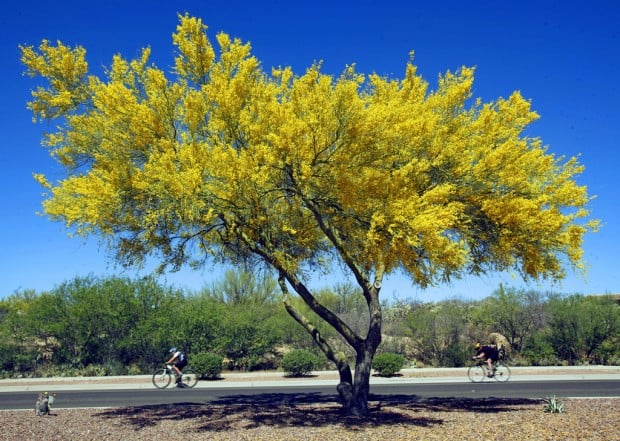
It's Arizona's official state tree.
Its name means "green stick" in Spanish.
It's the palo verde tree, and right now it's in full, glorious flower - bathing the Tucson area in brilliant yellow hues just a year after one of its most dismal blooms.
"The palo verde bloom this year is outstanding, just spectacular," said Russ Buhrow, curator of plants at Tohono Chul Park.
"It's the best palo verde bloom I've seen in at least 10 years," Buhrow said. "You can see the yellow in the foothills from midtown."
This year's big-time bloom comes on the heels of last year's monumental palo verde flop.
"Last year's bloom was terrible," Buhrow said. "The main reason was that there just wasn't enough rain."
People are also reading…
This year's extravagant display is a result not only of some soaking winter rains, but also of last year's flower failure.
"If you have a bloom that's as bad as last year's, the plants don't expend a lot of energy on flowers and fruit," Buhrow explained. "Then, as long as the trees remain healthy, they have lots of food reserves, mostly carbohydrates. And those reserves are available for a good bloom the next year."
Two species - the foothills palo verde and blue palo verde - account for much of this year's color.
A third species also puts out a bloom, said Mark Dimmitt, a former director of natural history at the Arizona-Sonora Desert Museum and a research associate there.
"Our other palo verde is the Mexican (species), which is not quite native," Dimmitt said. "In Arizona it occurs mostly in cities and other human-disturbed areas. It begins flowering along with the foothills palo verde and continues weeks after the foothills quit."
Palo verde trees in different parts of the Tucson area bloom at different times in the spring depending on rainfall, temperature and other factors, Dimmitt and Buhrow noted.
"Those on south slopes will usually bloom quicker, and those in warmer spots will bloom quicker," Buhrow said. "It also has to do with altitude. As you go up, the temperature drops. The higher you go, the later the bloom."
The palo verde bloom can have a downside for allergy sufferers.
"They are allergenic, but not like ragweed that flies for miles and miles," Buhrow said. "Still, if there's a gazillion of them blooming and you're in them, you could notice allergic effects."
tucson is a tree city
The Arizona State Forestry Division recently announced that 19 Arizona cities and towns - including Tucson - have received Tree City USA recognition. The Tree City program, sponsored by the Arbor Day Foundation, spotlights communities with tree departments, tree-care ordinances and community forestry programs.
Contact reporter Doug Kreutz at dkreutz@azstarnet.com or at 573-4192.



 Tucson's newest Shake Shack gets neighbors