BURLINGTON, Vt. – A 39-year-old democratic socialist scored an upset win to become mayor of this lakeside city four decades ago, and political warfare resulted.
But that was by no means the only result.
Battling a Democratic establishment that refused to work with him, Mayor Bernie Sanders – yes, that Bernie Sanders – led an economic revival that saw the number of jobs in Burlington grow by 19.5% during the 1980s.
Sanders also enacted a housing reform that another 39-year-old democratic socialist, Buffalo mayoral candidate India Walton, wants to emulate – although it only partially solved Burlington's affordable housing shortage.
People are also reading…
Meanwhile, Sanders' efforts to revive Burlington's waterfront proceeded through trial and error.
Yet many of his innovations remain today, from the restored farmland north of town to the artwork that adorns public spaces throughout this tiny, tidy city.
Even back then, Sanders railed against millionaires and billionaires, just like he later did as a congressman, a U.S. senator and two-time presidential candidate.
But a review of Sanders' eight years as Burlington mayor leaves an important lesson for Buffalo as it considers whether to install Walton in City Hall: It's possible to be both a socialist and a surprise.
Mayor Sanders preached against capitalism but worked with capitalists. He pushed controversial proposals and, if defeated, changed course. And according to key Burlington public figures and regular citizens interviewed here last week, Sanders proved to be a creative leader who shook the city out of its 1970s malaise while sticking to his core principle that government should serve the many, not the few.
"Some of the cops were afraid of him – you know, a socialist from Brooklyn," said Emmet Helrich, a retired Burlington police officer. "But he was great. He still is great."
'Monday night fights'
Burlington seemed primed for change in 1980. Vermont's largest city struggled through the 1970s, losing 1.7% of its population, yet five-term Mayor Gordon Paquette, a Democrat, remained in power.
Enter Bernie Sanders, then a part-time filmmaker, part-time carpenter, and four-time failed left-wing candidate for statewide office. Sanders barnstormed the city, railing that Paquette favored housing for the rich – two 18-story waterfront condo towers – not the poor.

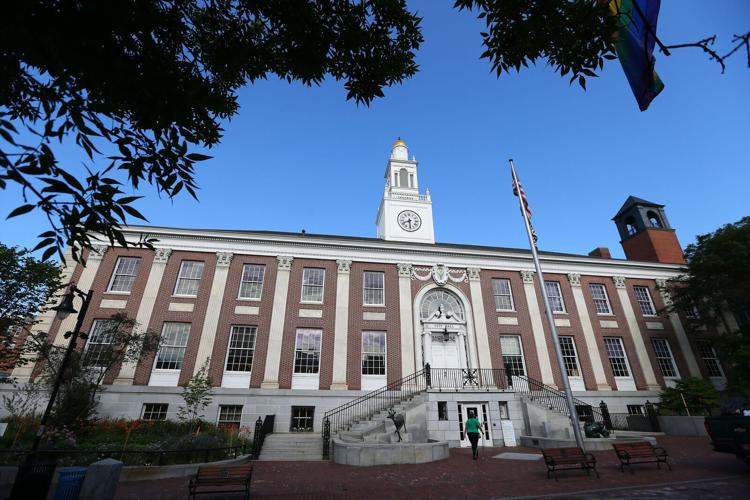
City Hall in Burlington.
Meanwhile, "Paquette consistently dismissed Sanders as no threat and ignored the many signs of political turbulence," wrote W.J. Conroy in his book "Bernie Sanders and the Boundaries of Reform: Socialism in Burlington."
The socialist surprised Paquette, just as Walton surprised the equally somnambulate four-term Buffalo mayor, Byron W. Brown, in last month's Democratic primary.
Sanders won by 10 votes, only to find himself facing down Paquette's Democratic machine, which still controlled the Board of Aldermen.
Board meetings came to be known as "the Monday night fights." Aldermen refused to confirm Sanders' appointees. They even fired his secretary.
Former Burlington Mayor Peter Clavelle describes political environment that Bernie Sanders encountered in the 1980s.
"The theory was that by doing that, he won't be able to run the city and the city will collapse and people would vote Bernie out," said John L. Franco Jr., an assistant city attorney during Sanders' tenure as mayor.
Relations between the mayor and the council grew so toxic that much of Sanders' early work – including drawing up budgets – took place by volunteers outside of City Hall.
"We couldn't meet in City Hall because we assumed it would be bugged," said Terry Bouricius, one of Sanders' board allies.
Asked about that, one of the Democratic aldermen, Maurice Mahoney, said: "The paranoia on both sides was pretty strange."
Eventually, the Democratic strategy of obstruction backfired.
Sanders won three new allies on the board in the 1982 election. And thanks to record turnout from Burlington's poorest wards, he won re-election the next year by double digits.

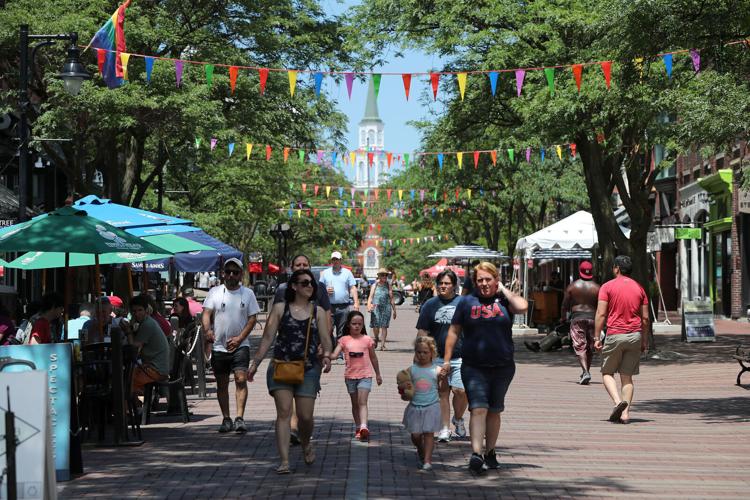
People walk through the Church Street Marketplace in Burlington.
Rebuilding Burlington
Armed with a mandate, Sanders moved to grow the local economy so that more people could benefit from it.
In 1983, Sanders created the Community and Economic Development Office, the sort of department Buffalo and other cities created years earlier.
Unlike other such offices, though, Sanders' team didn't try to lure out-of-town corporations. Instead, the city offered aid to the smallest homegrown companies.
"Here's a guy seen as a Democratic socialist, seen as anti-business by everybody, and he hires me to set up this loan fund and provide technical assistance to small businesses to help them grow," said Bruce Seifer, who went on to a three-decade career as Burlington's economic development guru.
The strategy worked. Locally owned shops line the Church Street Marketplace, the downtown pedestrian mall planned before Sanders was elected. Incubators sprouting tech firms occupy once-empty industrial buildings. Lake Champlain Chocolates started with one employee and now employs 200.
Sanders was especially supportive of employee-owned businesses like Gardener's Supply, which started with three employees and now has 300, said Cindy Turcot, the company's president and CEO.
"Bernie really understood that there could be a bridge between capitalism and socialism," said Turcot, an Elma native.
Seifer helped Sanders build that bridge.
"Bruce spent countless hours talking to business people about their needs and their wants and hopes, and then went out to try to deliver that," said Gary De Carolis, a former Burlington alderman. "So all of a sudden the progressives who were vilified as being anti-business were just the opposite: very pro-business in a way that didn't forget the little guy."
De Carolis, a Dunkirk native who spent his childhood summers with family in Buffalo, added: "I think the mayor in Buffalo has the same opportunity because that's a community, from what I remember, that is in a rebuilding phase."

Bruce Seifer, who worked in Burlington's economic development office for three decades, stands at the Bright Street Co-op in Burlington.
The housing struggle
The revival Sanders helped launch in this city of 42,000 only exacerbated its housing shortage.
Hemmed in between Lake Champlain and the Green Mountains and home to the University of Vermont, Burlington faces a chronically tight housing market. Zillow says the typical house in Burlington costs more than twice as much as one in Buffalo. And Burlington's rental vacancy rate is less than 1%, said Michael Monte, CEO of the Champlain Housing Trust.
As mayor, Sanders proposed rent control but voters rejected it, so he shifted gears, boosting public control of the housing supply through a city-run trust that later morphed into Monte's three-county effort.
The housing trust bought up housing so slumlords wouldn't. Thanks to the housing trust and other public housing efforts, about 25% of the city's apartments are affordable public rentals.
"If not for us, much of that housing's rents would be much much higher, and low-income people would not have an opportunity to be able to live and work in Burlington," Monte said.
The housing trust also aims to keep housing prices down by buying properties, holding onto the land and then selling the homes on it, thereby sparing homeowners the cost of the land.
In Buffalo, Walton proposes "a city-wide land trust federation with democratic decision-making at the neighborhood level." But Burlington's experience shows there are limits to that model.
The Champlain Land Trust controls 2,400 apartments but only 650 "shared equity homes." Monte said the land trust bought apartments but didn't want to evict tenants, so it couldn't put those units up for sale. Besides, the federal government subsidizes affordable rental housing, but not private homes on trust land.
So while the housing trust is considered a success in Burlington, it's a limited success.
"These are not new ideas; there are people who have been working on it for 40 years," said Beth Siegel, president of Mount Auburn Associates, an economic development firm that has worked with Burlington. "'Can you execute it well?' is the question."

A public access fishing pier on the waterfront in Burlington.
On the waterfront
Sanders also left behind a complex legacy on Burlington’s waterfront, which was an industrial wasteland dotted with oil storage tanks when he became mayor.
Development proposals, such as the condo towers Sanders fought, came and went. So when Sanders encountered a plan that combined the public space he wanted with a hotel, condos and a shopping center designed by the architect who built Baltimore’s Inner Harbor, he endorsed it.
Environmentalists didn’t.
"We just thought it was way too much for little Burlington," said Rick Sharp, a lawyer then leading a fight for a bike path.
Voters refused to fund the development, so Sanders scaled back. He agreed to build a boathouse and marina and backed Main Street Landing, a mixed-use redevelopment of Burlington’s waterfront train station.
"Bernie was our cheerleader," recalled Melinda Louise Moulton, CEO of Main Street Landing, who said it's wrong to presume a socialist mayor will be bad for business.
"I mean, socialism is about serving humanity," she said. "Well, how are you going to serve humanity if you don't give people housing, places to work, places to shop?"
Sanders also took the advice of his assistant counsel, Franco, joining a lawsuit arguing that the railroad land on Burlington's waterfront belonged to the state because it had been filled in from Lake Champlain.
In 1989, the year Sanders left the mayor's office, the Vermont Supreme Court agreed. Empowered with that decision, the new mayor filled the waterfront with public spaces: parks, a bike path and a science museum.
But Sanders doesn't downplay his role. Launching his first presidential bid in 2015, he said: "As mayor, I worked with the people of Burlington to help turn this waterfront into the beautiful, people-oriented public space it is today."

Cindy Turcot, president and CEO of Gardener's Supply and a native of Elma, left, and Will Raap, founder and chairman, at the location in Burlington.
The reformer
Sanders' impact on Burlington can also be seen in the Intervale, a 360-acre parcel of greenery north of the city. With Sanders' backing, Will Raap, founder of Gardener's Supply, formed a nonprofit in 1988 to transform the property, which was then a dump.
Rapp started a composting operation that helped renew what was once Vermont's richest soil. And now the Intervale teems with community farms.
"Gardener's Supply is a private sector business stimulating a public sector business stimulating a collaborative that created change in all of Vermont, and Bernie was very supportive of that," Raap said.
That's just one of many changes that took root under Sanders.
Under the previous mayor, local insurance agents rotated the city business among themselves. Sanders put the contract up for bid to save money.
Sanders' administration also sent a tax bill to the nonprofit local hospital, launching a legal battle that ended with the hospital and the university agreeing to share more revenue with the city.
The socialist mayor also tried to make life in Burlington cheaper and livelier.
Adjacent to the Intervale there's a city-owned, wood-fired power plant Sanders backed to lower electric rates.
Downtown there's City Market, a food co-op that Sanders proposed while mayor that finally opened years later to serve what had been a food desert.
And all around the city, you'll see murals and sculptures stemming from Sanders' creation of a public arts council.
Several sources said Sanders' tenure offers lessons for Walton if she defeats Mayor Brown's write-in bid. Even Sanders critics like Mahoney, the former alderman, said Sanders hired very well. Others said he proved to be an able administrator flexible enough to change direction when necessary.
"He didn't shy away from the fact that he was a Democratic socialist but he didn't wear the badge," said Peter Clavelle, who served as economic development director under Sanders before succeeding him as mayor. "He focused on making government work for people."