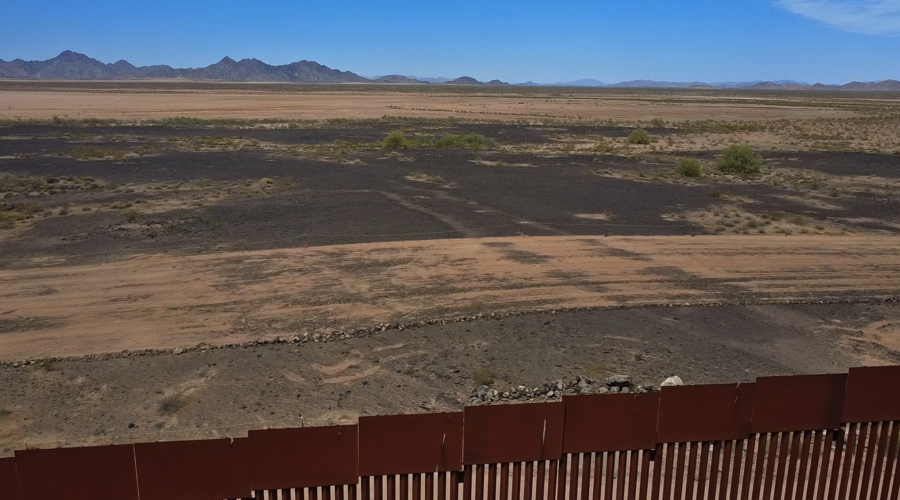
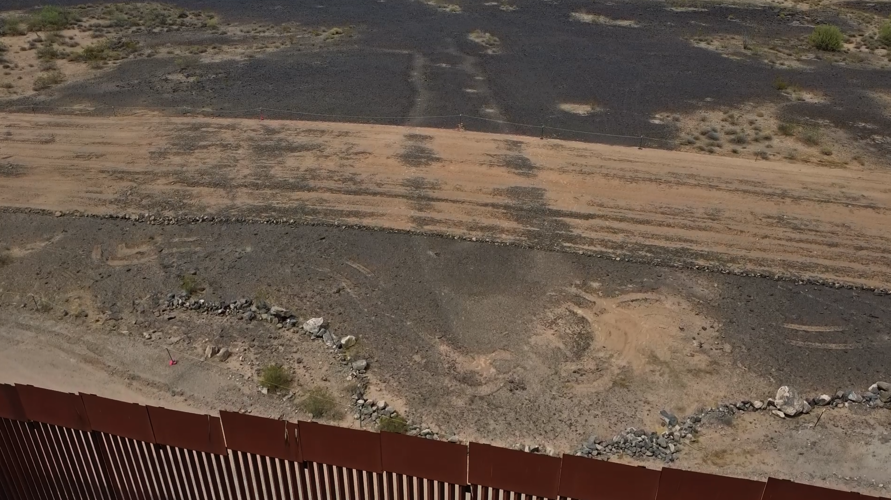
A giant fish carved into volcanic rock by ancient people more than 1,000 years ago has been bulldozed in half during construction of a second border wall in Arizona, according to new images of the damage at Cabeza Prieta National Wildlife Refuge.
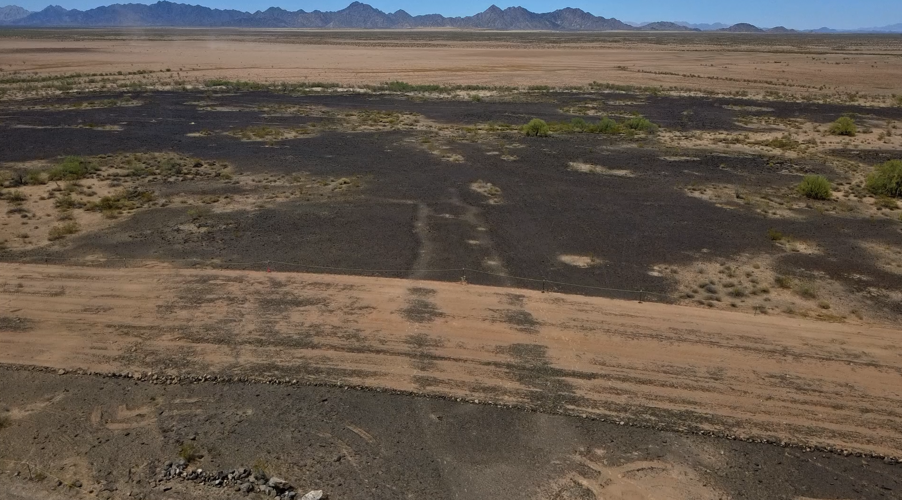
A drone video released Tuesday by the Center for Biological Diversity shows a roughly 50-foot-wide swath of freshly bladed desert slashing straight across the known archaeological site, which is considered sacred ground by members of the Tohono O’odham Nation.
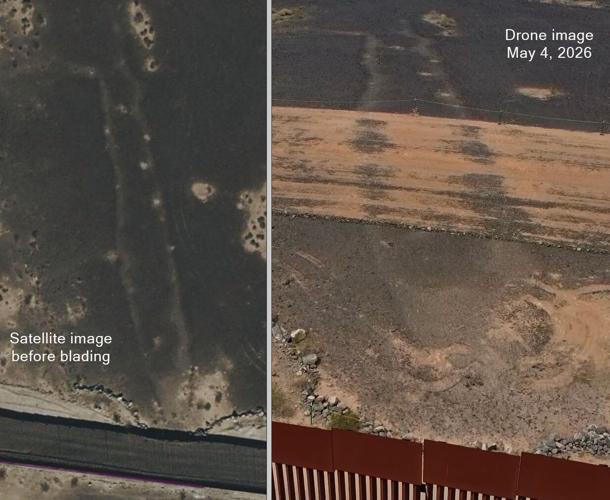
“It sort of cuts between the body and the head,” said Russ McSpadden, Southwest conservation advocate for the Tucson-based center. “It basically decapitates the head of the fish.”
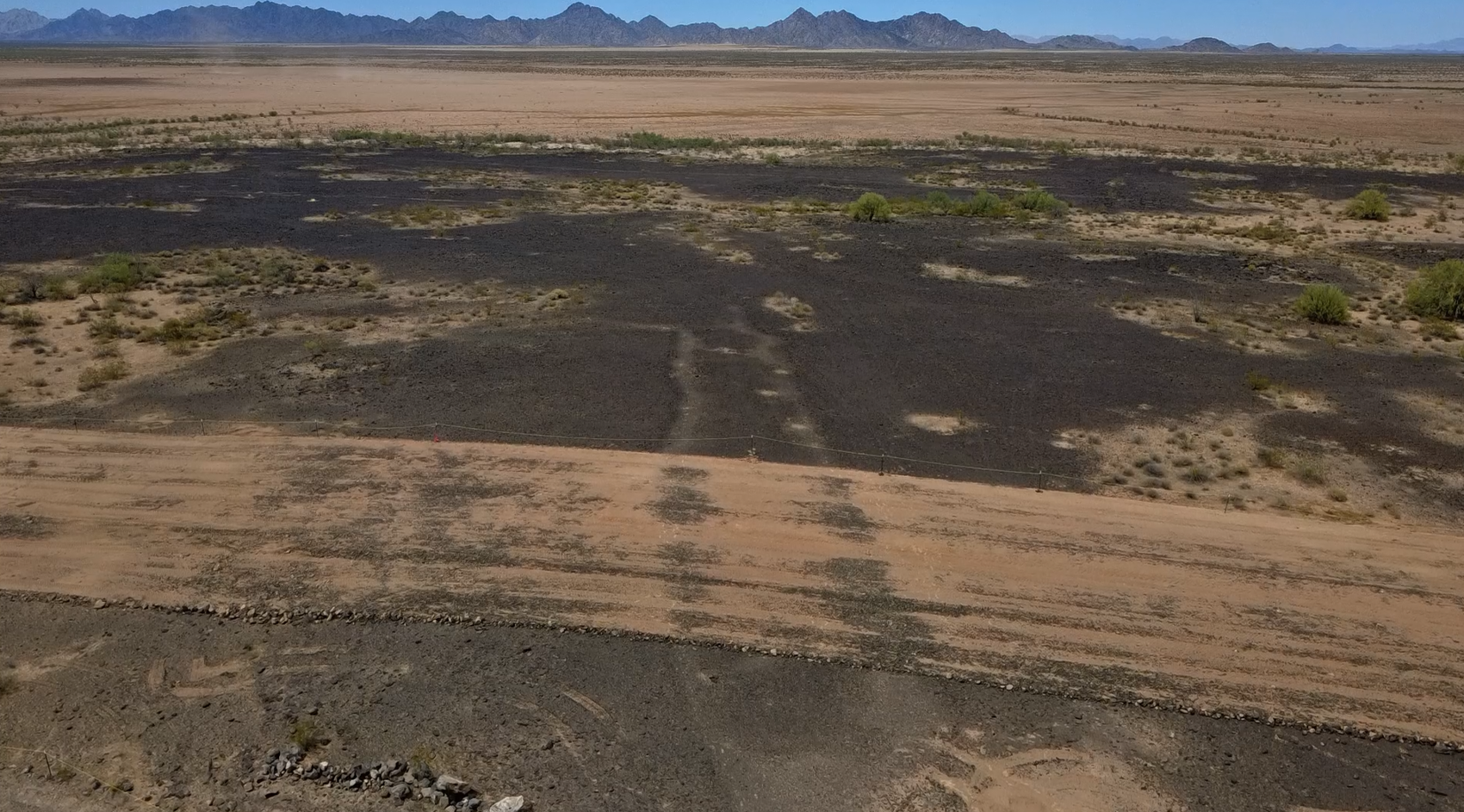
A drone image taken May 4 from the Mexican side of the border shows damage to an ancient archaeological site at Cabeza Prieta National Wildlife Refuge, where border wall contractors recently bulldozed through the fish-shaped geoglyph at the center of the image.
McSpadden spent the weekend documenting the geoglyph site, commonly known as Las Playas Intaglio, after hearing about the damage. Getting there took about two hours of driving on remote dirt roads from Ajo, followed by a mile and a half of hiking across a dry lakebed south of the notorious Camino del Diablo, aka the Devil’s Highway.
People are also reading…
There was construction equipment parked near the intaglio, but no one else was around, McSpadden said. In the two days he was there, he said, he could see the dust from wall construction activity about 15 miles away, but he never saw another person.

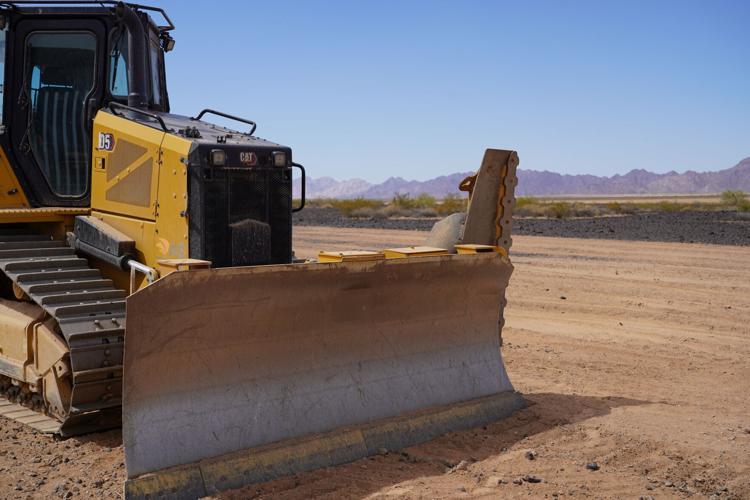
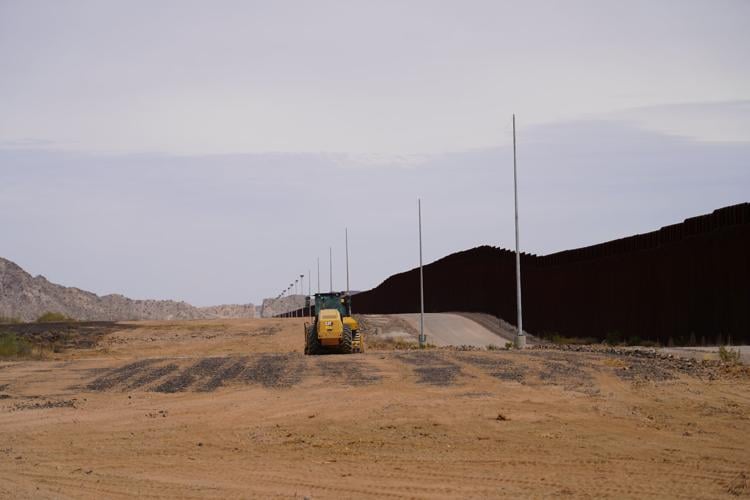
Border-wall construction equipment is parked near the site at Cabeza Prieta National Wildlife Refuge, where a contractor damaged a known archaeological site dating back roughly 1,000 years.
He ended up camping near the intaglio on Saturday and Sunday nights, then crossing the border at Lukeville on Monday to approach the site from the Mexican side so he could film it with a drone.
To him, the damage looks irreversible.
“It seems incredibly irresponsible to destroy a 1,000-year-old archaeological site like this. I mean, I don't know what the communication is like between (U.S. Customs and Border Protection) and contractors, but to me, this is clear evidence that when laws are waived for border wall construction, this is the kind of outcome that can happen," McSpadden said.
Work is now underway on a second, 30-foot-tall barrier that will run parallel to the existing wall along 23 miles of the border in Cabeza Prieta. The project, known as Tucson 1, is part of $46.6 billion in security infrastructure for the southern border approved last year as part of the so-called One Big Beautiful Bill.
In October, CBP and the Department of Homeland Security announced the first 10 contracts to be funded by the massive spending bill, along with waivers exempting the work from any environmental or historic preservation laws that could slow it down. The list included a $607 million award for Tucson 1 that went to an Alabama-based firm called BCCG a Joint Venture.

A before-and-after image of damage to La Playa Intaglio, a fish-shaped geoglyph dating back roughly 1,000 years at Cabeza Prieta National Wildlife Refuge.
When reached for comment about the damage to the archaeological site, both the contractor and the U.S. Fish and Wildlife Service, which manages Cabeza Prieta, referred all questions to Customs and Border Protection.
A spokesman for CBP responded to the Star with a written statement confirming that an unnamed border wall contractor had “inadvertently disturbed” the intaglio on April 23.
“(CBP) Commissioner (Rodney) Scott is engaged directly with tribal leadership to determine appropriate next steps,” the spokesman said. “The remaining portion of the site has been secured and will be protected in place.”
'Irreplaceable'
In a video message posted on Facebook Saturday, Tohono O’odham Chairman Verlon Jose said the intaglio was “an irreplaceable piece” of the tribe’s history and American history. He called its destruction “not only tragic but entirely, entirely preventable.”
“The significance of this site was not unknown. It had already been identified, and it had already been marked as a place to protect. And yet it was still lost,” said Jose, after surveying the damage himself with other tribal leaders. “No inspection can undo what has been done, and no review can restore what has been taken. This was more than land; it was memory, it was identity, it was history.”
U.S. Rep. Adelita Grijalva called on Homeland Security to immediately halt border wall construction and fully investigate the incident.
“Bulldozing a 1,000-year-old sacred site is not an accident — it’s the predictable result of rushing forward with a (second) wasteful border wall. It is a blatant act of disrespect and an unacceptable violation of tribal sovereignty, traditions, and the ancestry of the O’odham people,” the Tucson Democrat said in a written statement.

A piece of equipment sits in an area at Cabeza Prieta National Wildlife Refuge being cleared for construction of a second border wall in early May. Contractors on the project damaged a known archaeological site researchers now believe could date back at least 6,500 years.
The intaglio is roughly 270 feet long and 50 feet wide, with a rounded head that comes to within about 30 feet of the international boundary.
Little is known about its origins or its meaning. The head of the fish points south toward the Sea of Cortez, roughly 50 miles away across the desert, McSpadden said. “I've always jokingly said it's kind of a sign for ‘fish tacos that way.’”
Though the lines that form the geoglyph look unmistakably human-made when you’re standing next to them, he said, the overall shape of the design only really becomes clear when you see it from high above.
“It's not as big as the Nazca Lines in Peru, but when you're there you realize you can't really take it in from the ground,” McSpadden said. “It's pretty spectacular.”
The intaglio was made by scraping aside the darkened rocks and pebbles in the desert pavement to expose the lighter sediment below, according to a 2014 paper by married Ajo archaeologists Sandy and Rick Martynec, who surveyed the greater Las Playas area.
Other traces of human habitation found along the border there include ancient footpaths, stone symbols, pottery sherds, tool flakes and fragments of seashells, possibly left over from jewelry making.
'Lawless act'
It’s unclear how border security officials plan to protect what’s left of the geoglyph. McSpadden said the roughly 50-foot-wide path that was scraped through the fish appears to be where the second wall is going to be built. “From where I stood, that (50-foot) blading goes as far as the eye can see in that valley,” he said.
This was his third trip to the intaglio. The last time he was there was in 2023, he said, as part of a larger effort to catalog overhead lights that were installed during wall construction in the first Trump administration.
McSpadden ended up counting about 1,800 floodlights strung along the border, including one directly above the fish’s head at Las Playas. Some of them have been out there long enough now to have fallen into disrepair, their poles leaning and their wires chewed at by animals.

A drone image taken Monday from the Mexican side of the border shows damage to an archaeological site at Cabeza Prieta National Wildlife Refuge, where border wall contractors recently bulldozed through the 1,000-year-old, fish-shaped geogyph at the center of the image. Customs and Border Protection confirmed that an unnamed border wall contractor “inadvertently disturbed” the intaglio on April 23.
“They've never been able to fully maintain those,” McSpadden said. “So there are big city lights all along the Cabeza Prieta National Wildlife Refuge, right at the wall, and none of them work. None of them are on or get turned on at night.”
To him, the whole thing seems like an enormously expensive solution in search of a problem, especially in a remote place like Cabeza Prieta.
“This is a really difficult part of the desert to cross in, and I can't imagine the numbers justify a second wall,” he said. “I mean, if the first wall is not effective, I'm not sure why the second wall would be.”
McSpadden said he’d like to think there will be repercussions for destroying an ancient site like Las Playas Intaglio, but with the waivers that have been granted to speed border wall construction, “contractors can effectively work lawlessly at the border.”
“This is what we see as a lawless act: A place that should be protected was destroyed,” he said.

A drone image taken Monday from the Mexican side of the border shows damage to an archaeological site at Cabeza Prieta National Wildlife Refuge, where border wall contractors recently bulldozed through the 1,000-year-old, fish-shaped geogyph at the center of the image.
Tribal Chairman Jose, meanwhile, seems more interested in action than apologies.
“There are many more sacred sites along the U.S.-Mexico border, both on and off the reservation’s lands, and this tragedy makes one thing undeniable: Stronger protections are not a choice; they are an absolute necessity,” he said. “The Tohono O’odham Nation has made our position unmistakably clear to federal officials: This must never happen again.”



 Plans for border walls on Tohono O'odham land a 'betrayal,' chairman says