

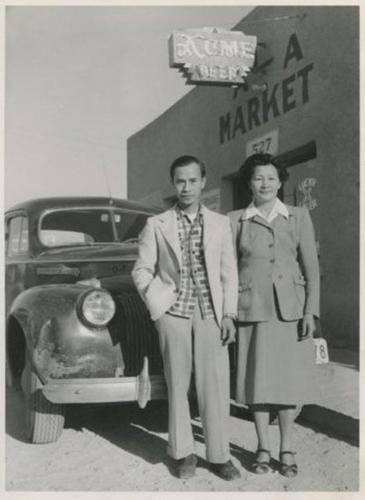
There was a time in Tucson, not that long ago, when one could find a small corner store owned by a Chinese family. In some barrios, there was a store on all four corners.
That was a time, of course, before the arrival of Walmart, Costco and supermarket chains, bringing in more goods and less personal service. Chinese stores in the barrios have all but disappeared, leaving behind history and memories.
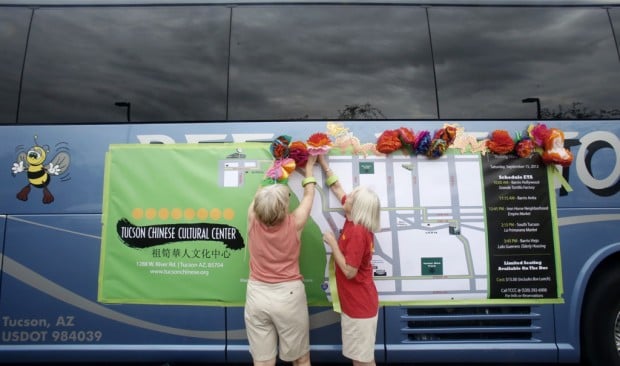
Some of that lost history will reappear next Saturday, when Tucson's Chinese Cultural Center launches its "Rolling History Party."
A 50-passenger bus will stop and visit several barrios so participants can celebrate and remember the role of Chinese grocers and their families.
"It's a flash party," said Robin Blackwood, who heads the cultural center's history committee.
The bus will stop in barrios Hollywood and Anita on the west side, the Iron Horse neighborhood south of Tucson High Magnet School, South Tucson and Barrio Santa Rosa.
People are also reading…
At the stops there will be entertainment, including Chinese dancers, Mexican folkloric dancers and mariachis.
The project is funded by the Tucson Pima Arts Council.
In addition to the dancers and music, Blackwood said there will be a video presentation of the culinary and cultural history of Tucson's Chinese pioneers.
The video is an amalgam of a chef preparing food, a scholar talking about the history and a panel of local residents reminiscing about growing up in the barrios, Blackwood said.
"It is about the heritage of Tucson's Chinese families," Blackwood said.
One of the gastronomic legacies is the Chinese tamal, called zongzi. The holiday food is served in late May to mid-June.
Instead of masa and corn husks, the zongzi is glutinous rice filled with eight ingredients, including meat, salted egg, dried shrimp, sausage and pork. It is wrapped tightly in bamboo leaves and boiled in water for several hours, said Blackwood.
"People who grew up eating them love them," she said.
While a seat on the bus costs $15, the public is invited to participate at the stops.
One of the stops will be at La Primavera Market, 1600 S. Ninth Ave., near Ochoa Elementary School, at 2:15 p.m.. The market is considered one of the oldest continuously operated neighborhood stores.
Lee Goon opened the store more than 100 years ago. Like other Chinese barrio stores, it sold beans, produce, lard, candy, pork, chile and much more. When he left Tucson for his native China, Lee Goon left the store to his son, Lee Hop, who operated that store and other businesses for many years.
The first stop will be at 10 a.m. at the Grande Tortilla Factory, 914 N. Grande Ave. About an hour later, the bus will roll to Barrio Anita and stop at the empty lot across from Anita Street Market, 849 N. Anita Ave.
From there, the bus will travel east on Sixth Street and over to the New Empire Food Market at 526 E. Ninth St., next to The Buffet Bar, the city's oldest cantina, at 12:45 p.m.
The last stop, for two hours, will be at the Lalo Guerrero Elderly Housing center, at West 18th Street and South Convent Avenue, at 3:45 p.m.
The Chinese and Mexican families depended on each other, said Patsy Lee, whose family owned Alan's Market at West Delaware Street and North Columbia Avenue, just west of the Santa Cruz River, in Barrio Hollywood.
The grocers depended on their Mexican customers, and Mexican families needed the credit given by the merchants, she said.
The families intermingled and intermarried.
"I grew up thinking I was Mexican," said Lee.
The Chinese presence in Tucson grew in the late 1800s as Chinese men fled persecution in California. More made Tucson their home after escaping anti-Chinese violence during the 1910 Mexican Revolution.
Many Chinese men in Tucson returned to China to bring a bride and to start families in the barrios, where they lived side-by-side with Mexican-American, African-American and indigenous families.
It is unknown how many Chinese stores were in Tucson, but Blackwood estimates there were nearly 300.
In Barrio Viejo, which was demolished in the late 1960s, there were nearly 90 in a one-square mile area.
If you go
"Beyond Groceries: Rolling History Party"
When: Sept. 15, starting at 10 a.m.
Tickets: $15 each. Limited seating will be available on bus.
For reservations or more information: 292-6900
"I grew up thinking I was Mexican."
Patsy Lee, whose family ran Alan's Market on west side
Ernesto "Neto" Portillo Jr. is editor of La Estrella de Tucsón. He can be reached at (520) 573-4187 or at netopjr@azstarnet.com


 Analysis: These 9 TUSD schools are at highest risk of merging or closing


