A train derailment in northern Sonora caused an industrial-chemical spill that’s put at least one person in the hospital, in critical condition, and could have implications for the north-flowing San Pedro River.

Rainfall during and after the July 25 spill complicated clean-up efforts and sent the contaminants flowing into a stream located in the headwaters that drain into the San Pedro River, said hydrologist Agustin Robles Morua, of the Sonora Institute of Technology, in a Monday interview with the Arizona Daily Star.
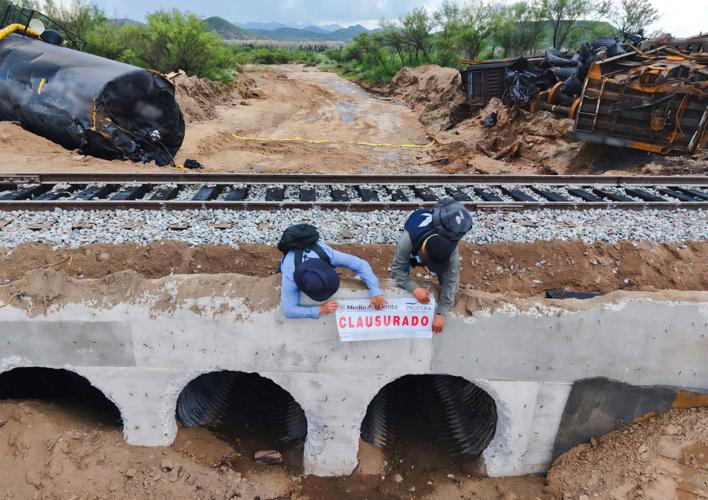
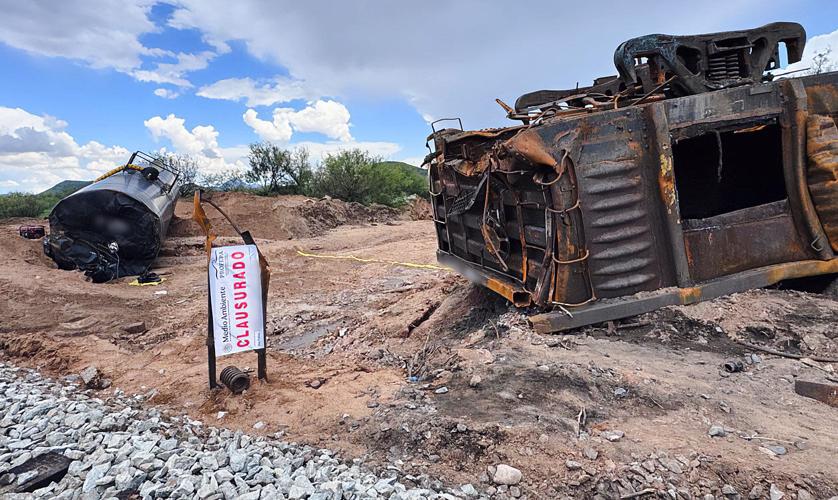
Several Ferromex train cars derailed the night of July 25, spilling 70,300 liters of sodium hydrosulfide into a streambed about 12 miles south of the border town of Naco, Sonora, according to Profepa, Mexico’s environmental agency.
Ferromex, a subsidiary of mining giant Grupo Mexico, is charged with remediating the site, under the oversight of Profepa, the environmental agency said in a statement to the Arizona Daily Star.
Sodium hydrosulfide can cause irritation and burns to the skin, eyes and respiratory tract and, upon contact with water, it becomes a toxic gas, hydrogen sulfide, Profepa said.
Rainfall during and after the spill complicated clean-up efforts and sent the contaminants flowing into a stream located in the headwaters that drain into the San Pedro River, said hydrologist Agustin Robles Morua, the Sonora Institute of Technology, in an interview with the Star.
People are also reading…
The Arizona Department of Environmental Quality has been working with U.S. and Mexican authorities — including the binational International Boundary and Water Commission, the U.S. Environmental Protection Agency and Profepa — to assess the impact of the spill, a spokesperson said Monday.
The spill occurred within the Upper San Pedro watershed, between two and four miles west of the San Pedro River in northern Sonora, said Alma Suarez, ADEQ’s deputy public information officer for water quality, in a Monday emailed statement.
“Given that the San Pedro river is one of the few rivers that flows north from Sonora into Arizona, this transboundary watershed is of particular concern, making this spill an event of interest for continued monitoring for any potential transboundary environmental impacts,” Suarez wrote.
So far, she said, “no official environmental assessment has identified impacts to Arizona, nearby communities, or the transboundary watershed.”

Ferromex, a subsidary of mining giant Grupo Mexico, is charged with remediating the spill site, under the oversight of Profepa, Mexico's environmental agency. The spilled chemical, sodium hydrosulfide, can cause irritation and burns to the skin, eyes and respiratory tract. Upon contact with water, it becomes a toxic gas, hydrogen sulfide, Profepa said.
The derailed train cars were also transporting copper concentrate; Profepa said the spilled concentrate, and the soil contaminated by it, has already been removed.
But containing the sodium hydrosulfide has been a much greater challenge.
“Containment dikes” installed by Ferromex collapsed amid the rainfall, allowing the pollutants to spread, Profepa said.
The agency has ordered additional clean-up measures and is still assessing the extent of the impact and necessary remediation, Profepa said.

Many in Sonora are still suffering effects to their health and livelihoods from a massive Grupo Mexico mine-waste spill that contaminated the Sonora River in 2014. A group of affected residents in Naco and Ejido Cuauhtémoc submitted a letter to Mexican authorities this week, demanding transparency and justice in the wake of the recent spill. "The people of Sonora still bear a deep wound inflicted by the ecocide of the Sonora River 12 years ago, whose environmental, health, and social consequences continue to affect thousands of families," said the statement, written in Spanish.
When sodium hydrosulfide reacts with water, it creates a toxic gas that is extremely dangerous.
A 53-year-old man who was exposed to the toxic fumes soon after the spill is now in critical condition at a Nogales hospital, according to the Sonoran Health Department and Sonoran outlet La Journada.
The father of five lives in Ejido Cuauhtémoc, near the spill site, and he inhaled the toxic fumes while walking to work on July 26. His family told La Journada that he has swelling in the brain and severe lung damage.
“No one ever talked about evacuation, about the risks associated with this acid,” a relative posted on Facebook Aug. 1.
Water defenders demand justice
Mexico’s Attorney General’s Office has ordered Ferromex to submit an environmental plan to assess the affected area and a related remediation plan, “subject to approval by the environmental authority,” Profepa’s statement said.
Many in Sonora are still suffering effects to their health and livelihoods from a massive Grupo Mexico mine-waste spill that contaminated the Sonora River 12 years ago.
Water defenders in Sonora say they’re demanding transparency, and “justice for the victims,” as the remediation proceeds.
Eduardo Ríos, a rancher and environmentalist in northern Sonora, shared a statement with the Star written by residents of Naco and Ejido Cuauhtémoc affected by the spill. He said the citizens group submitted the written demands for transparency and justice to Mexican authorities Monday.
“The people of Sonora still bear a deep wound inflicted by the ecocide of the Sonora River 12 years ago, whose environmental, health, and social consequences continue to affect thousands of families,” said the statement, written in Spanish. “That tragedy left a bitter perception of impunity and insufficient reparation. Precisely because of this historical experience, the Mexican state now has the ethical and legal obligation to demonstrate that it has learned from its mistakes. ... Environmental justice demands truth, transparency, full reparation and sanctions for those responsible.”
Robles Morua agreed more transparency is needed from the Mexican government, and from Grupo Mexico and Ferromex.
So far, authorities seem to be following the same playbook as during the 2014 spill, worsening an existing distrust of authorities, Robles Morua said.
“They are treating this as something minor, and they’re following the same procedure that occurred 12 years ago. They’re not really being very transparent with the information,” he said. “It’s already been more than a week and they haven’t shown any results at all on the actual samples that were taken and obtained.”
Risk to groundwater
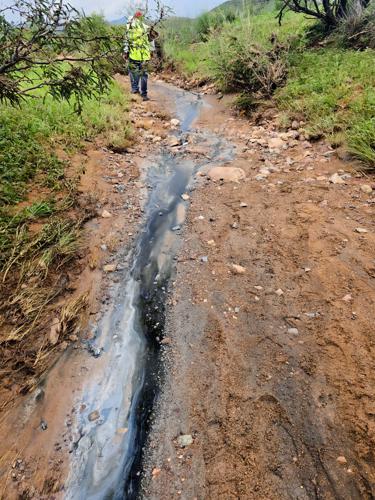
After the toxic gas dispersed, a secondary impact of the hazardous spill is the "plume" of contaminants in the stream, which was flowing in the aftermath of the spill due to heavy rains, Robles Morua said.
“As soon as it started raining and the stream started to flow, it was starting to carry the contaminant plume from the location of spill, moving northwards into the San Pedro River basin,” Robles Morua said.
Those chemicals could seep into the sediment and make their way into the groundwater, he said.
“The infiltration to groundwater will move slower, and that will mean it will potentially be there for a longer time,” he said.
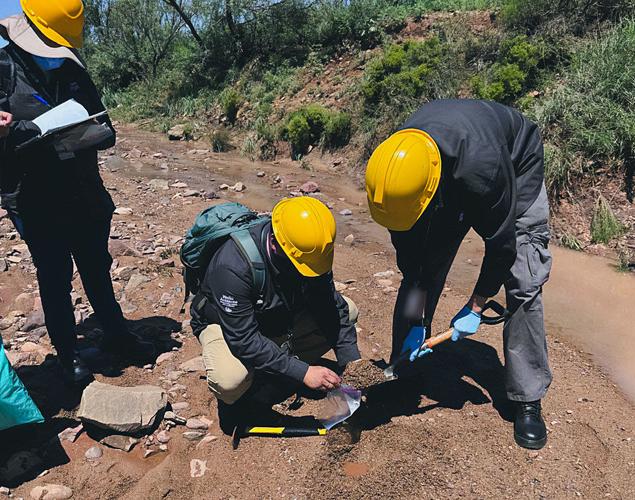
Environmental investigations are ongoing around the 1.9 miles of drainage area in Sonora affected by the spill, including soil, stream channel and biological resources, ADEQ’s Suarez said.
Profepa is evaluating potential groundwater impacts in Sonora, she said.

On the night of July 25, a Ferromex train derailment caused 70,300 liters of sodium hydrosulfide to spill into a stream about 12 miles south of Naco, Sonora, threatening the health of the San Pedro River basin, a Sonoran hydrologist said.
Robles Morua said he thinks the Arizona Department of Environmental Quality should conduct groundwater testing close to the border, where the San Pedro crosses into Arizona, south of Hereford.
ADEQ’s statement did not say whether Arizona-side groundwater testing is planned.
While there’s likely a minimal chance the contamination plume in the river would pose a health risk to humans downstream, especially now that the chemicals have dispersed, aquatic organisms that get exposed to the chemicals will die, Robles Morua said.
“They could potentially see micro-invertebrates that die off, because they’re very sensitive,” he said. “Aquatic life in these streams will die immediately upon contact with this solution. That will be very noticeable because people will see fish and other living organisms that thrive in these streams, they will die off immediately.”
Grupo Mexico was responsible for the 2014 spill from Cananea’s Buenavista del Cobre mine; residents living along the Rio Sonora say they are still suffering health effects.
That spill released about 11 million gallons — about 41 million liters — of copper sulfate acid solution into the Bacanuchi River, a tributary of the Sonora River, the Star reported at the time.
The spill contaminated the Bacanuchi and Sonora rivers, leaving more than 25,000 people in seven counties without water. A month later, heavy rains caused the river to swell and soaked nearby fields with toxic water, the Star reported.
The recent spill is much smaller, Robles Morua said.
At this point, “I would say it would be negligible, if there is risk to humans,” he said. But there isn’t yet data to prove that, he said.
“We really need to monitor and collect samples further downstream, just to make sure this is not the case (that people are at risk),” he said. “And that’s the job for the Arizona Department of Environmental Quality.”
Contact reporter Emily Bregel at ebregel@tucson.com. On X, formerly Twitter: @EmilyBregel

Emily Bregel
Border reporter