A 30-year-old man who grew up in Phoenix has spent the last three months confined in a decommissioned hotel in Equatorial Guinea, after ICE deported him there without warning.
Armed guards patrol the grounds of the Bamy Hotel, where Ahmed Soliman — whose family moved to Arizona from Egypt when he was 4 — has been imprisoned since late April, despite having committed no crime in the African nation.
He fears at any moment he’ll be returned to his home country, where a U.S. immigration judge agreed last fall he’d likely face torture and death, due to his family’s politics and his identity as a gay man.
Soliman said he’s one of 17 deportees from the U.S. confined in the hotel-turned-prison, where living conditions are inhumane and deteriorating.
“Things have been gradually, day-by-day getting worse,” he said in a phone interview with the Arizona Daily Star.
People are also reading…
Equatorial Guinea is among dozens of countries that have signed often-opaque “third-country removal” agreements with the Trump administration to accept U.S. deportees who can’t be deported to their home countries.
But too often, those third countries send the deportees back home anyway, a violation of international law, immigration attorneys say.
Soliman said ICE told him shortly before he was forcibly put onto an airplane that he was being deported to Equatorial Guinea, where rights advocates say homosexuality is de facto criminalized.
Soliman’s attorneys argue his sudden removal — without notice or a fear-screening, and while he still had a pending habeas corpus petition before U.S. District Court in Arizona — was unlawful and put Soliman’s life at risk.
The treatment he’s received by the U.S. government is “unconscionable,” his immigration attorney said.

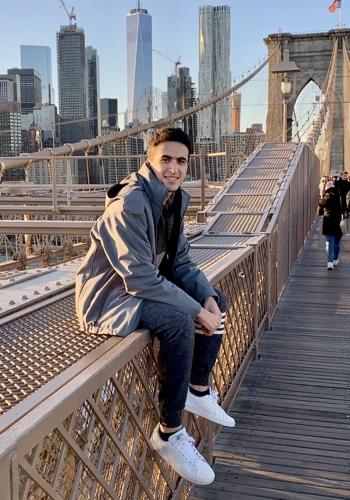
Ahmed Soliman, now 30, is pictured on the Brooklyn Bridge in 2019. Soliman, whose family moved from Egypt to Arizona when he was 4, has been detained at a decommissioned hotel in Equatorial Guinea for three months, since ICE deported him there April 28 without notice. He said he’s intent on speaking out about the injustices he and other deportees at the hotel are facing, despite the risks to his personal safety.
“More likely than not, if he has to return to Egypt he will be tortured and killed because of his identity,” said Kate O’Donnell, attorney with Tucson law firm Green Evans-Schroeder.
Bamy Hotel, on an island off the coast of central-west Africa, is now also holding a man with Ebola in quarantine one floor below the deportees, Soliman said. None of the deportees have received protective gear, he said.
Local officials dealing with the Ebola patient “came in with haz-mat suits. That put us all in unease,” he said. “You would never do this in a public hotel. They have no regard for us, for our health, for our safety.”
The Associated Press has also reported Ebola patients are in quarantine at Bamy Hotel, citing accounts from deportees who spoke on the condition of anonymity, fearing retaliation.
Soliman told the Star he’s intent on speaking out about the injustices he and other deportees at the hotel are facing, despite the risks to his personal safety.
“I’m at a point in life right now where I will do everything in my power to fight,” he said. “I’m doing this for the 17 people that live here, as well. It’s not just me.”
ICE spokesman Fernando Burgos did not respond to the Star’s questions about the conditions in which Soliman and other deportees are being held in Equatorial Guinea.
“Once an alien leaves the United States, ICE is no longer responsible for tracking their location or activities outside the country,” Burgos said in an emailed statement.
The Star contacted Equatorial Guinea’s Embassy in Washington, D.C., and a staff member said Ambassador Crisantos Obama Ondo would respond to the Star’s questions, sent by email July 29.
On July 31, an embassy staffer said the ambassador was on vacation and couldn’t answer the questions, which asked about the confinement conditions for U.S. deportees and allegations that Equatorial Guinea has returned U.S. deportees to their home countries.
Imprisoned in a hotel
In the hotel, Soliman said deportees are treated like prisoners. They’re provided with three basic meals, and soap and toilet paper, but everything else they must purchase on their own, using money sent by their families via Western Union.
People who take the deportees’ money to make purchases on their behalf often steal some of the funds, he said.
“Since I’ve been here, there’s no hygiene products except soap. No toothpaste, no change of clothes,” he said. “We have to hand-wash our clothes in our room and hang them on the balcony. Nothing is provided to us in this hotel except the food.”

Ahmed Soliman, who grew up in Phoenix, shared his view from inside the decommissioned Bamy Hotel in Malabo, Equatorial Guinea, where he’s been imprisoned since ICE deported him there, without warning, on April 28. Armed guards patrol outside the hotel, where Soliman said he and 16 other deportees from the U.S. are being confined, despite having not committed any crimes in the country.
The hotel is owned by the country’s long-running president, Teodoro Obiang Nguema Mbasogo, who has led Equatorial Guinea’s authoritarian government for more than four decades. The U.S. State Department has chronicled human rights abuses and corruption in the oil-rich country.
In recent weeks, deportees at the hotel have not even been receiving the soap and toilet paper they were getting previously, Soliman said.
Soliman believes the withholding of hygiene products is in retaliation for the public attention to the hotel arrangement, after a rights group filed a case in June against Equatorial Guinea before the African Commission on Human and Peoples’ Rights.
The filing asks the African Commission to force Equatorial Guinea to stop further deportations of U.S. deportees back to their home countries, in violation of U.S.-granted protections, and to improve detention conditions, the Associated Press reported.
Worst of all for the deportees languishing at Bamy Hotel, there’s no end date to their imprisonment, since no one there is serving a sentence for a crime, Soliman said.
‘Refoulement’
In its second term, the Trump administration has signed more than 30 agreements with foreign governments to accept U.S. deportees from other countries. Thousands have been deported from the U.S. to countries other than their own.
In a secretive agreement with Equatorial Guinea, the U.S. agreed to pay the central African nation $7.5 million in exchange for the country receiving deportees from the United States. At least 32 people, with no ties to the country, have been deported there under the deal.
Both ICE and the U.S. State Department refused to provide the Star with a copy of the deportation agreement with Equatorial Guinea, or share any details about the agreement.
Several U.S. deportees whom Soliman met at the hotel have already been returned to their home countries, despite protections granted to them in the U.S. that prohibited their deportation home, he said.
An immigration judge granted Soliman protection from removal to Egypt under the U.N.'s Conventions Against Torture, or CAT, in October 2025.
“Everyone in this hotel either has CAT or withholding of removal,” he said.
In granting Soliman protection under CAT, the immigration judge agreed Soliman cannot be deported back to his home country of Egypt, because he would face torture or death there due to his identity as a gay man and due to his family’s political activity there when he was a child.
Soliman’s father was a prominent Muslim scholar who began receiving threats from government officials for speaking out against the military-backed regime of then-President Hosni Mubarak, according to his September 2025 application for CAT protection.
Soliman “has spent nearly his entire life in the United States, a country in which, should he be given the chance, he may yet find peace and acceptance,” his CAT application said. “Should he be returned to Egypt, however, a country in which he has not lived since he was four years old and whose language he does not speak, not only will he never find peace and acceptance, but he will certainly be tortured and killed because of who he is.”
Returning someone to a country where they face persecution or death is called refoulement, and is a violation of international law.
“Under international human rights law, the principle of non-refoulement guarantees that no one should be returned to a country where they would face torture, cruel, inhuman or degrading treatment or punishment and other irreparable harm,” according to the United Nations.
Critics say the U.S. has been complicit in “chain refoulement,” in which the U.S. deports someone to a third country, which then deports the individual to their home country.
ICE’s Burgos denied that the U.S. engages in refoulement.
“ICE complies with all U.S. and international legal obligations, including the principle of non-refoulement, and does not remove individuals to countries where they are likely to face torture.”
Immigration attorneys say that’s false.
In a May filing with U.S. District Court in Arizona, Soliman’s attorneys argued his life was in danger due to ICE’s having deported him to Equatorial Guinea without notice and without a fear screening.
“The very real risk of refoulement to Egypt, and of persecution or torture in Equatorial Guinea calls into question the legality of the government’s actions,” said in the filing in Soliman’s habeas corpus petition, which was still pending at the time he was deported.
Since Soliman was already out of U.S. custody by then, the case was dismissed.

Ahmed Soliman, pictured in Glendale in 2020, grew up in Phoenix after his family moved from Egypt to Arizona when he was 4. He’s been detained at a hotel in Equatorial Guinea for three months, since ICE deported him there April 28 without notice.
‘Necessary tool’
ICE’s Burgos said third-country removal agreements are “a necessary tool to protect the American people.”
“Third-country removal agreements allow ICE to remove individuals who cannot be returned to their home countries due to court orders, ensuring public safety and due process,” he said in a statement. “These agreements are essential for removing individuals convicted of serious crimes who would otherwise remain in the United States.”
Soliman said his legal troubles in his 20s stemmed from self-hatred, which led to addiction.
Homosexuality was not accepted in his religious family, and he had no one to confide in and no way to express his emotions, Soliman said.
He started using recreational drugs in high school and at 21, he tried fentanyl and became addicted, leading to several citations.
“I was a young, dumb kid,” he said. “I grew up with a loving family. ... But also growing up in an Arab household, where you don’t talk about your emotions. I didn’t know how to process what was going on inside of me. I felt like something was wrong with me.”
He caused a car accident in 2021, while driving under the influence of fentanyl, and was convicted of narcotics possession and aggravated assault in 2023. He spent two years in prison.
Upon his release from prison in 2025, he was taken into ICE custody, where he was transferred between ICE detention centers in Arizona and California over the next six months.
By April, Soliman was still in ICE detention, and his attorneys filed a habeas corpus petition in U.S. District Court in Arizona, challenging the legality of his continued detention.
Soliman’s lawyers filed an emergency motion on April 27, when they realized ICE was taking steps to deport him, seeking a temporary restraining order.
“Petitioner has expressed a fear of removal to a third country, yet he has not been provided notice of any such removal nor afforded any opportunity to seek fear-based protection,” the motion said.
Judge John C. Hinderaker denied the temporary restraining order, but granted a motion to expedite the proceedings.
Within 24 hours, ICE had put Soliman on a plane to Equatorial Guinea.

An armed guard patrols outside the Bamy Hotel in Equatorial Guinea, where Ahmed Soliman has been imprisoned since ICE deported there in April. Soliman, 30, fears Equatorial Guinea will soon deport him back to Egypt, where he faces threats to his life. Soliman grew up in Phoenix, doesn’t speak Arabic and hasn’t been to Egypt since his family left when he was 4.
Third-country removals
The Trump administration has escalated its third-country removals this year, and is increasingly failing to provide detainees with notice, or a chance to make a fear claim, attorneys say.
Ariel G. Ruiz Soto, senior policy analyst for the nonpartisan Migration Policy Institute, said the removal strategy is more about instilling fear in immigrants than about logging high numbers of third-country removals.
DHS hopes that fear will persuade immigrants to accept a deportation to their home country, instead of risking ending up in an unknown country, Ruiz Soto said.
“The most important underlying motive … is essentially to reduce the number of people who are in the immigration court system by pressuring people to abandon their asylum cases, or their potential defense to a deportation,” he said. “The idea here is that these (third-country) agreements in general are not about scale; they’re about strategy and tactics, on the U.S. perspective.”
Countries accepting those agreements have their own motivations, he said.
“Many African countries have been interested in trying to do those agreements in exchange for reductions in economic sanctions, to secure humanitarian assistance and in other cases, to simply avoid visa restrictions,” he said. Countries that sign the agreements “don’t often think of the consequences that they would essentially inherit from the United States,” including the bureaucratic challenges in deporting those people elsewhere.
Mexico’s third-country removal agreement with the U.S. has largely “flown under the radar,” as controversial agreements with African countries like Eswatini have received more attention.
About 18,000 non-Mexicans have been deported to Mexico under its agreement with the U.S., most of them from Cuba, Ruiz Soto said.
Mexico has a robust asylum system compared to other Latin American countries, but it’s still struggling with the number of asylum seekers there now, and is largely leaving deportees to figure it out on their own, he said.
In Equatorial Guinea, there is no asylum.
The secretive agreements give the public little insight into whether either country has formalized obligations to keep safe the people deported, experts say.
“We need to be asking a lot more questions of the receiving countries, on why they are receiving migrants, under what conditions and what’s their long-term strategy of how to keep people safe. Often times that’s the part we know the least about,” Ruiz Soto said.
No fear screening
In late April, Soliman was suddenly transferred from ICE detention in Arizona to a Louisiana facility that’s known as a deportation hub.
After his arrival he asked an ICE officer, “This is my third time being transferred. What’s going on with me?”
“She looks at the list, saw my name and said, ‘Oh yeah, you’re going to Equatorial Guinea,’” he recalled. Soliman said his attorney had prepared him for a situation like this.
“Right away I told them, ‘I can’t go to that country. I’m afraid for my life. I want my credible fear interview.’ They said, ‘It’s too late for that. You’re getting on that fight,’” he recalled.
Soliman said he sat down, in an act of passive resistance, as his lawyers had advised him to do. But several men carried him onto the plane. He was shackled at the wrists and ankles, with his hands locked to a chain around his waist, and remained shackled for the 30 hours of travel.
Asked about the lack of notice for Soliman — which his lawyers say violated his due-process rights under the U.S. Constitution — an ICE spokesman denied the accusation in its emailed statement.
“Before removal to a third country, ICE provides individuals with notification forms and conducts medical clearances. ICE policy requires officials to refer any fear claims to U.S. Citizenship and Immigration Services for evaluation,” ICE’s Burgos said. “While ICE does not comment on specific allegations, it remains committed to upholding due process rights under the U.S. Constitution.”
ICE said it could not provide evidence supporting the claim, which contradicts Soliman’s account, as well as a DHS attorney’s sworn statements in Soliman’s habeas corpus case.
In a May 6 order, the U.S. District Court judge said DHS “must” address Soliman’s allegations it did not provide him with a fear screening before deporting him to Equatorial Guinea.
In its response, DHS said a fear screening was not required, arguing the court was obligated to trust in the “diplomatic assurances” Equatorial Guinea provided to DHS, promising “that nobody removed to that country from the United States will be tortured.”
DHS would not provide those specific “diplomatic assurances” to the court, arguing they are not subject to judicial review.
Third Country Deportation Watch, a project of Refugees International and Human Rights First, said many of those deported to Equatorial Guinea have since been repatriated to countries where their lives are at risk.
“… It is clear that general diplomatic assurances of compliance with treaty obligations secured for these third country agreements cannot be relied upon to ensure non-refoulement,” the watchdog group wrote.
Soliman’s attorneys maintain his due process rights were violated in his unlawful deportation.
But there’s no legal recourse for him at this time; litigation over the issue is still playing out in an appeals court.
“His treatment and the violation of his rights is emblematic of a larger pattern that we are seeing countrywide,” O’Donnell said. “What is important to remember is, this is a young man who is motivated to turn his life around, and he has a family who is in pieces because of what has happened to him.
“He’s not a danger to his community, he is very motivated to change things in his life. And now he is on an island stuck somewhere because of multiple violations of his rights.”
For Soliman, it's hard to even think about not returning to the United States. But at this point, he's hoping to at least avoid deportation to a country where his life would be at risk.
His fear is growing, as he’s watched others in the hotel get sent back to their home countries, despite the protections granted them by U.S. immigration judges.
“If they can do it to them, what’s stopping them from doing it to me? It’s just a matter of time,” he said.
Contact reporter Emily Bregel at ebregel@tucson.com. On X, formerly Twitter: @EmilyBregel

Emily Bregel
Border reporter








 Arizona man hospitalized in Equatorial Guinea; U.S. officials mum on abuse claims