
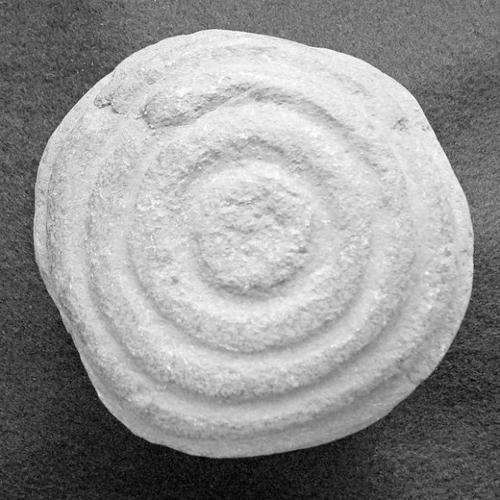
SIERRA VISTA — A mysterious "circle stone" is puzzling archaeologists who unearthed it with an ancient village in Sierra Vista's west end.
"You don't find little pieces of rock art like that very often," archaeologist Avi Buckles said.
The stone has caused a buzz of amazement and speculation among his peers.
Buckles works for WestLand Resources Inc., an Arizona engineering and environmental consultancy firm that has been studying the site for more than a year. The company has offices in Tucson and Phoenix.
Bill Deaver, a senior archaeologist and principal investigator with WestLand, walked among the still-exposed ruins recently and described what is believed to be a desert Mogollon community that preliminary analysis indicates existed from about the time of Christ until A.D. 600.
People are also reading…
Deaver estimated 200 people may have occupied the tiny village during those centuries. At any point in time, no more than one or two families lived there, with a family of four or five people dwelling in a "prehistoric frame-and-stucco" house built partially below ground level.
"What we found are mostly pieces of broken plain brown ware and plain red pottery," Deaver said. "We didn't find any painted pottery here. The material culture here is quite basic. There's not a lot of elaboration with it."
The archaeologists also found a lot of broken chipping debris from tool-making but found few tools. They found grinding implements, which were "pretty rudimentary," Deaver said, noting the Mogollon are known for having a longer reliance than other cultures on hunting and gathering. They subsisted on grass and native plants: acorns, walnuts, grass seeds and cactus fruits. Arm bracelets made from seashells pointed to known trade corridors.
The archaeologists are not ruling out the possibility that the villagers were growing and grinding corn. In the Tucson area, from 1200 B.C. until the time of Christ, there was significant reliance on corn as part of the diet of the indigenous culture, Deaver said.
But, he added, "up here," in the chaparral grasslands, "I would put this under the rubric of the Mogollon culture."
Exactly what the people in this village ate, as well as other specific information, remains to be precisely known. There is much analysis and study to be done by WestLand in the months and years ahead.
Mark Chenault, WestLand's archaeology program manager, said of the ceramics, "Because this is plain ware, it indicates it's early, but it doesn't tell us a precise date yet, so we're waiting to run our archaeo-magnetic dating samples and our radiocarbon dating samples to get a better calendar date for the occupation."
Archaeology is like solving a puzzle with more pieces missing than there are pieces in hand.
One tantalizing piece that you can hold in your hand is "the circle stone," as WestLand archaeologist Christine Jerla calls it. It's roughly the size of a softball, and one hemisphere has concentric circles carved in relief. The motif is reminiscent of the relatively common spiral petroglyphs found etched on rock faces in Arizona.
The circle stone is just one of more than 700 features found at the site, Deaver said.
About 20 boxes of artifacts were found at the site, which is known to archaeologists by the name given to it by developers Karol George and Dick Pino, Summit Heights. It is a pending new-homes development on 40 acres.
George said he and Pino have spent about $240,000 to comply with U.S. Army Corps of Engineers regulations. The archaeological diversion also will cost the developers a curation fee of $600 per box of artifacts, unless the developers are established customers billed under a grandfathered rate that is just under $600, Jerla said.
Deaver showed reporters the remains of one excavated pit house. To the untrained eye, there isn't much there.
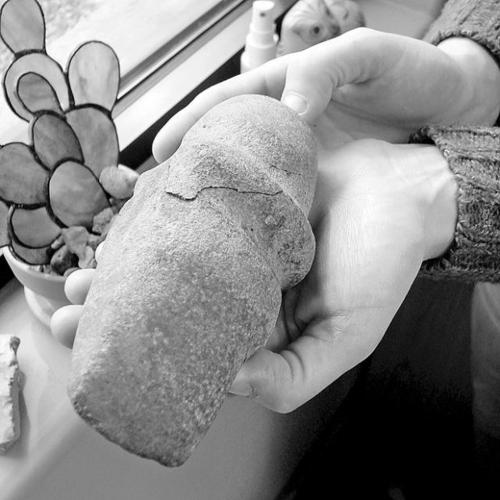
One of the artifacts found on the site — a three-quarter-groove ax — was likely used in the construction of homes. The ax was slightly cracked by a backhoe during the excavations.
"Human intelligence hasn't really changed for ... 100,000 years, or depending on what you believe in terms of when people came around," Deaver said, "but at least for the last 10,000 years our capacity for knowledge is the same ... our intelligence. ... What has changed is our technology."
 Japanese company invests in mine near Mount Lemmon