

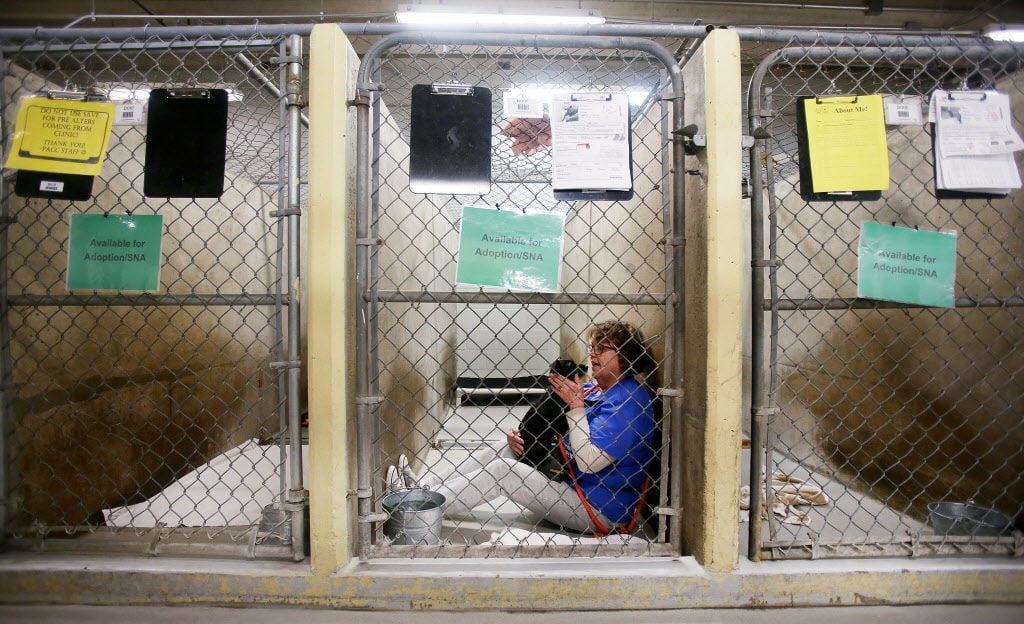
Tucson and Pima County have reached an agreement after months of arguing about how to pay for animal-control services, but it’s still not clear where the money will come from.
The city budgeted $3.7 million for animal-control services next year. The county says the services will cost the city about $4.9 million.
City leaders will rely on donations and grants to fill part of the gap. They’re also counting on higher revenue from licensing fees, both by getting more people to license their pets and by increasing the cost to buy a license, totaling about $150,000 in the coming fiscal year.
If those sources don’t cover the difference, the city will negotiate a reduction in enforcement services to keep the bills lower, said Interim City Manager Martha Durkin.
The city and county reached a good compromise in the new one-year contract, Durkin said.
People are also reading…
The current agreement, which covers enforcement, licensing, education and animal care, expires next week. The City Council approved the new contract Tuesday.
The county agreed to waive administrative fees it had charged the city, which the city said it didn’t owe because the fees weren’t part of the contract for services, but the city will pay them going forward. Those fees are about $23,000 a month for the city.
The city agreed to pay the county $238,050 for its share of building a temporary tent structure the county needed to house overflow animals instead of killing them. That’s in addition to the city’s share of the tent shelter’s operating costs.
The money also will come from savings from lower-than-expected debt payments, Durkin said.
Officials from both sides also agreed to quarterly meetings about the Pima Animal Care Center. About 55 percent of animals at PACC come from the city.
Civano land sale, other council action
The council also took action on the following items.
- The city will sell a 168-acre parcel of city-owned land near Civano on South Houghton Road to help balance the budget for the fiscal year beginning July 1.
Trails and trail access at popular mountain-biking area, Fantasy Island, will be preserved, said Councilmember Shirley Scott.
- The procurement code will be changed to remove a policy that gave Tucson businesses preferential treatment in the bidding process. The change follows a court ruling last year that found the policy in violation of state law, said city procurement director
- Marcheta Gillespie
- .
Two local companies benefited from the policy during the 22 months it was in effect, she said. O’Rielly Chevrolet won a $347,000 contract for police vehicles and State Industrial Supply won a hardware contract worth $25,000 a year.
- Two applications by downtown developers to receive an eight-year government property lease excise tax incentive will advance to the economic analysis phase. For developers to qualify for the incentive, the analyses must show the benefit to the city is greater than the tax break.
The projects are a mixed-use building with apartments and retail spaces at One West Broadway and three-story row houses at 201 S. Stone Ave.
- Comcast will receive up to $180,000 in city tax incentives for creating high-paying managerial jobs at its new call center.
Under the Primary Jobs Incentive program, employers must create at least 25 new jobs that pay at least $52,400.
The Comcast project creates 40 new jobs that pay above that threshold.
The council will finalize the terms of the incentive agreement in a future vote.
- City staff will begin collecting petition signatures to annex 95 acres of land in the Tucson Auto Mall area. Once inside the city limits, the city expects to collect an estimated $921,268 in new revenue from the area, which includes three auto dealerships, Copper Point charter school, offices and homes.
- The city will spend an estimated $7.4 million to house inmates at the Pima County jail next fiscal year, a 7 percent increase.
- Property tax levies were set at 53 cents per $100 assessed value for the primary property tax and $1.06 per $100 assessed value for the secondary property tax. The 13.5-cent increase will cost the owner of an average $150,000 home about $20 more per year.
Contact reporter Becky Pallack at bpallack@tucson.com or 573-4346. On Twitter: @BeckyPallack

Becky Pallack
Product manager
 $25M distribution center to be built in Tucson


