

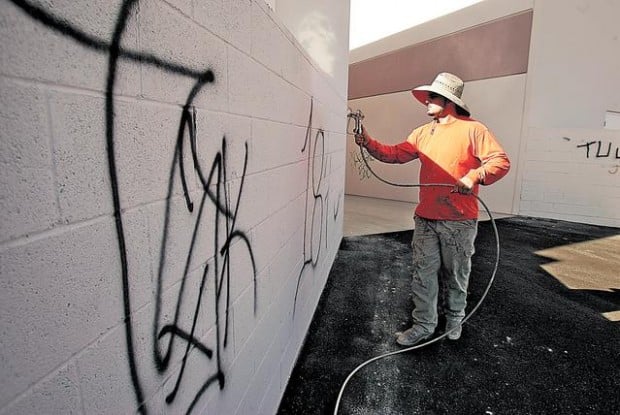
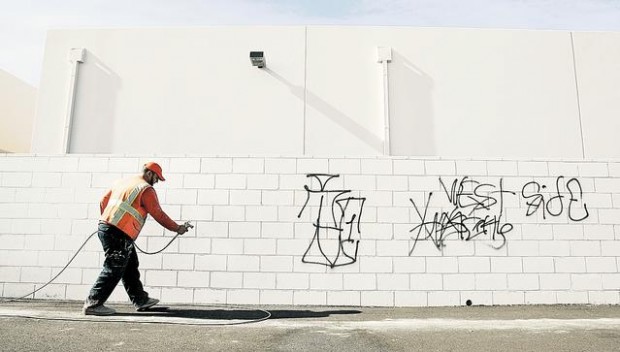
Tucson's effort to quickly paint over graffiti might be causing a backlash.
Officials at the city's Department of Neighborhood Resources worry that vandals might be striking back with extra intensity after the city cleans up the graffiti, Community Services Director Levonne Gaddy said.
In the past three months, reports of graffiti have spiked on certain days, Gaddy said last week.
Usually, the city gets between 40 and 50 reports of graffiti every day. But on a day in mid-October, there were 107 reports, Gaddy said. On a day in mid-November, 109 calls came in, and again in mid-December there were 137 calls, she said.
Another spike could be on the way — as the department received 90 calls on Wednesday, she said. Graffiti Protective Coatings, the company that's got a contract with the city to clean the tagging and graffiti, was working through Thursday to clean the vandalism, she said.
People are also reading…
"We're wondering if there's a reaction to this speedy, thorough cleaning we're doing," she said.
Weather permitting, the city tries to clean up graffiti within 48 hours, Gaddy said. And with the cost of cleanup at 25 cents per square foot, and an expected 2.5 million square feet of surface defaced by graffiti expected this fiscal year, that's $625,000 required to clean up the vandalism to private property, she said.
Two-thirds of that money comes from the city's general fund, Gaddy said. The additional third comes from state Highway User Revenue Funds, she said.
Sgt. Fabian Pacheco, a spokesman for the Tucson Police Department, has a different opinion, saying quick cleanup has the opposite effect on the spread of graffiti. The sooner you remove it from a surface, the less likely it will be that it will return, he said.
Gangs use graffiti to mark their territory, and sometimes young vandals do it because they want to see their names displayed on walls, Pacheco said. In Tucson, it appears that the latter is more common, and most graffiti is not linked to gang activity, he said.
Lorraine Stockdale, 54, lives in the Dunbar Spring neighborhood, west of North Stone Avenue between Speedway and Sixth Street. She has been working to clean up graffiti for the past year and a half, she said.
In Stockdale's part of the city, just north of Downtown, the vandalism appears to be the result of "warring neighborhoods" trying to leave their mark, she said. One group of vandals will deface a wall, and then another group will write over it.
Stockdale said that when she saw graffiti, she would get "a sense of fear, and then irritation and anger. We're really proud of this neighborhood.
"It feels offensive and aggressive," she added. For that reason, she became certified by the city to remove graffiti around her neighborhood. It's made a difference, she said.
Stockdale's neighborhood includes some industrial areas that create larger canvases for graffiti, and she has noticed an increase in larger messes. She said the city likes to take care of those cases.
It's important that people to report acts of vandalism while they're in progress, if possible, and if they recognize the vandals involved, identify them to police, Pacheco said.
"This is not something that the Tucson Police Department alone is going to solve on its own," Pacheco said. "It requires a partnership with the community, so they play a part in the abatement of graffiti."
Did you know . . .
After a rash of vandalism involving the use of glass-etching chemicals to create graffiti, the Tucson City Council in April voted to regulate those chemicals in the same way that rules deal with spray paint: prohibiting the sale to those younger than 18; requiring placement behind a store counter or within sight of a cashier; requiring identification from buyers younger than age 26; and forbidding their sale at swap meets and garage sales.


