

Walk down the main corridor of the University of Arizona's Engineering Building and you come to a wired-glass window behind which is a control room.
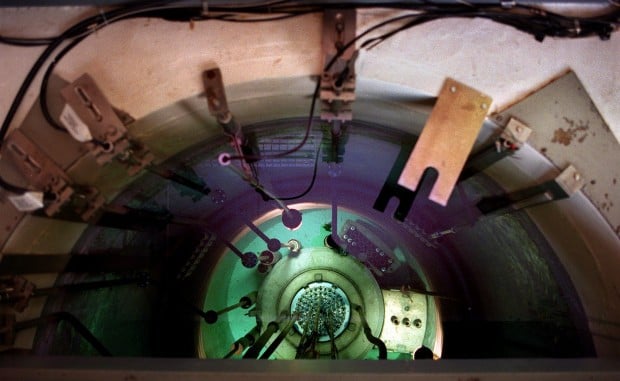
About 10 feet beneath you is the top of a pool containing the core of a nuclear reactor. It's been there for 52 years, right in the middle of the most densely peopled part of Tucson.
"For fifty years, it was perhaps one of the best-kept secrets on campus," said retired nuclear-engineering professor Morris Farr. "Thousands of people strolled by on a daily basis. Very few realized there was a nuclear reactor there. We liked it that way. We didn't want to attract attention."
The real secret of this reactor, though, is that you could break into the control room, start throwing switches and turning dials and there is no way you could make anything bad happen.
The TRIGA reactor (see At a Glance below) is "inherently safe." It can't melt down no matter how many operating errors you make.
People are also reading…
That doesn't mean it is totally benign, which is why you couldn't walk down that corridor last week.
The Engineering Building was off-limits, as workers took advantage of the campus' holiday closure to take the first steps in dismantling the reactor - apparently shipping off the spent fuel rods that were removed from the reactor core earlier this year.
Last week's procedures were indeed secret. University officials would not answer questions about what was going on behind the opaque temporary fence they had erected on the north side of the building.
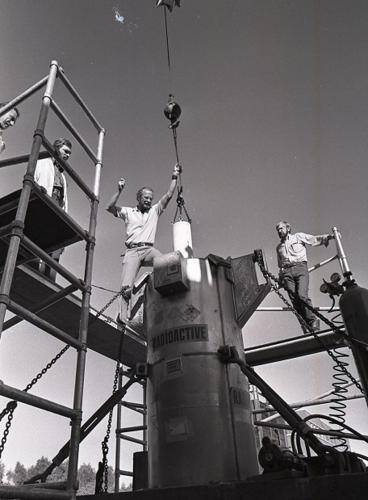
A crane was operating, and a cylindrical metal cask of the type used to transport nuclear fuel rods sat nearby on Tuesday. By Thursday, the cask was gone and a shipping container was strapped to a flatbed truck labeled with yellow-and-black radiation warnings. On Saturday, the fence had been removed and the flatbed truck was gone.
The fuel rods, which are the property of the U.S. Department of Energy, needed to be removed and taken to a disposal site before the UA could begin physically decommissioning its reactor - planning for which began a year and a half ago and completion of which could take up to another year.
The Nuclear Regulatory Commission has yet to approve the UA's decommissioning plan. A contract for performing the job is scheduled for award on Jan. 4.
The reactor and its containment pool - stainless steel surrounded by concrete - must be dismantled and hauled to a disposal site along with a layer of soil beneath it and all the equipment and materials in the reactor rooms.
It will take as much time to decommission the reactor as it did to design, build and install it.
"something constructive"
The General Atomics TRIGA reactor was installed in the basement of the UA's Engineering Building in 1958 and went into operation on Dec. 5, months after the first prototype had been demonstrated in San Diego and less than three years after a group of physicists, mathematicians, chemists and engineers were brought together at a former schoolhouse in San Diego to brainstorm new ways of harnessing nuclear power.
Scientists such as Edward Teller and Frederic de Hoffman, who had participated in development of the atomic bombs dropped on Japan in 1945, wanted to "get away from bombs for a while and do something constructive with nuclear energy," physicist Freeman Dyson wrote in his book "Disturbing the Universe."
Dyson, then a brilliant young physicist with no nuclear-engineering experience, joined a team headed by Teller, who had become known as the "father of the H-bomb." The team's task was to design an "inherently safe reactor" that didn't rely on engineering systems to prevent a meltdown of its radioactive core.
Dyson proposed placing hydrogen in the fuel rods themselves, on the theory that warm hydrogen would impede a chain reaction.
Dyson, in a recent telephone interview from his office at the Institute for Advanced Study in Princeton, N.J., downplayed his breakthrough concept. "The physics was quite easy," he said. "The chemistry was hard."
"The hero of the whole thing was Massoud Simnad, the Iranian who actually did the chemistry," said Dyson. "Iranians can be very good nuclear engineers, as we're finding out," he said.
John Williams, director of the UA Nuclear Reactor Laboratory, said Dyson's insight was the critical ingredient. "The genius of this design is mixing the moderator into the fuel," Williams said. "And it's foolproof, idiot-proof if you like, because it relies on laws of nature, not engineering safeguards."
Dyson, who still keeps daily office hours as an emeritus member of the faculty at the Institute for Advanced Study, said he takes "great pride in the fact that we designed it, licensed it, manufactured it and sold it all within two years. Nowadays you have to have 10 lawyers for everything you do. The whole society is grinding to a halt."
He also takes pride in the safety record of the TRIGA reactors, which continue to live up to their "inherently safe" label.
General Atomics is still producing upgraded versions of the reactors and has sold more than 60 of them.
"Atoms for peace"
At the UA, the reactor became the basis for a Nuclear Engineering Department that grew rapidly after its installation.
Retired nuclear-engineering professor Robert Seale came to the UA in 1961. He credits Tom Martin, the dean of engineering, for recognizing the opportunity.
President Dwight D. Eisenhower's "Atoms for Peace" program and the newly created Atomic Energy Commission were "trying to get nuclear technology into the universities," Seale said. The university simply had to provide the space and commit to hiring faculty.
Under department head Lynn Weaver, the department quickly grew to eight to 10 faculty, said Seale. Seale later became department head, stepping down just before plans were hatched to eliminate the program.
"We were always a small department, didn't have a lot of students," he said. When former UA President Manuel Pacheco went looking for places to cut during budget trouble in the early 1990s, nuclear engineering became a target.
"The UA administrators are nose-counters," Seale said. "I guess the Legislature has forced them to be that way."
Only two faculty remain from the Nuclear Engineering Department: Williams, who teaches in the department of aerospace and mechanical engineering and is director of the UA Reactor Lab; and Barry Ganapol, who also teaches in AME.
The loss of the department was a big influence on the decision to stop operating the reactor, said Williams.
State of the art no more
The UA's license to operate expired this year, and the Nuclear Regulatory Commission would want a demonstration that the UA could suitably maintain the reactor for the 20-year extension period. "Really, the answer to that is 'no,'" said Williams. "Our infrastructure is going away. We used to have professors and students and curriculum and people knowledgeable about nuclear energy," he said.
The reactor would also need "new systems and upgrading," he said, something UA administrators were not willing to do.
Engineering Dean Jeff Goldberg said the annual expense of operating and securing the reactor is no longer justified.
"Once we lost the student mission, the only real use of that thing was research, and it's 50 years old. So it's no longer state-of-the-art, so why would we have that thing?"
Leslie Tolbert, UA vice president for research, said the reactor's research capabilities are limited. "It's an aging reactor with not a lot of real use."
Tolbert said the UA was spending $175,000 a year to secure and operate the reactor. The cost of decommissioning it should be around $2 million.
Fears of sabotage
Edwin Lyman, a senior staff scientist with the Union of Concerned Scientists, said the decision to decommission the reactor is overdue.
His organization has been worried about research reactors on college campuses ever since the terror attacks of Sept. 11, 2001.
You can't make a bomb with the low-enriched uranium in the UA reactor's core, he said, but "a saboteur who knows what he or she is doing could cause a terrible accident."
The Union of Concerned Scientists has been lobbying for greater oversight of research reactors by the NRC and urges consolidation of academic research in locations removed from population centers with tighter security.
AT A GLANCE
The UA research reactor is a light-water reactor fueled with 20 percent enriched uranium in a zirconium hydride matrix.
The power generated by it is only enough to power 100 hair dryers.
The reactor is called a "TRIGA" reactor, a trademark standing for Training Research Isotope-production General Atomics. The UA facility was the first of more than 60 TRIGA reactors installed worldwide.
The UA reactor has been used for reactor- dynamics research; neutron-activation analysis of mineralogical samples - especially meteorites; radiation-effects testing; processing of electronic materials; and isotope production for biomedical and other research.
SOURCES: UA News, John Williams
Contact reporter Tom Beal at tbeal@azstarnet.com or 573-4158.


