

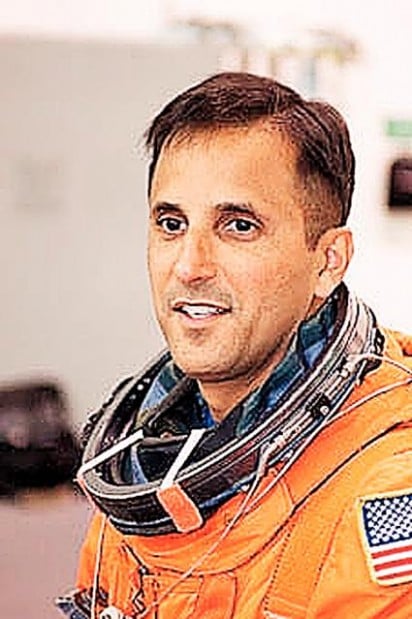
In a thundering rumble and giant plume of smoke, a University of Arizona graduate soon will begin a journey that's out of this world.
His destination — the International Space Station, 200 miles above Earth's surface.
Astronaut Joseph Acaba is scheduled to launch on March 12 from NASA's Kennedy Space Center in Florida as a mission specialist for STS-119, NASA's 125th space shuttle mission.
Acaba, 41, earned a graduate degree in geology from the UA in 1992 after moving to Tucson from California.
In an interview with NASA, Acaba said it was a dream come true when he learned he'd be a part of the mission.
"It was kind of that same feeling that I got when I received the phone call asking me if I wanted to come and become an astronaut — just something that's almost unbelievable, the realization of a dream and just a very happy moment," he said.
People are also reading…
UA faculty members also are thrilled to see another Wildcat in space.
"It's fabulous," said Karl Flessa, head of the UA's department of geosciences. "We're proud of him," he said, adding that he also was excited to see someone with a geology background headed into space.
In a UA press release, Acaba described his time in Tucson as a great experience, particularly because he's interested in the outdoors and geology.
"The UA has a phenomenal department, and it solidified what I had learned as an undergraduate," he said. "I didn't want to leave Tucson, but for employment purposes, I had to. Life leads you in different directions."
Acaba still keeps in touch with his college adviser and thesis director at the UA, Joseph Schreiber Jr., who is now retired.
When the UA graduate called to tell him about the mission, Schreiber said the news didn't catch him off-guard because he always knew Acaba was destined for greatness.
"I wasn't too surprised at all. He has a lot of talent," he said. "You bet I'm proud of him."
After graduation, Acaba left Tucson to teach math and science at a high school and middle school in Florida.
He was selected as one of three educators to become mission specialists in 2004, and he completed his astronaut-candidate training in 2006.
Acaba will be one of seven crew members aboard space shuttle Discovery for a two-week mission to install a final set of solar arrays on the International Space Station.
The power-collecting arrays will be connected perpendicular to the Space Station's truss — a beam consisting of 11 segments that together exceed the length of a football field.
Installation of the arrays, which have a total wingspan of 240 feet, and a final truss segment will compete construction of the station's backbone.
Another duty will be slightly less glamorous. The STS-119 crew will install a replacement unit for the broken urine-processing assembly — a device that recycles astronauts' urine on the Space Station.
As a mission specialist, Acaba is scheduled to take part in two of four spacewalks during the mission, working outside the station in the vacuum of space.
STS-119 will be the first space shuttle flight of 2009. It will be Discovery's 36th flight and the 28th space shuttle flight to the Space Station. Eight other space shuttle missions are scheduled before the shuttle program is retired in 2010.
"All the shuttle missions are important. We're trying to complete the International Space Station before the shuttle program is retired next year," said Katherine Trinidad, a NASA spokeswoman.
"The last set of array wings will allow us to fully power up the science operations on the station for the first time."
In the NASA release, Acaba also spoke of the importance of the work he's embarking upon.
"I think it's going to be neat to pull away and see the station in its new configuration with the new solar arrays out there," he said. "I think like anyone who may work with their hands — whether you're working in construction or a medical doctor — when you finish a job, you really feel fulfilled."
The mission originally was slated to launch on Feb. 12, but there have been concerns about the shuttle's hydrogen control valves, which move gaseous hydrogen from the main engines to the external tank. The March 12 launch date is still tentative.
While NASA runs tests and inspections on the valves, Acaba and the crew have been conducting extra practice and training for the mission.
It also might be giving him a chance to think back on his time in Tucson.
In the UA press release, Acaba waxed nostalgic about another aspect of the UA — the athletics.
Comparing the UA with the University of California-Santa Barbara, where Acaba was an undergraduate, he said: "The Wildcat fans are definitely a couple of notches above. It was quite an experience, especially going to the basketball and football games."
DID YOU KNOW
Joseph Acaba won't be the first UA grad in space.
Thomas Jones, a veteran of four space flights, earned a doctorate in planetary science from the UA in 1988. He has logged more than 52 days — 1,272 hours — in space, including three spacewalks that totaled more than 19 hours.
Don Pettit, a veteran of two spaceflights, earned a doctorate in chemical engineering from the UA in 1983. Pettit has logged more than 176 days in space. He lived aboard the International Space Station for more than 5 1/2 months in 2002-03.
The late Richard "Dick" Scobee received a bachelor's degree in aerospace engineering from the UA in 1965. He logged 168 hours in space. Commander Scobee died on Jan. 28, 1986, when space shuttle Challenger exploded shortly after launch.
Sherwood "Woody" Spring earned a master of science degree in aerospace engineering from the UA in 1974. Spring was selected as an astronaut in 1980 and has logged 165 hours in space.
And although he's not a UA graduate, no list of astronauts with Tucson ties would be complete without Frank Borman, the Tucson High School graduate who was one of the first three people to orbit the moon as commander of Apollo 8 in 1968.
Source: Johnson Space Center
mission details:
Go to www.nasa.gov/external flash/STS119_flash for an interactive timeline of the STS-119 shuttle Discovery mission.


