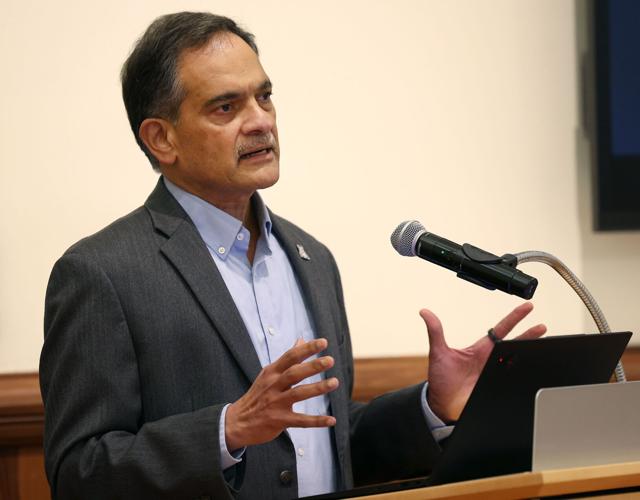
UA President Suresh Garimella speaks during Monday's Faculty Senate meeting.
After reports of the University of Arizona’s fall 2026 first-year enrollment dropping, President Suresh Garimella said that amid the “noise,” there hasn’t been a “substantive change” in the number of first-year undergraduates coming to the university over a number of years.
“I want to clarify something, which perhaps eludes the superficial look at these numbers,” Garimella told faculty and administrators at the first Faculty Senate meeting of the new academic year Monday.
“There has not been a substantive change in the number of fully, academically qualified first-year undergraduate students enrolling in the university over a number of years,” he said, not providing specific figures or definitions. “We’ve looked at the numbers. … We’ve been pretty much — within the noise — at the same pace and that continues this fall.”
According to internal university data the Arizona Daily Star obtained in August, as of two weeks before the semester started, the UA numbers indicated a nearly 23% drop in first-year undergraduate students in fall 2026, after a 19% decline last year. The expected class of first-year undergraduates this year was approximately 5,800 in early August, the internal data showed, down from 7,500 in fall 2025 and 9,300 in fall 2024.
People are also reading…
In his Faculty Senate talk Monday, Garimella addressed UA’s admissions and application process changes. The university instituted a hard deadline of Nov. 1 last year and then continued to accept applications through the spring on a rolling basis. He said it takes a while for counselors and colleges to adapt to the changes, but that he knows the UA is better prepared this year “with the systems and tools in place.”
The Faculty Senate meeting brought a contentious back-and-forth between Garimella and UA Faculty Chair Leila Hudson. The two leaders painted two very different versions of UA highlights, Faculty Senator Keith Maggert commented to fellow senators.
Garimella’s report to senators included listing certain achievements made by the university as it enters the new academic year, including getting rid of the massive budget deficit from the 2023 financial crisis, continuing to keep tuition and fees for in-state students flat over the last three years, increasing student retention and graduation rates, and more.
He said UA’s retention and graduation rates, with the help of the faculty, are now the “highest on record,” which he said was not an “empty KPI,” or key performance indicator.
This was in response to Hudson saying faculty leaders have a “slightly different perspective” on what to focus on than "the shiny KPIs, metrics and plans” that administrators consider important.
UA’s current one-year retention rate stands at 83.2%, while its four-year and six-year graduation rates stand at 57.2% and 70.9%, respectively, university data shows.
In September 2025, UA Provost Patricia Prelock said she wants to increase student retention by 2% each year over the next three years so UA gets to 90%, and to increase graduation rates by 2% over the next five years so they reach 65% for four-year graduation and 85% for six-year graduation.
“It is not an empty KPI, it’s not an empty number. Sorry Leila, this is extremely important,” Garimella said in a firm tone during his report. “Universities in Arizona have had a shameful number for retention and graduation. It is something that I will focus on, and I’m so glad that our faculty helped with that.”

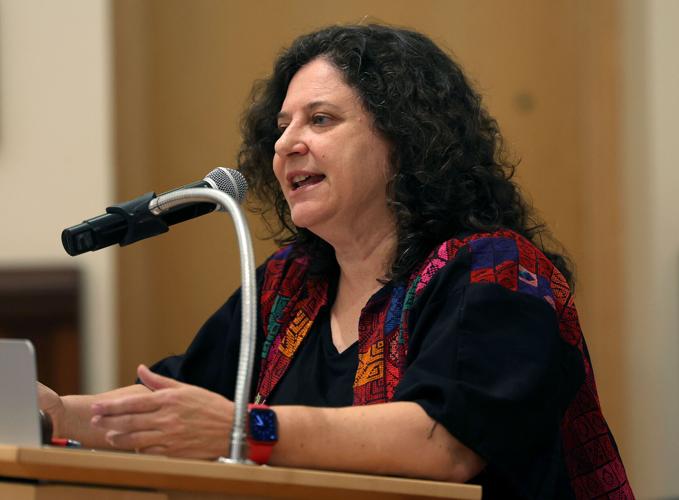
Leila Hudson, chair of the UA faculty, speaks during the Faculty Senate meeting Monday.
Hudson made the comment while discussing her disapproval of what she called the UA’s “corporate-style leadership that bypasses faculty governance and indeed violates the shared governance law,” a state law that mandates faculty representatives are to be consulted in “academic and education activities and matters related to faculty personnel.”
“It more importantly affects our reputation, our morale and our finances,” Hudson said in her speech at the start of Monday's meeting.
“I just came from the KPI leadership forum where we got a very nice ‘overview’ of the things that are going right as we try and set metrics by which to evaluate ourselves,” she continued.
“Here on this (faculty) side, we’re a little more gritty and human. We’re the place where policy meets the road and we have a slightly different perspective than the shiny KPIs, metrics and plans that are rolled out for the selected university leadership. We’ve become familiar with several different techniques for bypassing faculty governance to make policy without community consultation — especially the faculty participation mandated by law and tradition.”
Garimella reported that UA’s yield rates, which refer to the percentage of students who accept a university’s offer of admission once they apply and get in, is higher across-the-board for in-state, out-of-state and international students.
While he didn’t give specific percentage rates Monday, in May, Provost Prelock told faculty senators that the yield rate for Arizona residents this year is 45.6%, up from last year’s 39%; the rate for non-resident students is 11.2%, higher than last year’s 10.3%; and for international students it is 12.7%, compared to last year’s 10.8%.
On the online side, Garimella said Arizona Online’s yield rates are up by 7% while the University of Arizona Global Campus' first-year retention rate has risen by 15% since 2023, bringing it to 53% this year. “I’m very proud of what the UAGC is trying to do,” he said.
Garimella also introduced a new “optimization tool” as part of efforts to strengthen the UA’s partnerships with community colleges, including Pima Community College, Arizona Western College in Yuma, Cochise Community College, Maricopa Community Colleges and more. He said the mission is to avoid having students lose academic credits when they transfer from a community college to the UA, where he said students can lose up to 30 credits.
“Thirty credits is one year of tuition, it’s one year of time, and we want to make that zero,” Garimella said.
“And we’re doing that by this optimization tool we’ve come up with, which has the curricula of all these community colleges uploaded there,” he continued. “And so, students can choose what courses they want to take at Pima for their first year and move over here in the second year. I think that’s a great thing for them to do. It’s part of our engagement mission, it’s part of our students’ success mission. And many studies, many data results have shown that community college students who transfer to a four-year college graduate and retain at higher rates.”
Garimella said PCC and Arizona Western College, among others, are very interested in working closely with the UA. He said the additional piece in these partnerships is the financial difference it makes to students, since they pay less at community colleges before transferring to the UA.
“One of my goals in fundraising is to try and raise money to support these students who are coming over from community colleges,” he said.
On the topic of university research, he said the UA’s research awards have gone up by 17%.
“This is at a time that there’s such strong federal headwinds for research funding,” Garimella said. “I credit our research faculty, our staff, our students that are working so hard to get there, and of course our Office of Research and Partnerships. … We’re trying to diversify the pie so that even as federal headwinds are challenging, we’re able to maintain our research portfolio.”
Finally, Garimella notified the Faculty Senate of a Stanford University analysis that listed the UA in third place nationally among universities that are the most effective producers of billion-dollar startups. “Who knew,” Garimella said, that the UA is ahead of Stanford, the Massachusetts Institute of Technology and “all these other places that you like to quote.”
The testy tone of Monday’s meeting started with Hudson addressing a slew of changes instituted at the UA during the summer, typically a time when faculty, staff and students are off, and Faculty Senate doesn’t meet for its monthly meetings. She discussed large-scale changes including dismantling UA’s Health Sciences enterprise and distributing its functions to different parts of the university, and transferring $70 million in endowment interest payouts from the UA Foundation to UA’s legal ownership.
“Selecting a handful of faculty to communicate with the leadership doesn’t supplant the role of all of you who are elected by your peers,” the faculty chair said, addressing the senators.
“After the most successful administration and faculty governance collaboration of President Garimella’s tenure, we fought the (U.S.) Department of Education ‘compact’ in fall (2025) together and President Garimella consulted with many of us in the way that faculty governance is supposed to work,” she said.
Hudson was referring to the Trump White House's “Compact for Academic Excellence in Higher Education,” which was first given to nine universities including the UA in fall 2025. Garimella and administrators consulted with faculty and the overall university community before declining to sign it.
In response to Maggert’s comment on different pictures being painted by Garimella and Hudson, Garimella said there were “several inaccuracies” in what Hudson said and that he won’t point them out one by one. He said he was surprised by some he said weren’t factual that are things Hudson “should know” about.
“I’m happy to get questions from the Senate in writing and I’m happy to address those,” he said before stating he had another meeting that he had to leave for.
For her part, Hudson ended her speech by saying the UA is heading in the “wrong direction” on the shared governance and corporate-style leadership front she talked about, and said there’s always a way out of the culture of “fear, control, extraction, and corporate bureaucracy."
“It is traditional faculty governance,” she said. “It is a feature, not a bug (and) in spite of my blunt words today, my hand remains outstretched to the administration.
"Since it looks like you’re going to be here a little longer than you anticipated, President Garimella, let's turn the page and work together," she said.
When asked later by the Star to clarify what she meant by this comment, Hudson declined. Garimella arrived at the UA as president on Oct. 1, 2024.
Hudson told the senators she was pleased to hear about all the different successes that Garimella listed in his report to the Senate, but that her issues are related to a larger context of whether or not the elected representatives of the faculty are sufficiently consulted in decisions. This would make those successes more powerful and collaborative, she said.
Hudson said it would’ve been “lovely” to start out the new academic year “on a completely positive note of harmony and collaboration.” Unfortunately, she said, the events of the summer and late spring make it "contentious" and led faculty members to want a dialogue with the administration.
“The fact that it’s contentious is not the end of the world. In fact, this is the way that dialogue happens,” Hudson said.
“We start by speaking out honestly and bluntly, even if that is sometimes uncomfortable. And my offer to the Garimella administration has been consistent and remains on the table, which is if we don’t talk about things in a serious, consultative way behind the scenes, the only thing left is to engage in these little contentious meetings in public."
Reporter Prerana Sannappanavar covers higher education for the Arizona Daily Star and Tucson.com. Contact her at psannappa1@tucson.com or DM her on Twitter.

Prerana Sannappanavar
Higher Education Reporter