

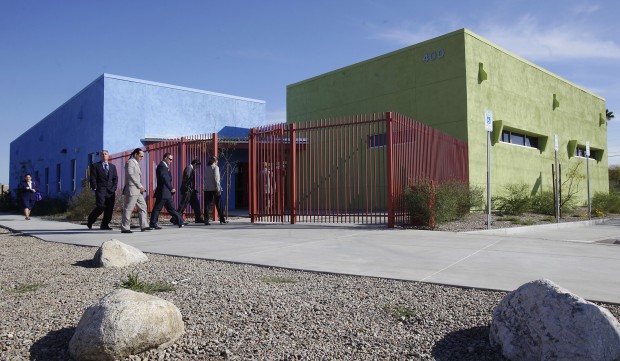
The Sullivan Jackson Employment Center - a blue, green and gold stucco building on East 26th Street in South Tucson - doesn't look architecturally significant. But it is the first Pima County facility built to the "green" standards set by the LEED program of the U.S. Green Building Council.
Its modest appearance is by design, said Phil Swaim of Swaim Associates whose partner, Kevin Barber, is the building's architect.
It serves the homeless seeking work and sits amid subsidized housing units, down the street from a soup kitchen where the homeless and hungry gather daily.
"We didn't want a building that would look extravagant. It had to be respectful to the clients who come in, but there was no reason to be opulent," Swaim said.
"The building is designed perfectly for the work we do. It's a wonderful place," said Steven Nelson, program coordinator at the center.
People are also reading…
"This building makes our homeless clients feel like they are respected, and they are grateful that the people of Pima County are interested in seeing them get back on their feet and go to work."
Opulence, of course, is a relative notion. Compared with the now-demolished former bakery two blocks away that once housed the center, the new building is a palace, Nelson said.
Its L-shape encloses a shaded patio. On one side of the L are offices for the social service workers whose job is to teach the homeless how to identify their skills and find a job. The other side is devoted to classrooms, a computer center and a phone center where the trainees put those newly learned skills to work.
The building features all of the simple things that can be done to qualify for LEED certification. LEED stands for Leadership in Energy and Environmental Design.
It is well-insulated and sited to deflect heat on the east and west sides.
It has low-water-use fixtures and landscaping. The lights are motion-sensitive, the windows double-glazed.
The goal was to win a "silver" LEED rating. The county was recently notified that it had been certified at the higher "gold" level.
And it came in under budget, said Reid H. Spaulding, director of the county's Facilities Management Department.
Total cost for the 6,500- square-foot building was $1,593,000, which included furnishings, LEED commissioning, moving expenses and demolition of the old facility, Spaulding said.
He said meeting LEED requirements and gaining certification added about 2 percent to the cost of the building, but its low water and energy use will recoup that quickly.
Photovoltaic panels on the roof, provided through a program financed by Tucson Electric Power ratepayers, will take care of 8 percent of the building's energy needs, he said.
The economy played a role in keeping the building within budget, Spaulding said. All the contractors' bids came in below the estimates set by the county.
But while the distressed economy helped build a better building, it made services more crucial and tougher to provide, Nelson said.
One measure of the problem: In 2007-08, the average wage of those placed in employment was $10.52. That average is down to $7.85 this year.
The center enrolls 530 to 600 clients in its programs each year, teaming with social service agencies to "stabilize" the homeless, find them housing and support them while they undergo job training and find work.
It is a "continuum of care" model that Nelson said was developed by Jody Sullivan and her late husband, Paul, who ran the center at its previous location for 20 years until his death in 2004.
The new building now bears Paul Sullivan's name, along with that of Eddie Jackson, for whom the previous center was named.
Jackson was a longtime labor leader who became a champion for job training after his Steelworkers union was decimated by the union-busting of the early '80s.
The Pima County Board of Supervisors named the building for both men in a proclamation last month that noted the two were "close friends in effort and in spirit during their lifetimes."
Contact reporter Tom Beal at tbeal@azstarnet.com or 573-4158.


