

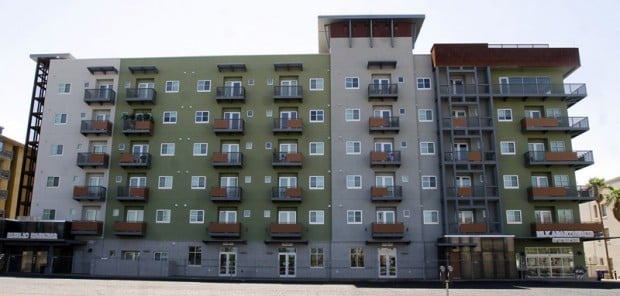
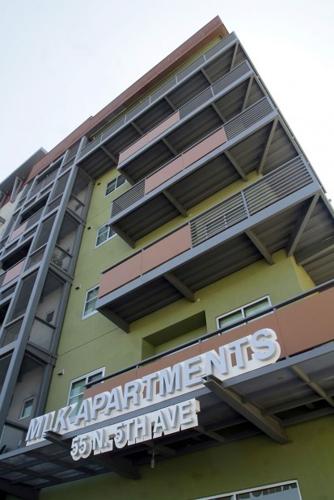
A recent appraisal of the new Martin Luther King Jr. housing project downtown says it is worth less than half of the $23 million the city spent to build it.
The appraisal requested by the state shows the project is valued at $10.5 million.
The state sought the appraisal as a condition of a tax credit sale in which it bought back $8.5 million of tax credits in 2009 after the economy went into recession.
The appraisal doesn’t matter, city officials said, because there’s no plan to sell the building at 55 N. Fifth Ave., just east of the Ronstadt Transit Center.
Plus, city officials note the market value of the property was never a consideration in its application for federal funds to build the project.
“The market value is really irrelevant here,” said Albert Elías, director of the city’s Housing and Community Department. “The funding for this project was never based on its appraised value.”
People are also reading…
Instead, the funding was based on the U.S. Department of Housing and Urban Development criteria for projects that revitalize a community and include public housing, Elías said. Tucson was awarded the funding through a competitive grant application for federal HOPE VI funds because the proposal created new, high-quality public housing units and served to revitalize this historic area downtown, he said.
The city only did the appraisal at this time because the state Department of Housing requires it for the $8.5 million in tax credits they provided, Elías said.
“This is a unique property because it has features related to accessibility and energy efficiency that HUD required be included that you don't find in most housing,” Elías said. “These are all factors that make this particular appraisal not germane when one tries to understand the value of the project to the community.”
The building houses 68 residents in one-bedroom units. All the residents are seniors or people with disabilities.
The market value of the property, as estimated in the appraisal, includes the tax credits the city already has sold as part of the market value of $10.5 million.
The city originally had been authorized to sell as much as $10 million in tax credits for the building, but it exchanged its tax credit allotments back to the state after the 2008 housing market meltdown. Instead the credits sold at 85 cents on the dollar, or $8.5 million. As part of the transaction, the state required an appraisal of the property.
Because the appraisal was done using a “hypothetical condition” that tax credits had not been sold, to get the real market value it would be correct to subtract the $8.5 million in tax credits from the market value, said Tom Baker, of Baker, Peterson, Baker & Associates Inc., who conducted the appraisal. That would make the actual market value in the range of $2 million.
However, Baker noted the property was set up specifically to sell the tax credits, and he said the property severely restricts the rents that can be collected, which limits the market value of a property.
“You get tax credits in exchange for putting restrictions on the property,” Baker said. “That’s what happens with low-income housing.”
Lloyd Construction built the structure after winning a competitive bid. The city used one of the alternative contracting methods that helped fuel huge cost overruns in many Rio Nuevo projects.
The prices reflect the historic depression of the housing market facing the country and Tucson, said Jody Gibbs, a housing advocate.
The building is expensive, at $23 million for only 68 units, or $340,000 per unit. That price does not include more than $17 million Rio Nuevo spent building the underground parking beneath the MLK housing project. The parking garage serves more downtown parking needs than just the MLK project.
By contrast, the new senior housing development built on the west side is a 143-unit building that is expected to cost about $26 million, or about $181,000 a unit.
Gibbs said it’s possible that the market turned so badly that a building constructed for $23 million is now worth only $10.5 million. But housing is such a mess, he suggested, that even though the building is worth $10 million, if you built it right now it couldn’t be constructed for that amount.
He said many people in Tucson are caught in the same trap. Even as housing values plummet and people are pushed out of homes, it’s still not cheap.
“We are in a hell of a mess in this country right now, especially in Tucson,” Gibbs said.
Contact reporter Rob O’Dell at 573-4346 or rodell@azstarnet.com


