

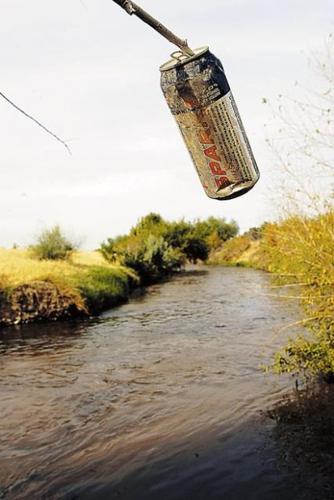
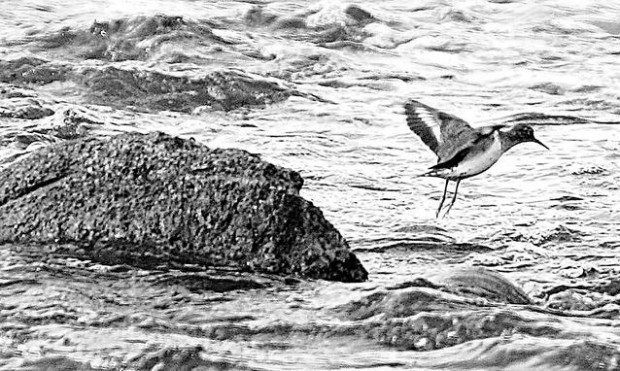
The effluent-fed flows along two stretches of the Santa Cruz River are significant enough to merit the highest protections under federal law, the Environmental Protection Agency said this week.
In a letter sent late Wednesday to the U.S. Army Corps of Engineers, EPA Assistant Administrator for Water Benjamin Grumbles said two portions of the Santa Cruz River — one stretching from Tubac to Continental Road and the other from the Roger Road sewage- treatment plant to the county line — should be considered "traditional navigable waters," a designation that brings with it the highest level of protection under the Clean Water Act.
The letter put to rest months of uncertainty after the Army Corps of Engineers first granted the designation, then withdrew it. In August, the EPA announced it would take on the Santa Cruz River as a "special case" and make the determination itself.
People are also reading…
Local environmental groups lauded the decision even as national environmental groups raised concerns about another EPA announcement about how the Corps of Engineers should make decisions about other ephemeral and intermittent streams.
They said the guidelines did not provide adequate protection for watersheds and called on Congress to pass the Clean Water Restoration Act.
The act attempts to clarify how the Clean Water Act should be applied after a 2006 Supreme Court decision that many regard as confusing.
Carolyn Campbell, executive director of the Coalition for Sonoran Desert Protection, lobbied for the designation and wants the entire Santa Cruz eventually to be protected.
"This was really good news to have back the protections that we lost when the Corps rescinded the designation," Campbell said. "I see this as an important interim step while they study whether the rest of the river should have this protection. I'm very hopeful for the whole river to get the traditional navigable waterway, but with this, all the tributaries should be protected because they all eventually touch these two portions."
Before the 2006 Supreme Court decision, the Corps generally had treated the Santa Cruz River as if it were a traditional navigable waterway. But several opinions issued by the justices supporting their ruling in the case led to confusion about how much water and what kinds of navigation were enough to meet the designation.
Home-builder organizations fought hard against treating streams with intermittent flows, like the Santa Cruz, as navigable waters. Reached Thursday, representatives of the Southern Arizona Home Builders Association and the National Association of Home Builders said they were unaware of the decision.
SAHBA Vice President Roger Yohem said his organization could not comment until its lawyers reviewed the decision.
Environmentalists and some elected officials believe Pima County also lobbied against the designation to prevent a drawn-out permitting process from slowing down county construction projects.
That feeling eased only after the Board of Supervisors in August passed a resolution supporting the designation. County Administrator Chuck Huckelberry said county staff only wanted timely decisions on permits, and he cleared staff of any inappropriate actions.
Huckelberry said Thursday the decision is "fine and what we asked for."
Supervisor Richard Elías, who pushed for the county to support the designation, said he was pleased but the county needs to keep pushing for the entire river to be protected.
Grumbles based the designation on the width and depth of recorded flows in the Santa Cruz, the presence of activities like canoeing and birding along the river and the potential for more water in the river if the Corps moves ahead with restoration projects on the river.
"This is good news for the river and the watershed," he said. "We found evidence from the physical characteristics that it is susceptible to future navigation, and it had been navigated in the past. We feel this decision is on solid ground."
He said the guidelines issued Wednesday for determining whether the ephemeral or intermittent streams common in the Western United States are navigable should help the Corps make decisions about other waterways.
But environmental groups blasted the guidelines as confusing and no improvement over earlier guidelines issued in 2007.
Melissa Samet, senior director for water resources with the group American Rivers, said the EPA made the correct decision on the Santa Cruz, but there is no guarantee that similar waterways will receive the same protection.
"The real question is, how do you protect the headwaters and ephemeral streams because if you don't, you have very serious consequences for the watershed downstream," she said.
Rep. Raúl Grijalva said that issuing the guidelines now is part of a last-ditch effort by the outgoing administration to influence environmental regulations in favor of business interests. He said Congress needs to intervene to make sure the Clean Water Act protections apply where they should.
"The Clean Water Restoration Act is the only way to clean this up," he said.
DID YOU KNOW
The Santa Cruz River flows both north and south, and crosses the international border twice.
The river starts in the San Rafael Valley, near Patagonia, and runs south into Mexico before doubling back into the U.S. near Nogales and traveling north through Tucson to where it peters out near Casa Grande.


