

Susan Wethington specializes in hummingbird tacos.
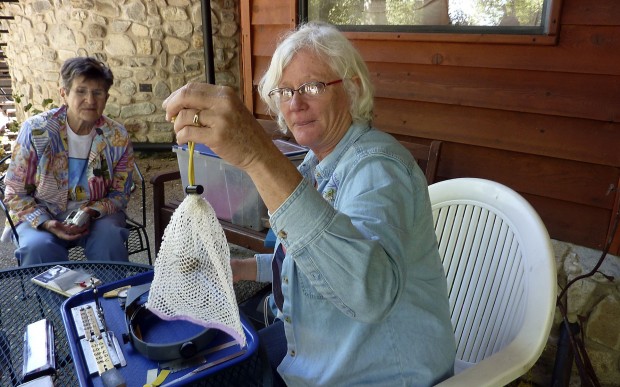
OK, they're not actually tacos, but that's how the little guys look, folded up in a mesh blanket and plopped onto a tiny electric scale at the Chuparosa Inn at Madera Canyon east of Green Valley.
There's a small crowd of onlookers gathered on the bed-and-breakfast porch to coo at the twice-monthly spectacle of ornithological cuteness as Wethington bands, measures, pokes and prods each tiny captive.
Wethington is an avian biologist and executive director of the nonprofit Hummingbird Monitoring Network. Madera Canyon is just one of 30 sites in the network stretching across the U.S. and Canada where scientists and volunteers seek to expand knowledge of the popular species one taco at a time.
The long-term project began in 2002, with the goal of measuring and detecting trends in hummingbird populations. The network hopes to use its results to develop policies that will preserve and protect hummingbirds throughout the Western Hemisphere, the only part of the globe where hummingbirds are found.
People are also reading…
Wethington likens her work to a census, except every subject is guaranteed to not be filling out paperwork.
"We don't get wildlife to give birth certificates or death certificates or even tell us when they move," she said.
So Wethington's enumerators have to go door-to-door, so to speak, where the birds live.
Arizona, and Madera Canyon in particular, is a hotbed for hummingbirds. The U.S. is home to 23 species, but Southern Arizona is home to the greatest diversity of hummingbirds in the nation. As many as 15 species have been identified in Madera Canyon. Nearly a third of the network's monitoring sites are in Arizona, with the majority in the southern half of the state.
Madera Canyon itself is a mecca for all things bird-related. The Friends of Madera Canyon say 256 birds have been documented in the canyon, and the area draws birders from around the country.
This morning is no exception. A motorist headed up the mountain hits the brakes when he sees Wethington's husband, Lee Rogers, manning the hummingbird traps.
"What are you guys doing?" he asks.
His name is Felipe Guerrero. He's an employee with the Rocky Mountain Bird Observatory taking bird surveys in Arizona's national parks and monuments. It's his day off, so he decided to head up to Madera Canyon for, what else, birding.
"I'd be really interested to see you guys have them in hand," he tells Rogers. Guerrero spends the rest of the morning helping the network trap hummingbirds.
"It's funny," Guerrero says. "My work is working with birds, but in my off-time I'm looking for birds."
Trapping hummingbirds isn't difficult, but it takes patience. Rogers, a retired engineer, tends a trap from a lawn chair down the road while his wife takes data at the lodge. The trap is simple, a hummingbird feeder with a galvanized wire basket suspended over it.
If a hummingbird shows up for a drink, Rogers pulls on fishing wire to drop the basket. Then Rogers reaches up into the trap, gently cups the hummingbird in his hand and works the creature into a small mesh bag. He takes the hummingbird up the road and clips it to something like a miniature clothes rack where the bird waits its turn in the carousel.
The only trick is waiting for the birds to show up.
"It's sort of like fishing a little bit," Rogers says.
On the other side of the lodge, 16-year-old Liz Horton tends another set of traps. It's her first time out volunteering with the network.
"It's been pretty slow this morning," Horton says. She's trapped four hummingbirds since 5:30 a.m. They're coming about two every hour.
The network traps at its sites twice a month for five hours at a time, starting within a half-hour of sunrise. Each location traps within the same time frames, using the same protocol.
Horton says she heard about the project through "a friend of friend."
Her parents, both veterinarians in Rio Rico as well as amateur bird watchers, brought her up to appreciate wildlife. So working with the network just seemed like a natural thing to do for summer vacation, she said.
"It's been kind of a family thing to go for a hike and look for animals," she said. "It's a nice little spot here to hang out and enjoy the morning."
Meanwhile, Wethington sits on the porch with a giant pair of optivisors strapped to her forehead. The magnifying glasses are normally used by jewelers, but Wethington finds them ideal for examining the tiny birds.
One by one she pulls each hummingbird out of its mesh bag and meticulously records data for each one, including breed, age, sex, wingspan and weight. Sometimes they flutter a bit in her hands, but mostly they just sit there, like patients getting an annoying but necessary checkup at the doctor's office.
After Wethington measures the birds, she blows on their bellies with a straw to measure any fat and to see if they are molting. Then she takes pollen samples from their beaks and chests.
If pollen is found she makes a microscope slide to be examined later. She wants to know just what the hummingbirds are eating.
If the bird isn't banded, she attaches a tiny anklet with a pair of special banding pliers designed by her engineer husband.
The bands are regulated by the U.S. Geological Survey, which issues permits for bird banding.
"You can't just go out and do this," Wethington says.
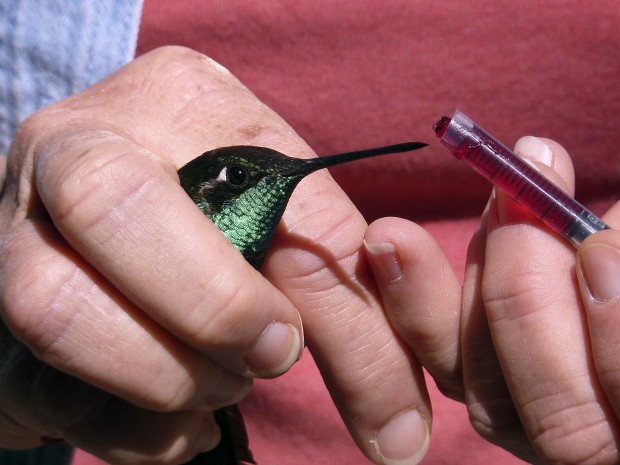
Afterward, Wethington gives the stunned hummingbird a drink from a feeder, holding it between two fingers. Then she lets a lucky onlooker hold the shell-shocked bird in the palm of her hand.
"It feels just like a cat purring," says Mary Ann Eng, who came to see the hummingbirds with her husband, Robert.
"You're the launch pad now," Wethington says, and after a minute or two, the bird takes off.
"This is much closer to them than I thought I'd get," Guerrero says.
So far the monitoring project has produced no shortage of evidence of the hummingbird's impressive range. Birds trapped and banded in Madera Canyon have turned up at monitoring sites in Colorado, Montana and British Columbia, Wethington said.
Twelve of Madera Canyon's hummingbird species are migrants from Mexico, where they spend the winter.
Wethington said she hopes to start monitoring sites in Mexico and Latin America in the near future. The vast majority of the hemisphere's hummingbird species are native to Latin America.
Hummingbirds play a vital role in the ecosystem, Wethington said, so it's important that conservationists understand as much about them as possible.
Hummingbirds pollinate 300 plant species in the U.S. alone, and even more in Latin America, she said.
"Hummingbirds need plants for food and plants need hummingbirds," she said.
Hummingbirds are also sensitive creatures and thus a good barometer for changes in the environment. If hummingbird populations are on the decline, it might be a good indicator something is going wrong, Wethington said.
"I think conserving the great diversity of life is critical. We're all related," she said. "If pollinators are lost, most plants will not be pollinated."
In the meantime, Wethington said the network will continue to expand its volunteer efforts throughout the hemisphere, and she doesn't think it will be hard to bring people into the fold.
"These are a group of animals people particularly appreciate," she said. "I think people would like to know their great-great-grandchildren will be able to enjoy these amazing creatures."


