

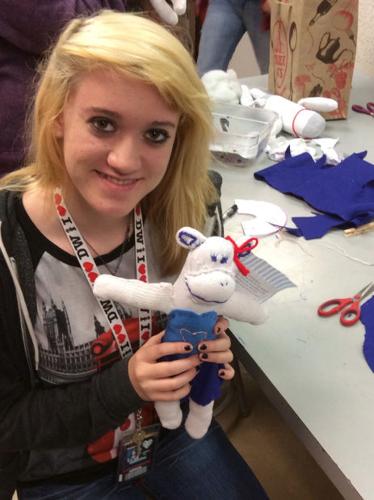
Cross Middle School students are using the healing power of arts and crafts to cheer up ailing children.
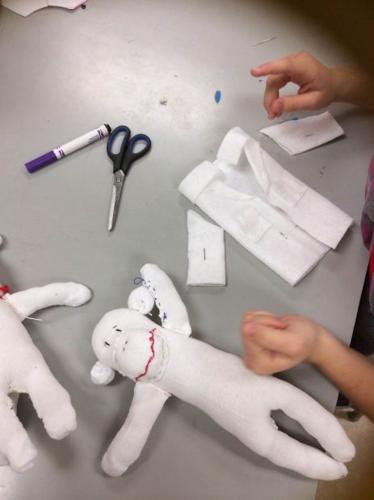
Art teacher Carolyn Reece is having her 125 seventh- and eighth-graders sew monkey puppets out of socks and other household materials to donate to young Tucson Medical Center patients through a partnership with the Children’s Miracle Network. Each student made a puppet.
Reece got Walmart to donate socks for the project.
The Amphitheater Unified School District school is at 1000 W. Chapala Drive.
Reece said the project, which has taken up most of the month, is part of a lesson tied to the Depression, when she says sock monkeys were popularized, as well as the importance of helping the less fortunate and art’s ability to provide comfort.
“Sock monkeys were created in the time of the Great Depression as a charity gift, due to the economic downfall,” she said. “We learned the history of the era and the charity that was necessary.”
People are also reading…
Reece has also taught the students five different stitches and had them create sock monkey posters to ask other students for donations.
The students have embraced the assignment.
“They love it,” she said. “I was apprehensive about sewing and using sharp objects with this many kids, but they absolutely love the fact that they are donating them to children in need. They are completely driven and motivated. It’s completely amazing.”
Josh Figueroa, 14, said the lessons have hit home for him.
“I think it means giving to kids less fortunate that have maybe had diseases that make them incapable of going out and playing with other kids,” the eighth-grader said.
“This project gives them something to play with while they’re at the hospital and not able to go outside because a disease or disability prevents them from doing so.”
Mikayla Bull, also 14 and in the eighth grade, said she appreciates Reece’s class.
“I think she’s a great art teacher,” she said, adding that the project means a lot to her because she thinks the puppets will help sick kids feel better.
“Many of these kids are privileged, so they can’t truly understand it,” Reece said. “But about 30 percent of our kids are from low-economic backgrounds or part of the foster system. Those kids completely get how much a gift that’s homey, that is specially made for you by someone you don’t know, has a stronger impact.”
The conversations the endeavor has sparked in students have been mesmerizing, she said.
“They wonder what the kids are going through, what the families are going through, and how long they’ve been in the hospital,” she said.
“It’s bringing about awareness of the less fortunate. I didn’t anticipate the reaction being so great. Without prompting, they have had these conversations. They can’t imagine being in the hospital for two weeks, and feel so lucky they get to play.”


