PORTLAND, Ore. — The decision by Alaska Airlines to stop flying one of its planes over the Pacific Ocean to Hawaii due to warnings from a cabin-pressurization system — yet keep flying it over land — is raising questions about whether the jet should have been in the air at all.
The nation’s top accident investigator says warning lights were triggered on three flights, including each of the two days before the brand-new Boeing 737 Max 9 suffered a terrifying fuselage blowout Friday night. A plug covering a spot left for an emergency door tore off the plane as it flew 16,000 feet above Oregon.

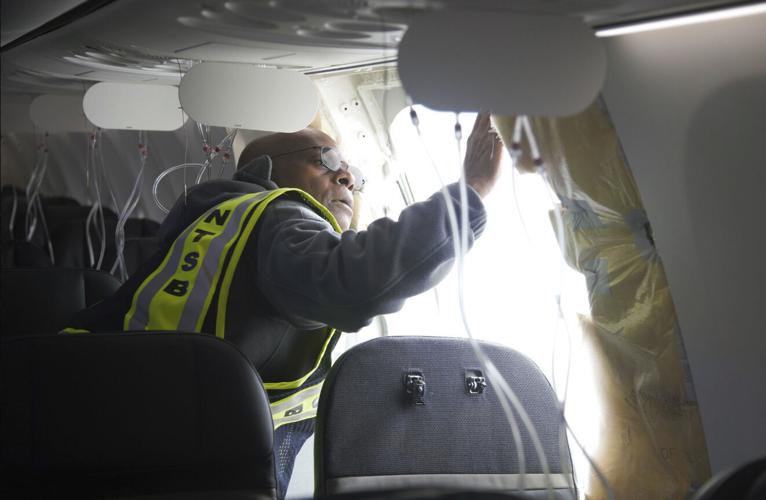
National Transportation Safety Board Investigator-in-Charge John Lovell examines the fuselage plug area of Alaska Airlines Flight 1282 on Sunday in Portland, Ore.
Jennifer Homendy, chair of the National Transportation Safety Board, said maintenance crews checked the plane and cleared it to fly — but the airline decided not to use it for the long route to Hawaii over water so that it “could return very quickly to an airport” if the warning light reappeared.
People are also reading…
Friday’s flight was headed from Oregon to Southern California, and made it back to Portland without serious injury to any of the 171 passengers and six crew members. But the decision to allow it to fly over land in the first place struck some aviation experts as illogical.
“If you are afraid to take the airplane far from land, what is the reason for that? That has to be answered by Alaska Airlines,” said Steven Wallace, an air-safety consultant and commercial pilot who once headed accident investigations for the Federal Aviation Administration.
The FAA grounded all Max 9s operated by Alaska and United and some flown by foreign airlines for inspection after the Friday night flight. The inspections are focused on plugs used to seal an area set aside for extra emergency doors that are not required on United and Alaska Max 9s.

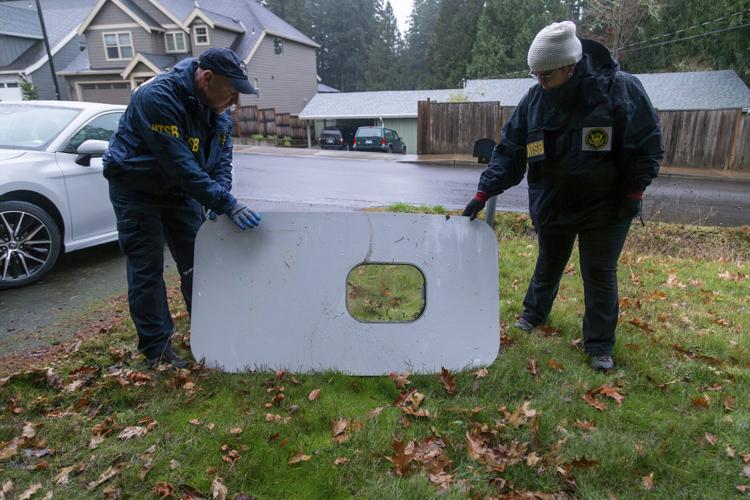
The door plug from Alaska Airlines Flight 1282 is shown Monday in Portland, Ore.
Monday afternoon, United Airlines said it found loose bolts and other “installation issues” on door plugs that were inspected after the Alaska Airlines incident.
“Since we began preliminary inspections on Saturday, we have found instances that appear to relate to installation issues in the door plug — for example, bolts that needed additional tightening,” Chicago-based United said.
Boeing, which has had its own share of problems with various planes over the years, pledged to “help address any and all findings” that airlines make during their inspections.
The FAA declined to comment on whether the Alaska Airlines plane in question should have been allowed to keep flying. The agency said “it would be premature” to comment while the NTSB is investigating the Friday night flight.
Seattle-based Alaska Airlines also declined to comment, saying it would need permission from the NTSB to discuss the plane and its maintenance history. “We will provide information as soon as the NTSB permits us to do so,” the airline said.
Alan Diehl, a former crash investigator for both the NTSB and the Federal Aviation Administration, said Alaska should have grounded the plane, period. However, he and other critics said the decision to stop flying the plane to Hawaii might have averted a disaster.

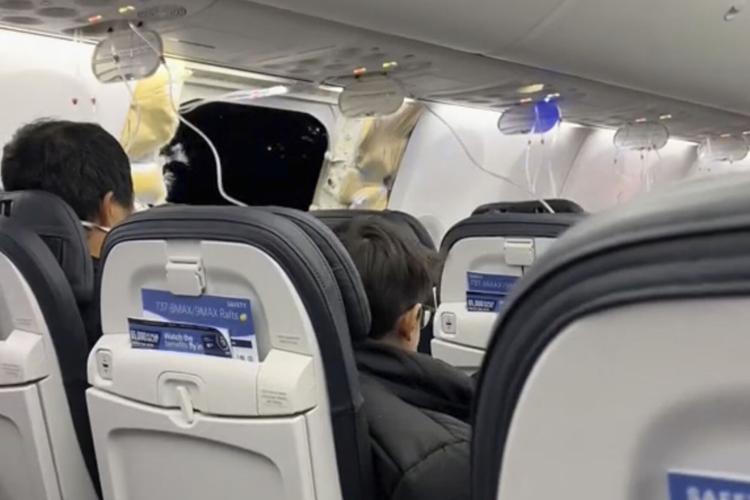
This image from video shows passengers near the damage on an Alaska Airlines Boeing 737 Max 9, which was forced to return Friday to Portland International Airport.
If the blowout had happened halfway to Hawaii, pilots would have been forced to fly low enough so passengers could breathe without oxygen masks, which burns more fuel. And the gaping hole in the fuselage would create drag. The plane might have run out of fuel before reaching land, experts said.
“As far as I’m concerned, there’s an angel in Alaska,” Diehl said. “Whoever made the decision to do that probably saved a lot of lives.”
Other aviation insiders saw nothing unusual in the airline’s decision to limit but not ground the plane after the pressurization warnings on flights Dec. 7, Jan 3 and Jan. 4 — the day before the blowout.
“Whatever maintenance they performed on it, (they decided) ‘Let’s be conservative and not put this thing out over water,’” said John Cox, a former airline pilot and now a safety consultant. He said the intermittent nature of the pressurization warnings — three out of the plane’s 145 flights — might have made them suspect a bad sensor or something else.
It’s not clear whether the airline would have been required to report the warning lights to the FAA or the fact that it had limited the plane to flying over land. Wallace said rules about such reporting aren’t specific.
Homendy, the NTSB chair, cautioned that the pressurization warning light might be unrelated to Friday’s incident, which occurred as the plane cruised about three miles (4.8 kilometers) over Oregon.
On Monday, the FAA approved guidelines for inspecting the door plugs on other Max 9 jets and repairing them, if necessary. That move could speed the return to service of the 171 planes that the FAA grounded.
Alaska has 64 other Max 9s, and United Airlines owns 79 of them. No other U.S. airlines operate that model.
The NTSB said the lost door plug was found Sunday near Portland in the backyard of a home.

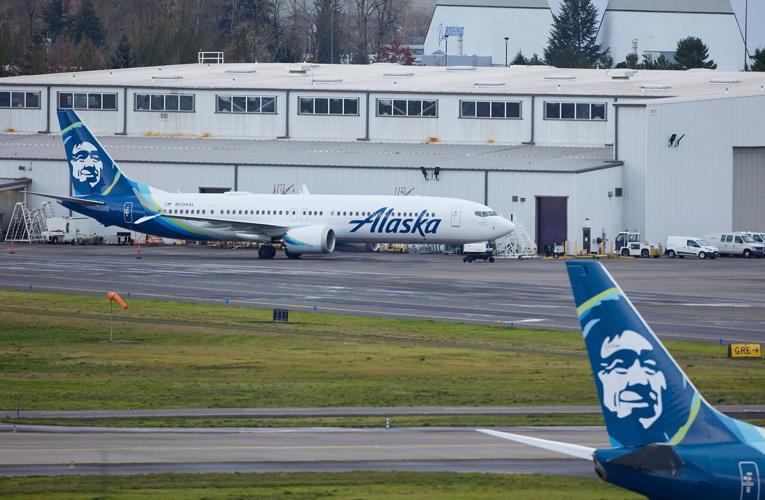
Alaska Airlines N704AL, a 737 Max 9 which made an emergency landing at Portland International Airport after a part of the fuselage broke off mid-flight Friday, is parked at a maintenance hanger Saturday in Portland, Ore.
At a news conference Sunday night, Homendy said an explosive rush of air damaged several rows of seats and pulled insulation from the walls. The cockpit door flew open and banged into a lavatory door.
Two cellphones that appeared to have belonged to passengers on Friday’s flight were found on the ground. One was discovered in a yard, the other on the side of a road. Both were turned over to the NTSB.
Grounding 171 of 218 Max 9s in operation, including all those used by Alaska and United, led to flight cancellations at both carriers.
Today in history: Jan. 8
1815: Battle of New Orleans

In 1815, the last major engagement of the War of 1812 came to an end as U.S. forces defeated the British in the Battle of New Orleans, not having received word of the signing of a peace treaty.
1935: Elvis Presley

In 1935, rock-and-roll legend Elvis Presley was born in Tupelo, Mississippi.
1964: Lyndon Johnson

In 1964, President Lyndon B. Johnson, in his State of the Union address, declared an “unconditional war on poverty in America.”
1994: Tonya Harding

In 1994, Tonya Harding won the ladies’ U.S. Figure Skating Championship in Detroit, a day after Nancy Kerrigan dropped out because of the clubbing attack that had injured her right knee. (The U.S. Figure Skating Association later stripped Harding of the title.)
2008: Hillary Clinton

In 2008, Sen. Hillary Rodham Clinton powered to victory in New Hampshire’s 2008 Democratic primary in a startling upset, defeating Sen. Barack Obama and resurrecting her bid for the White House.
2008: John McCain

In 2008, John McCain defeated his Republican rivals to move back into contention for the GOP nomination.
2011: Gabrielle Giffords

In 2011, U.S. Rep. Gabrielle Giffords, D-Ariz., was shot and critically wounded when a gunman opened fire as the congresswoman met with constituents in Tucson; six people were killed, 12 others also injured. (Gunman Jared Lee Loughner was sentenced in Nov. 2012 to seven consecutive life sentences, plus 140 years.)
2012: Gabrielle Giffords

Ten years ago: Bells rang in Tucson, Arizona, as residents paused to remember the six people killed in the shooting rampage a year earlier that left U.S. Rep. Gabrielle Giffords severely wounded; Giffords led a crowd in the Pledge of Allegiance during an evening vigil.
2012: Mitt Romney

Ten years ago: Mitt Romney’s Republican presidential rivals piled on the criticism during a morning debate, two days before the New Hampshire primary.
2016: "El Chapo"

In 2016, Joaquin “El Chapo” Guzman, the world’s most-wanted drug lord, was captured for a third time in a daring raid by Mexican marines, six months after walking through a tunnel to freedom from a maximum security prison.
2017: Israel

Five years ago: A Palestinian truck driver rammed his vehicle into a crowd of Israeli soldiers, killing at least four people in one of the deadliest attacks of a wave of violence lasting more than a year. (The driver was shot dead.)
2017: The Golden Globes

Five years ago: “La La Land” won seven Golden Globe Awards, including best motion picture, comedy or musical, while “Moonlight” was recognized as best movie drama; Meryl Streep, accepting a lifetime achievement award, criticized President-elect Donald Trump without mentioning him by name.
2020: Iran

In 2020, Iran struck back at the United States for killing Iran’s top military commander, firing missiles at two Iraqi military bases housing American troops; more than 100 U.S. service members were diagnosed with traumatic brain injuries after the attack. As Iran braced for a counterattack, the country’s Revolutionary Guard shot down a Ukrainian jetliner after apparently mistaking it for a missile; all 176 people on board were killed, including 82 Iranians and more than 50 Canadians.
2021: Nancy Pelosi

One year ago: House Speaker Nancy Pelosi said she had spoken to the chairman of the Joint Chiefs of Staff about preventing Trump from initiating military actions or a nuclear strike; she said the situation of “this unhinged President could not be more dangerous.”