Separate U.S. negotiating tracks for Canada and Mexico are testing a trilateral free trade zone that defined North America's economy for 32 years, with the U.S. potentially forcing concessions on Canada that Mexico agrees to in its more advanced talks.
President Donald Trump's decision not to extend the United States-Mexico-Canada Agreement for another 16 years on July 1 leaves the trade deal in force but requires annual reviews until all three countries either agree on its renewal, or it expires in 2036.

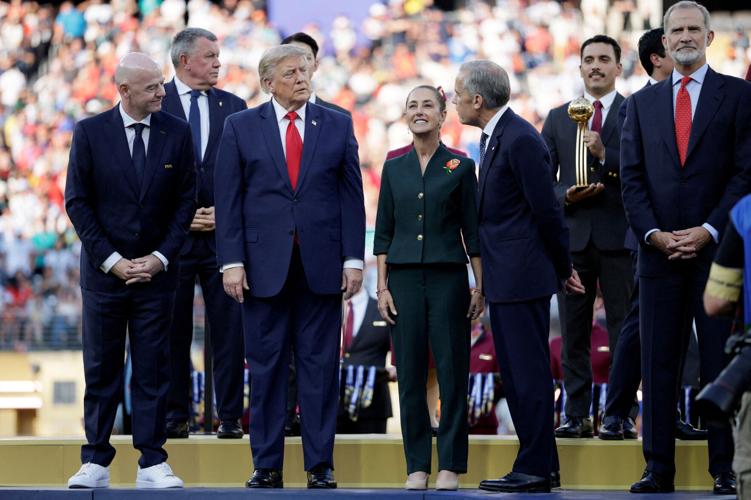
President Donald Trump attends the trophy presentation with FIFA President Gianni Infantino, Mexican President Claudia Sheinbaum, Canada's Prime Minister Mark Carney and Spain's King Felipe VI on Sunday at New York New Jersey Stadium in East Rutherford, N.J.
Trump ratcheted up pressure on Canada on Monday by imposing 50% tariffs on a wide range of goods, with his administration saying it responded to Canadian policies on autos and dairy as well as provincial alcohol bans. The tariffs take effect Aug. 19.
The nations will continue to engage with one another bilaterally, according to people from all three countries familiar with the talks. They expressed hope that agreements struck between two countries could be brought together within a trilateral framework.
People are also reading…
The economic stakes are high for Canada and Mexico, which send most of their exports to the U.S., and for automakers and other companies whose production networks cross North American borders several times.

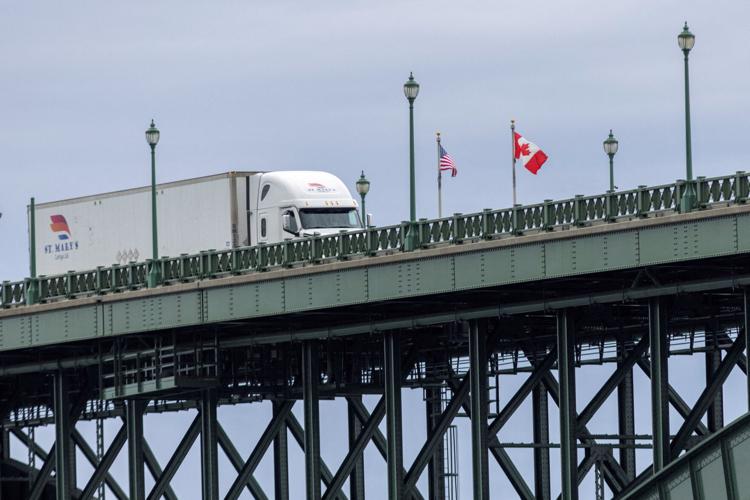
A transport truck drives toward Canada amid the uncertainty of tariffs policy April 2, 2025, at the Canada-U.S. border crossing in Fort Erie, Ontario.
Different trade realities
The difficulty will be keeping the separate processes aligned to each country's priorities when Canada and Mexico have different trade realities and political constraints, and given strained relations between Trump and Canadian Prime Minister Mark Carney, trade experts noted.
Carney said Tuesday he and Trump agreed to intensify talks.
"The challenge is to keep those two processes moving in the same direction so that they feed into the trilateral mindset that Canada and Mexico have — and that the U.S. has expressed doubts about," said Juan Carlos Baker, a former senior Mexican trade negotiator.
Mexico and Canada wanted to extend the trilateral pact, but agreed to bilateral talks with Washington.
The three economies conduct about $1.6 trillion in annual goods trade under the agreement, which also shielded Canada and Mexico from many of Trump's global tariffs. Trump negotiated the agreement known as USMCA during his first term, replacing the 1994 North American Free Trade Agreement.
U.S. businesses and workers who depend on cross-border commerce are preparing for an uncertain future, following the country's decision on July 1st not to renew the United States-Mexico-Canada Agreement (USMCA). For more than three decades, free trade has helped turn the U.S.-Mexico border into one of the world's busiest commercial corridors. The recent decision has given rise to concerns that trade flows will see a sharp drop off. That scenario would put employment at risk, including the jobs of many truck drivers. Each year, truckers carry billions of dollars worth of goods through Eagle Pass, Texas, where bridges across the Rio Grande see a constant flow of freight vehicles in both directions. In downtown Eagle Pass, an area already struggling with decreased tourism volumes from across the river, the news has many locals concerned. Goods traveling between these countries overwhelmingly move on 18-wheelers, and truckers like Julio Garcia fear the impact of lower volumes. However, the U.S. decision not to renew the USMCA doesn't abruptly end the pact, instead triggering a "sunset clause" that mandates yearly reviews for another ten years. While the community in Eagle Pass remains nervous, that period is giving people hope that a new deal guaranteeing free trade will ultimately emerge. Shotlist: Eagle Pass, Texas, USA - Recent: 1. Words reading "The Best Way to Mexico"; 2. Truck passing by; 3. Street; 4. SOUNDBITE (English) Gustavo Garcia, Eagle Pass businessman (starting with shot 3/partially overlaid with shot 5): "I don't know what's going to happen. Like me, as a small business owner, I'm trying to do more things. Hopefully we don't come to another recession, hopefully. But how I see everything, it's like if you are in a desert, everything is so calm in the business side." [SHOT OVERLAYING SOUNDBITE]; 5. Various of street view, shops [SHOT OVERLAYING SOUNDBITE]; 6. Various of truck at gas station; 7. Various of truck driver Julio Garcia filling gas; 8. SOUNDBITE (English) Julio Garcia, cross-border trucker (starting with shot 7/partially overlaid with shot 9-10): "We worry a lot about that. It's not good because it's gonna lower our jobs. I live in a border town, so we've got a lot of commercial trucks coming from Mexico to Laredo. It's going to be bad." [SHOT OVERLAYING SOUNDBITE]; 9. Truck; 10. U.S. flag, flag of Texas [SHOT OVERLAYING SOUNDBITE]; 11. Various of words on plate reading "International Center for Trade"; 12. Various of eagle statue painted with indigenous symbols, U.S. flag stars. [Restrictions: No access Chinese mainland]
Mexico started its third round of formal bilateral talks Tuesday. Canada has had no formal talks, but its minister in charge of U.S. trade, Dominic LeBlanc, has phone calls and occasional meetings in Washington with U.S. Trade Representative Jamieson Greer.
Canada hopes the U.S. will remove steel and aluminum tariffs and avoid the new tariffs set for August.
A Mexican official familiar with the negotiations said U.S.-Mexico talks were about six months more advanced than informal U.S.-Canada discussions and could give Mexico greater investment certainty and potentially better terms in areas such as steel tariffs.
Mexican and U.S. officials broadly agree on several problems they want to address, the official said, including declining U.S. manufacturing employment, growing use of Asian components in North American vehicles and transshipment of goods from outside the region.
"Mexico and the U.S. are in agreement about the goals," the official said. "What we are discussing is how to reach them."
Mexico already took steps to address some U.S. complaints, including imposing tariffs on non-free-trade partners, tightening customs rules and addressing intellectual property concerns.

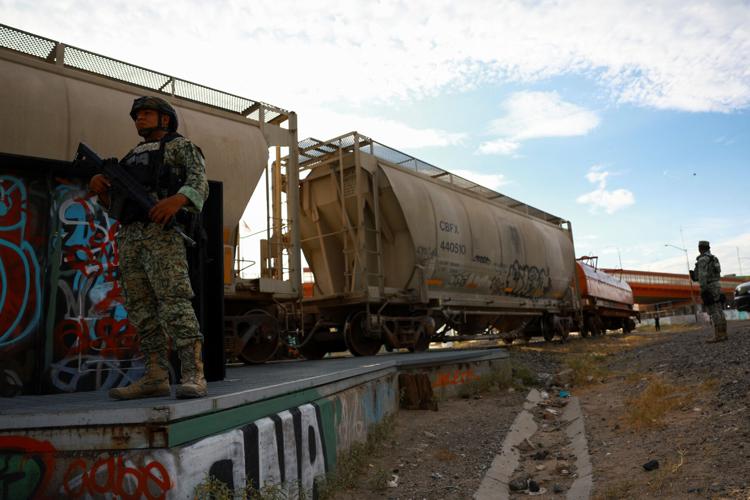
Members of the Mexican army stand guard Tuesday in Ciudad Juarez, Mexico, as vehicles aboard a freight train are exported to the U.S.
Politics shape strategy
Mexico has been more accommodating than Canada, people familiar with both countries' strategies said.
Carney on Tuesday suggested Canadian provinces wait to put U.S. alcohol back on shelves until a broader trade agreement is reached.
Mexican President Claudia Sheinbaum made concessions that she can frame as advancing Mexico's priorities, including tighter border security, reduced fentanyl trafficking and greater scrutiny of Chinese investment.
Carney won the election last year promising to stand up to Trump.
"She has more degrees of freedom to operate than Prime Minister Carney does," Baker said of Sheinbaum.
With most Canadian provinces vowing to keep U.S. alcohol off store shelves in response to President Donald Trump’s latest tariff threats, CBC’s Eli Glasner asks: are the booze bans an effective pressure tactic or merely political symbolism — and an inconvenience for consumers.
Canadian officials dispute the idea that Canada is behind.
Gabriel Brunet, spokesperson for LeBlanc, said Canada is ready to expedite talks on the trade pact.
"To that end, Canada has put forward proposals that are fair, balanced, and good for the broader North American economy,” he added.
Mexico's Economy Ministry declined to comment.
Greer said Wednesday he hoped to strike some interim trade agreements with Mexico and Canada this year while tackling thornier changes of the USMCA such as stricter rules of origin in 2027.
The Trump administration is preparing a new round of tariffs on dozens of trading partners as temporary import duties introduced earlier this year are due to expire this week
Washington’s leverage
The core risk for Canada and Mexico is that bilateral talks could become the blueprint that one country must either accept or challenge and delay a trilateral deal.
Neither government is expected to ask the other to hold back from reaching an advantageous bilateral deal.
Mexico "will do what's best for Mexico," but it also wants to keep the USMCA trilateral and would resist proposals that explicitly broke apart the agreement, Baker said.
Carney also sought to improve relations with Mexico.
The Mexican official said attacking the trade pact could remain politically useful to Trump among voters who blame trade agreements for manufacturing job losses, ahead of U.S. midterm elections.
Canadian negotiators must use the 30-day window before the new tariffs take effect to make rapid progress, said Matthew Holmes, executive vice president at the Canadian Chamber of Commerce, a lobby group that advises the government on U.S. trade relations.
Canada signaled it will not accept unfavorable terms merely to close the talks quickly — and the 10-year review timeframe could allow Carney to negotiate with a different U.S. president.
"What I've heard from the prime minister and other members of the negotiation team is, 'We want a good deal for Canada,’” Holmes said, '“‘not a fast deal for Canada.’”