The United States will send an additional 5,000 troops to Poland, U.S. President Donald Trump said Thursday.
Trump, in a social media post, cited his relationship with Poland's conservative nationalist president, Karol Nawrocki, as the reason behind his decision to send additional troops.
The announcement came two days after U.S. Vice President JD Vance told reporters a U.S. troop deployment to Poland was delayed.
The U.S. has been reviewing its troop presence in Europe and was long expected to scale it back following demands from Trump that NATO take a larger role in the defense of Europe.

"Based on the successful Election of the now President of Poland, Karol Nawrocki, who I was proud to Endorse, and our relationship with him, I am pleased to announce that the United States will be sending an additional 5,000 Troops to Poland," Trump said in the post.
People are also reading…
Trump hosted Nawrocki at the White House in May last year and backed him at a crucial moment ahead of the Polish election in which Nawrocki went on to defeat the candidate of Polish Prime Minister Donald Tusk's pro-European, centrist party.
He met Nawrocki again at the White House in September, and said at the time that the U.S. could increase its troop presence in Poland and pledged to secure the country's defense.

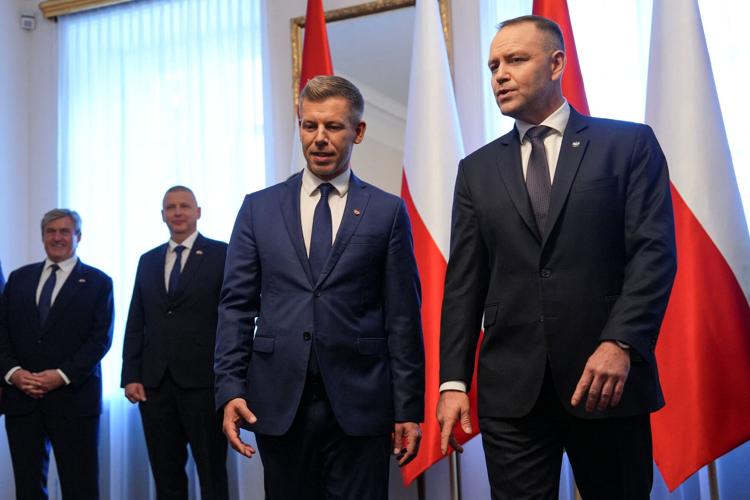
Poland's President Karol Nawrocki meets with Hungarian Prime Minister Peter Magyar during his first official visit to the country Wednesday in Warsaw, Poland.
The announcement came as Russia launched nuclear-capable missiles and issued nuclear munitions to some units Thursday as part of major nuclear exercises amid heightened tensions with NATO over the Ukraine war and drone activity in the Baltic.
Russia is conducting some of the biggest nuclear exercises in years, involving 64,000 people to drill its forces in "the preparation and use of nuclear forces in the event of aggression."
Russian President Vladimir Putin told Belarusian President Alexander Lukashenko, Russian Defence Minister Andrei Belousov and top generals that the use of such weapons would always be an exceptional and extreme measure of last resort.

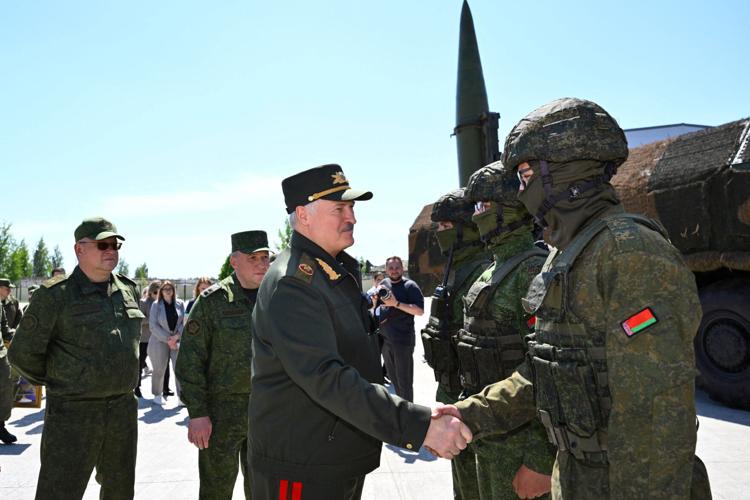
Belarusian President Alexander Lukashenko shakes hands with a service member Thursday next to the Iskander-M missile launcher as he visits a missile brigade of the Armed Forces during joint Russian-Belarusian nuclear exercises, in the Asipovichy district, Mogilev region, Belarus.
"Given the growing tensions in the world and the emergence of new threats and risks, our nuclear triad must continue to serve as a reliable guarantor of the sovereignty of the Union State of Russia and Belarus," Putin said in the Kremlin.
While Russia does not want to get involved in an arms race, he added, it will develop its nuclear forces and keep them on a sufficient level, including with new missiles and submarines.
Russia has the world's biggest nuclear arsenal with about 4,400 deployed and stockpiled nuclear warheads, while the U.S. has about 3,700, according to the Federation of American Scientists.
China is the world's third-largest nuclear power with about 620, followed by France with 290 and Britain with about 225, the federation says.
Russia and China said on Wednesday that Trump's Golden Dome missile-defense shield plans threatened strategic stability.

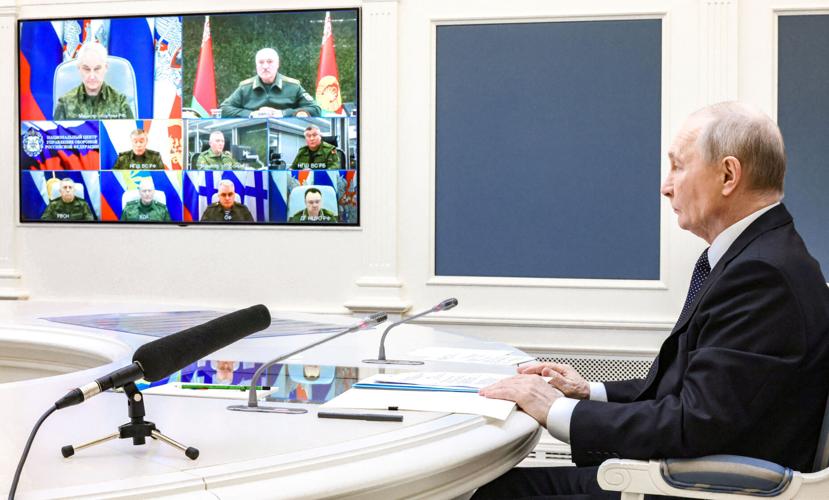
Russian President Vladimir Putin observes a joint training of the nuclear forces of Russia and Belarus via video link Thursday at the Kremlin in Moscow, Russia.
Moscow accused Baltic countries of allowing Ukraine to fly over their territory to attack northern Russia, an accusation NATO denies.
The Baltic states, all strong backers of Ukraine, say Russia is redirecting Ukrainian drones into their airspace from their intended targets in Russia.
The Kremlin criticized remarks by Lithuania's top diplomat as "verging on insanity" on Wednesday after Foreign Minister Kestutis Budrys said NATO had to show Moscow it was capable of penetrating the Russian exclave of Kaliningrad.
Kaliningrad is sandwiched between NATO members Lithuania and Poland on the Baltic coast. It has a population of about one million and is heavily militarized, serving as the headquarters of Russia's Baltic Fleet.