A few weeks ago, Emily Plumb sat with her daughter Cleo on her lap at their home in northeast Wisconsin, swaying and humming a song.
That wasn't unusual. What happened next was.
“Emily,” she recalled her husband, Ty, saying. “She’s repeating you.”

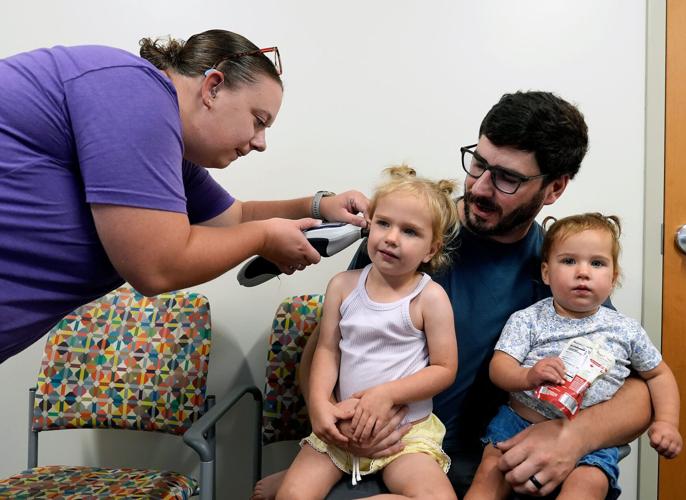
In July, the Plumb sisters became the first in the nation to receive a newly approved gene therapy called Otarmeni to treat a rare genetic form of hearing loss. Their father, Ty, holds the sisters as audiologist Dr. Olivia Riemer checks 2-year-old Cleo’s ear canal Aug. 24 at Children’s Wisconsin Appleton Clinic in Appleton.
Cleo, who’s nearly 3, and her little sister Lennon, 19 months, were both born unable to hear because of a rare genetic condition. In July, they were the first in the U.S. to receive a newly approved gene therapy called Otarmeni that in clinical trials showed a significant improvement in hearing for the children who participated.
Doctors at Children's Wisconsin who were involved with the girls' procedure say it marks a new era in hearing loss treatment, the kind of breakthrough not seen since cochlear implants were developed decades ago.
People are also reading…
It's not a silver bullet. It could be many weeks before meaningful change is noticed in Cleo and Lennon's hearing, and no one knows whether the therapy is a permanent fix.
But although the waiting is hard, the Plumbs are finding hope in each small change they think they see – like the humming, or a turned head for a baby's cry or a knock at the door.

Ty Plumb holds his daughter Lennon, 19 months, during a hearing test run by audiologist Dr. Olivia Riemer on Aug. 25 at Children’s Wisconsin Appleton Clinic in Appleton.
"We know their future's going to be great, no matter what," Emily said. "But I hope one day they can say, 'Thank you so much, Mom. I know that was one of the hardest things for you to go through, but it was the best for us.'"
Ty and Emily started to suspect something was wrong when Cleo, at 1, wasn't hitting expected speech milestones. She failed the hearing screening administered to all newborns at birth, but results of a second test told them she could hear.
That turned out to be wrong.

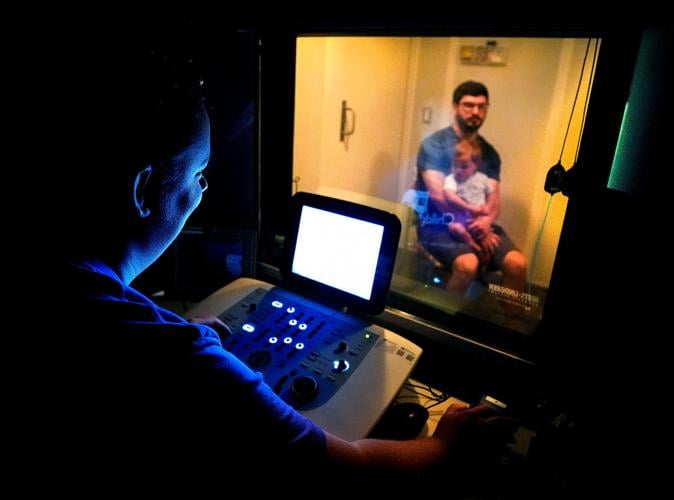
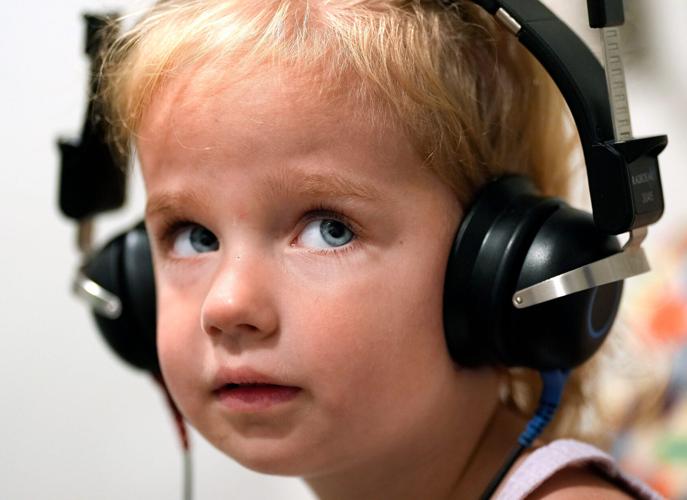
Cleo Plumb, 2, reacts to a sound in her headphones during an Aug. 25 hearing test at Children’s Wisconsin Appleton Clinic in Appleton.
After Lennon also failed her hearing screening, both girls were sent to Milwaukee for further testing.
Another test found both Cleo and Lennon showed signs of auditory neuropathy, a hearing disorder in which the inner ear can detect sound but has a problem sending sound information to the brain. MRIs confirmed there was nothing wrong with the structure of their ears.
That's when doctors suggested the girls undergo genetic testing to determine whether a malfunctioning otoferlin gene – one of more than 100 genes linked to hearing loss, and the only one subject to a potential therapeutic treatment – was the culprit.
The otoferlin gene helps brains recognize sound. When it's not working properly, sound waves enter the inner ear, but it is unable to tell the brain that what came in was a sound. It's like typing an email, but not being able to press the "send" button, so the message is never received. About 50 Americans annually are born with such a mutation.
Ty and Emily were glad to find out the otoferlin gene was the one at fault in both their daughters, only to be disappointed that a nationwide clinical trial of Otarmeni taking place, with Children's Wisconsin participating, wasn't accepting more enrollees.
Though Cleo was quick at picking up sign language, her parents eventually worried she would fall behind in conversation skills. They scheduled an appointment for her to receive a cochlear implant.

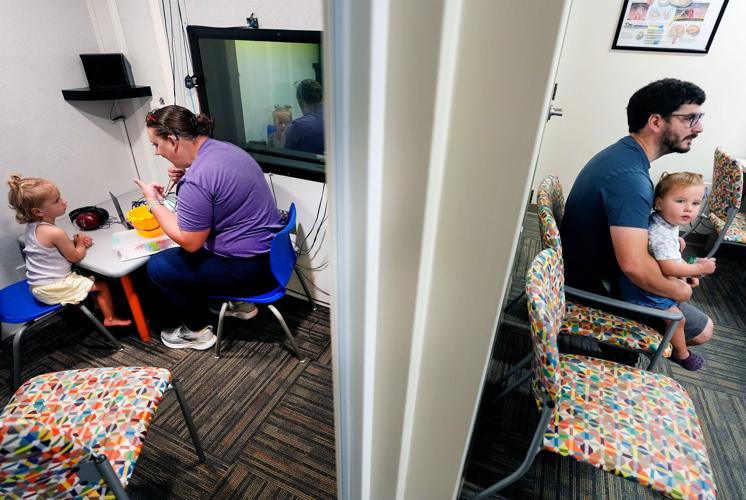
Ty Plumb watches as his daughter Cleo, age 2, tries to listen to her sister’s hearing test through the testing room door Aug. 25 at Children’s Wisconsin Appleton Clinic in Appleton.
Then Ty received a call from Dr. Brit Gniedziejko, an audiologist at Children's. The U.S. Food and Drug Administration granted Otarmeni accelerated approval, she told him, and surgeons in Milwaukee were getting trained on it. Were he and Emily interested?
Both girls' surgeries were scheduled for July 20. Ty and Emily recalled learning about a week beforehand that their daughters would be the first in the country – outside of clinical trials – to receive the newly approved therapy.
"I think I just felt relief. We were fighting for this for so long," Ty said. "It was like, 'Yeah, we're getting somewhere.'"

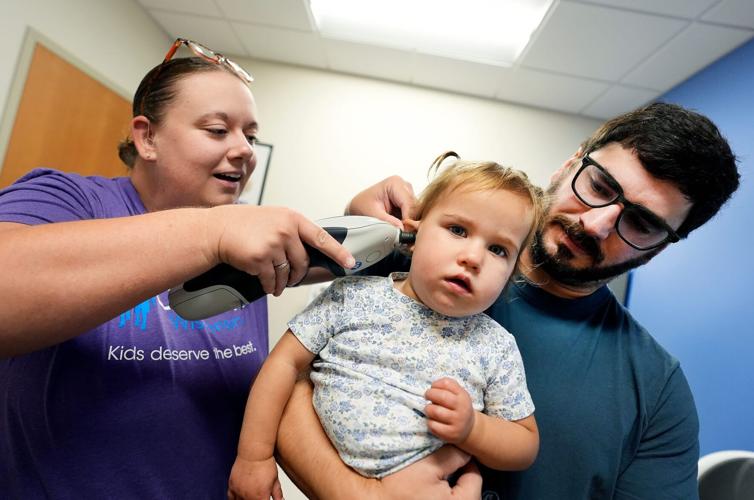
Ty Plumb holds his daughter Lennon, 19 months, as audiologist Dr. Olivia Riemer checks her ear canal Aug. 25 at Children’s Wisconsin Appleton Clinic in Appleton.
Children's hosted two of 12 children nationally who participated in the Otarmeni clinical trial during 2023 and 2024. All started with profound hearing loss, said Dr. Michael Harris, chief of otology and neurotologic skull base surgery at the Medical College of Wisconsin and one of two surgeons on Cleo and Lennon's procedures. After receiving the gene therapy, Harris said, many of them could hear a soft voice or even a whisper.
The surgery begins with an incision behind the ear. Surgeons place a small catheter into the inner ear and infuse the medicine over roughly 20 minutes, which helps the inner ear reconstruct the genetic code that was previously mutated. Then they close up the incision – and the waiting begins.
In the clinical trial, the biggest improvements were observed in the first six months after surgery, Gniedziejko said.
Doctors didn't pick up much during Cleo and Lennon's first post-surgery hearing tests Aug. 25. They'll keep monitoring over the coming months.
The significance of the surgeries was on Harris's mind. He and his team, including co-surgeon Dr. Karl Doerfer, medical director of otolaryngology ambulatory services at the medical college, rehearsed the procedure multiple times.

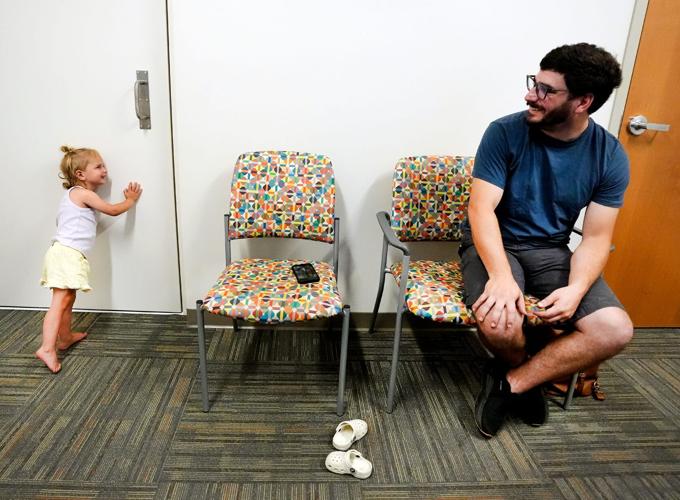
The Plumb sisters take part in hearing tests at Children’s Wisconsin Appleton Clinic in Appleton.
Children in the clinical trial were followed for 72 weeks, over which time their hearing remained stable, Harris said. But the future is unknown. How durable the therapy is will be determined only after years of follow-up.
The procedure has now been performed at children's hospitals in California and Boston as well. Another one scheduled soon in Milwaukee will mean Children's Wisconsin will have performed three of the first five.
"This really is the beginning – for us, for the whole field," Harris said. "We don't know the full arc here, what the outcomes are going to be. We're going to be with [the Plumbs] every step of the way."

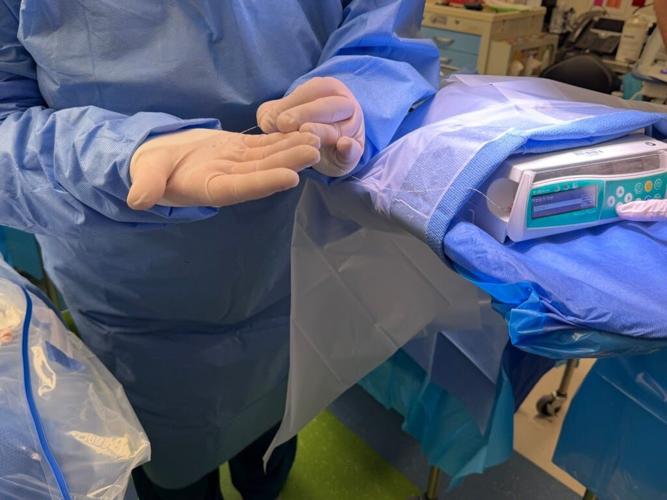
Jennifer Schmid, surgical technologist at Children’s Wisconsin, holds the catheter used during a procedure to deliver a newly approved gene therapy into the ears of the Plumb sisters on July 20 in Milwaukee. The therapy is infused directly to reach the cells affected by genetic hearing loss.
Harris and Gniedziejko are hopeful that this therapy opens the door to future therapies to correct other types of genetic hearing loss. Gniedziejko called it the first step "that completely changes everything" about genetic hearing loss, transforming it from something that could once only be managed.
After the surgeries and a subsequent recovery period, things in the Plumb household are back to normal. The girls go to day care, where the other kids and their teacher can all use sign language to communicate with them. They play with their dog, Betty.
Ty and Emily say they're just hoping for some hearing improvement for both Cleo and Lennon. If they need additional help, they could still get cochlear implants. Crucially, the gene therapy isn't an option if a cochlear implant is already installed.
"As frustrated as we were when Cleo was misdiagnosed, I think it was kind of a blessing in disguise," Emily said.
Ty and Emily said they are hopeful this therapy and other future ones could help other people's children, even as they wait for results of their own. They're grateful for the doctors at Children's Wisconsin and for Regeneron, the pharmaceutical company that developed Otarmeni.
"All the work that we put in is over with now," Ty said. "Now it's time to hope."
Some 75,000 people with hearing loss live in Ivory Coast. For many of them, daily tasks that often require speaking and hearing are incredibly difficult to navigate. Israël Mansaré, a psychologist and interpreter, has decided to become their voice and ears.