

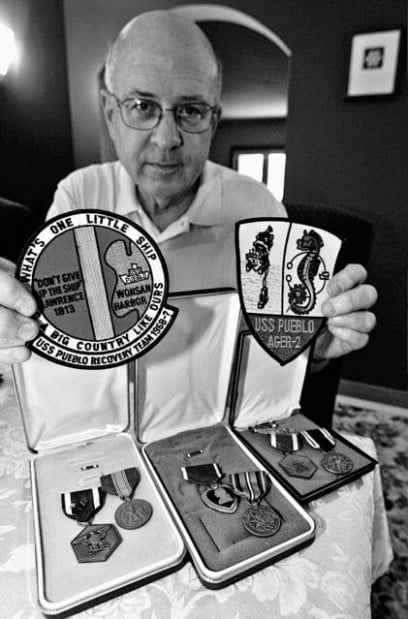
JERICHO, Vt. — Ralph McClintock expected only a three-week mission when he boarded the USS Pueblo in January 1968.
Instead, he and his shipmates became pawns in a Cold War sideshow when North Korea captured the Navy spy ship and imprisoned its 82 crew members. Some still suffer the physical effects of torture or malnutrition they suffered during 11 months of captivity.
McClintock is proud of his service as a 24-year-old communications technician and the bonds he made with his crew mates, but that pride is tinged with bitterness.
"We were treated as heroes when we got back, but what the Navy, the institution of the Navy really wanted, in my opinion, is the Pueblo to have sunk," McClintock said at his Jericho home. "When we came back, the Navy now has to look at itself, and they don't like to look at themselves."
On Wednesday, 40 of the 69 surviving crew members will gather in neighboring Essex for a four-day reunion featuring exhibits and speeches by experts on U.S.-Korean relations.
People are also reading…
McClintock, the host for the reunion, isn't the only one who is disillusioned.
"I think the crew has always wanted someone in the Navy to stand up and say, 'Hey, you guys did a great job in a poorly conceived mission without any backup,' " said Skip Schumacher, 65, of St. Louis, a lieutenant junior grade on the ship.
Their capture was almost overshadowed in a year that saw the Tet offensive in Vietnam, the assassinations of the Rev. Martin Luther King and Sen. Robert Kennedy, and riots outside the Democratic National Convention in Chicago.
"This was a difficult and humiliating event," said Mitch Lerner, who teaches American diplomatic history at Ohio State University and wrote a book about the Pueblo.
"It wasn't just an American ship that was captured. The crew was beaten and publicly humiliated, and the U.S. couldn't do anything about it," said Lerner, who will speak at the reunion.
The crew kept the military chain of command alive and resisted its captors. The sailors planted defiant codes into forced letters of confession and extended their middle fingers when North Koreans photographed them and sent the images around the world.
But when they came home, most of the young sailors acknowledged that they gave the enemy more than their names, ranks and serial numbers.
"They've been living with that all these years," Schumacher said.
A Navy spokesman, Lt. j.g. Thomas Buck, said no appropriate Navy official was available to comment on the criticisms of the Navy's handling of the Pueblo incident and its aftermath.
McClintock, then a ham radio operator, volunteered for the Pueblo. He was accustomed to the spy-versus-spy culture of the Cold War, when American and Soviet naval vessels shadowed and occasionally harassed each other.
On Jan. 23, 1968, after being harassed for a day, North Korean patrol boats opened fire on the Pueblo. The United States said the Pueblo was in international water; North Korea said it was in its territory.
One sailor was killed by the gunfire.
Lerner said the military's failure to protect the Pueblo wasn't sinister.
"The American government and the American military assumed this ship would be safe because the Soviets did similar things to us," Lerner said. "No one stopped to think the Soviet Union and the North Koreans were not the same thing."
Lerner said U.S. officials realized military action would not have brought the crew home alive.
"The praise that (President) Lyndon Johnson got for acting like a diplomat was really significant," Lerner said.
The crew was released two days before Christmas.


