

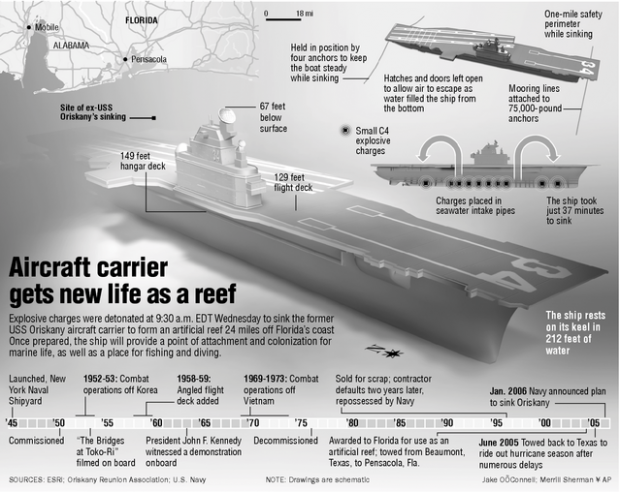
IN THE GULF OF MEXICO — As hundreds of veterans looked on solemnly, the Navy blew holes in a retired aircraft carrier and sent the 888-foot USS Oriskany to the bottom of the sea Wednesday, creating the world's largest man-made reef.
The rusted hulk took 37 minutes to slip beneath the waves, about four hours faster than predicted, after more than 500 pounds of plastic explosives went off with bright flashes of light and clouds of brown and gray smoke.
Korean and Vietnam War veterans aboard a flotilla of 300 charter boats watched from beyond a one-mile safety perimeter as the "Mighty O" went down in 212 feet of water, about 24 miles off Pensacola Beach.
Lloyd Quiter of North Collins, N.Y., who served four tours on the ship in Vietnam, played the attention-all-hands signal on his boatswain's pipe, and wept.
"I'm a little stunned. It's a little hard to take," he said.
People are also reading…
The Oriskany (pronounced oh-RISK-uh-nee) became the first vessel sunk under a Navy program to dispose of old warships by turning them into diving attractions teeming with fish and other marine life.
Over the years, other ships have been turned into reefs, including the warship USS Spiegel Grove, a cargo vessel that was scuttled in 2002 off Key Largo. But that was a civilian project, paid for with a combination of county and private money.
The Oriskany, commissioned in 1950 and named after an American Revolutionary War battle, saw duty during the Korean War and was home to John McCain when the Navy pilot and future senator served in Vietnam. It was also among the ships used by President John F. Kennedy in a show of force during the 1962 Cuban missile crisis. It was decommissioned in 1976.
McCain was shot down over Hanoi in 1967 after taking off from the Oriskany and was held as a prisoner of war for five years.
"It was a small, old carrier that fought very valiantly, and I'm very proud to have been a part of the air wing that served with great courage and distinction," he told CNN.
McCain said he had hoped the ship would be turned into a museum, but the artificial reef will "provide a lot of recreation and a lot of good times for people."
The $20 million sinking was delayed for nearly two years by hurricanes and environmental-permit problems. The ship will not be open to recreational divers until at least Friday, so that Navy divers can explore the wreck and check for any hazards.


