

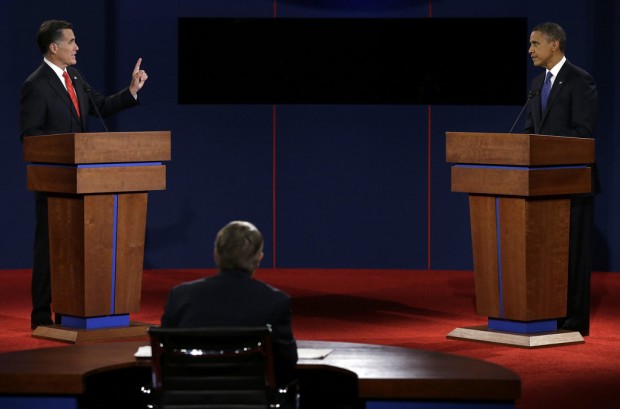
WASHINGTON - Challenger Mitt Romney used Wednesday's debate to put President Obama on the defensive on health care, jobs and other issues. The president's reluctance to fire back harshly gave new hope to Republican partisans.
Romney managed to highlight his top campaign themes - calling for lower tax rates, less regulation, the repeal of "Obamacare" - while largely fending off Obama's demands for details on how to pay for his proposals or safeguard Americans' health and well-being.
Neither Obama nor the debate's moderator, meanwhile, pressed Romney on some of his most vulnerable points. They included Romney's claim that 47 percent of Americans are docile dependents on the government, a topic heavily featured in TV ads and public conversations the past two weeks.
The 90-minute debate in Denver may have been too wonky to captivate millions of American viewers and change the campaign's overall arc. Polls show Obama leading in key battleground states.
People are also reading…
But it delighted Republicans who felt Romney was the aggressor without going overboard, and who were surprised by Obama's cautious, at times listless demeanor.
Even some Democratic partisans grudgingly acknowledged that Romney had a good debate.
"I think he won, unfortunately," said Karl Amelchenko, 36, a lawyer from Raleigh, N.C., who supports Obama. "Romney was aggressive. He attacked."
The nominees have two more debates this month, and a government jobs report on Friday could reshape the contest. Obama has aired more TV ads than Romney in several key states, and it's unclear whether Romney can follow his solid debate performance with the type of incisive message that has eluded him so far.
Obama and moderator Jim Lehrer repeatedly failed to force Romney to detail how he would cut tax rates at every income level without expanding the deficit or forcing middle-income people to pay a higher total tax bill.
"If you believe that we can cut taxes by $5 trillion and add $2 trillion in additional spending that the military is not asking for," Obama said, "and you think that by closing loopholes and deductions for the well-to-do, somehow you will not end up picking up the tab, then Governor Romney's plan may work for you."
"Virtually everything he just said about my tax plan is inaccurate," Romney retorted. "I'm not looking for a $5 trillion tax cut."
As Romney all but accused Obama of lying about his tax plan, the president alternated between looking directly at his Republican rival and bowing his head to take notes. "Now he's saying his big bold idea is 'never mind,' " Obama said.
Romney held his ground. He said he would reduce income tax rates without adding to the deficit and without reducing "the share paid by high-income individuals."
Economists say Romney has yet to explain how he can manage that feat.
Obama seemed frustrated but almost resigned. He said Romney's running mate, Rep. Paul Ryan, "put forward a budget that reflects many of the principles that Governor Romney's talked about. And it wasn't very detailed. This seems to be a trend."
But rather than press Romney any harder for details, the president moved on.
Obama seemed eager not to appear prickly or angry. He flashed his familiar smile often, and it's possible that many viewers saw him as relaxed and unshaken.
But the president also failed to follow through on some openings, such as when he noted that Romney once said he would reject a deficit-reduction plan even if it called for only $1 in new tax revenues for every $10 in spending cuts.
Both men spoke to middle America, making few references to issues that fire up the right and left fringes.
Republican consultant Matt Mackowiak said Romney "was on offense most of the night, holding Obama accountable for massive investments in green energy, the growing national debt and weak economic recovery. Obama never asked Romney to defend the Bain Capital record, his decision to release only two years of tax returns or the '47 percent' comment."
Democratic strategist Doug Hattaway said Romney "did fine, as expected. But fine doesn't get the job done." He said Romney failed to "change the dynamics of the race."
With a month remaining until the election, and early voting under way in many states, Republican partisans hope Hattaway is wrong.
what they said in first presidential debate
President Obama and Republican Mitt Romney sparred over taxes, deficits and health care Wednesday in their first debate. A look at what they said:
Spending
Obama: "I think we've got to invest in education and training. I think it's important for us to develop new sources of energy here in America, that we change our tax code to make sure that we're helping small businesses and companies that are investing here in the United States, that we take some of the money that we're saving as we wind down two wars to rebuild America and that we reduce our deficit in a balanced way that allows us to make these critical investments."
Romney: "First of all, I will eliminate all programs by this test, if they don't pass it: Is the program so critical it's worth borrowing money from China to pay for it? And if not, I'll get rid of it. … No. 2, I'll take programs that are currently good programs but I think could be run more efficiently at the state level and send them to the state. No. 3, I'll make government more efficient and to cut back the number of employees, combine some agencies and departments."
Jobs
Obama: "We've got some data on which approach is more likely to create jobs and opportunity for Americans, and I believe that the economy works best when middle-class families are getting tax breaks so that they've got some money in their pockets. And those of us who have done extraordinarily well because of this magnificent country that we live in, that we can afford to do a little bit more to make sure we're not blowing up the deficit."
Romney: "My priority is jobs. And so what I do is I bring down the tax rates, lower deductions and exemptions - the same idea behind Bowles-Simpson, by the way. Get the rates down, lower deductions and exemptions, to create more jobs. Because there's nothing better for getting us to a balanced budget than having more people working, earning more money, paying more taxes. That's by far the most effective and efficient way to get this budget balanced."


