

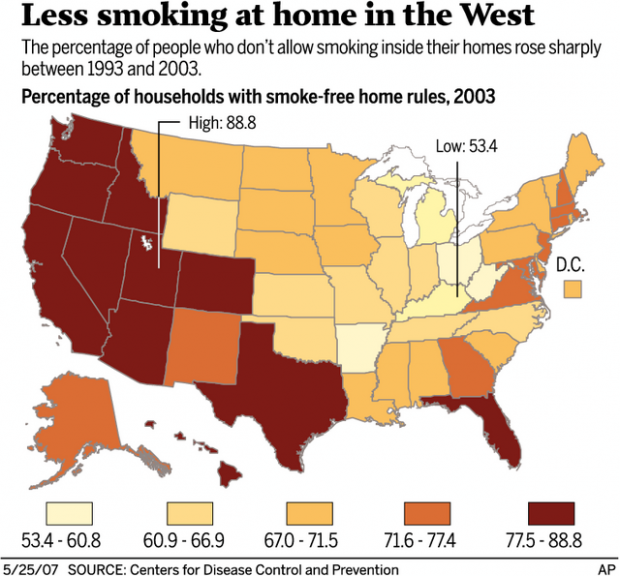
ATLANTA — Smoking is forbidden in nearly three out of four U.S. households, a dramatic increase from the 43 percent of homes that prohibited smoking a decade ago, the federal government reported Thursday.
The Centers for Disease Control and Prevention, which conducted the survey in 2003, said it was the first study to offer a state-by-state look at the prevalence of smoking in American homes.
Utah led the nation, with people in nearly nine out of 10 homes saying smoking was never allowed. The state's large population of Mormons, who eschew tobacco, probably contributed to that statistic, the agency said.
Kentucky was in last place, with a little more than half of households sending smokers outside (or, at least, to the garage).
But even in Kentucky, smokers found fewer place to light up. Ten years earlier, only a quarter of the state's households barred smoking.
People are also reading…
"That really says that people are starting to understand the hazards of secondhand smoke," said Dr. Corinne Husten, co-author of the study and chief of the epidemiology branch of the CDC's Office on Smoking and Health.
Tobin Hilliard joined the millions of Americans living in smoke-free homes when he moved in with his nonsmoking fiancee 10 years ago. He had to abandon the pleasure of smoking a cigarette at the kitchen table, on the living room couch or in the bedroom.
"It was just understood: 'If you're lighting up, you will be stepping out into whatever the weather conditions are,' " said Hilliard, 35, who is still a pack-a-day smoker in Clermont, Fla.
The CDC report was based on a national survey done mostly by telephone every two years. For a household to be included in the results, everyone 15 and older had to respond, and they all had to agree on the smoking rules.
The study was published the CDC's Morbidity and Mortality Weekly Report.
local angle
Arizona fared well in this study.
In 1993, 54.4 percent of Arizona homes prohibited smoking.
In 2003, that figure had climbed to 82.4 percent — the third-highest total in the nation, behind Utah, with 88.8 percent, and California, with 84.4 percent.
Still, the percentage shift here — 51.5 percent — didn't rate nearly as high as in other states, mostly because they fared so poorly at the start of the study.
For example, Kentucky had a 107.9 percent shift — because only 25.7 percent of homes prohibited smoking in 1993.
As the CDC officials said, part of the shift here may have been due to increasing pressure not to smoke in public buildings.
The Smoke-Free Arizona Act went into effect this month. The ban covers nearly all buildings accessible to the public — including offices, hotel and apartment common areas and laundromats. Smoking in restaurants in Tucson had been banned since 1999. There was an exception for restaurants with separate smoking areas. Pima County adopted a similar ban in 2001.
Arizona Daily Star


