

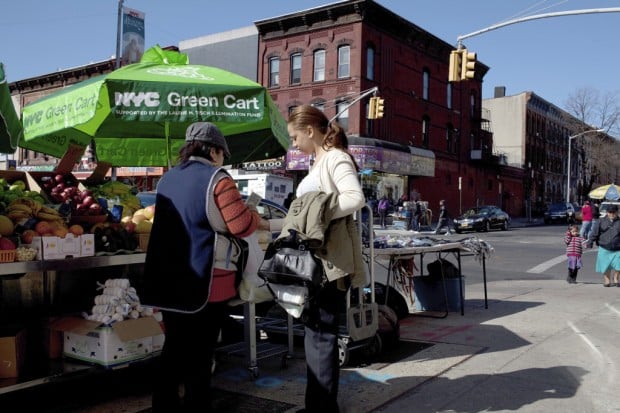
NEW YORK - On the busy commercial strip along Knickerbocker Avenue in Brooklyn's Bushwick neighborhood are all the shops one might expect to find in a poor area branded a "food desert": two 99-cent stores, a check-cashing center and plenty of pizza and fried chicken joints.
But thanks to Alfonso Victor and Elena Ferreira, there's also an oasis of fresh fruits and vegetables. Just about every weekday for the past three years, even in the depths of winter, the couple has set up a produce cart here, piled high with pineapples, tangerines, lettuce, tomatoes and specialty items for the area's Latino community, such as plantains, yucca, hot peppers and cilantro.
Victor, from Mexico, and Ferreira, from the Dominican Republic, are two of more than 500 vendors who participate in New York's Green Cart program, which puts fruit and vegetable carts on the streets in low-income areas with high rates of obesity and diet-related diseases.
People are also reading…
Though green carts are only one of several city strategies designed to encourage consumption of more-healthful food, there is early evidence it is working: In New York's high-poverty neighborhoods, the percentage of adults who said they ate no fruits or vegetables during the previous day is slowly dropping, from 19 percent in 2004 to 15 percent in 2010.
Alarming statistics - more than 70 million Americans are now considered obese - and first lady Michelle Obama's "Let's Move" campaign have focused national attention on efforts to make healthful food more accessible and affordable. New York's Green Cart program is fast becoming a model for other American cities.
Philadelphia launched its Healthy Carts program in 2011. Similar programs are being introduced in Washington; Chicago; Los Angeles; Madison, Wis.; and California's Santa Clara County.
"Green carts are a quick and nimble approach that can get fresh food out there relatively quickly," says Rick Luftglass, executive director of the Laurie M. Tisch Illumination Fund, which has provided $2 million to support green carts in New York. "And because they are mobile, you can follow the need. If sales aren't good on one block, you can move a few blocks away. It allows the market to build around the customers."
Nationally, much of the discussion about improving food access has centered on how to lure supermarkets back to urban areas. But New York's Green Cart program has required significantly less time and investment than large and often-controversial construction projects, says Karen Karp, president of Karp Resources, which provides education and training to green cart vendors. The program required no changes in zoning and no new bureaucracy.
Potential vendors apply for permits through the same process as someone who wants to sell hot dogs or soft pretzels. And barriers to entry are low. On average it costs vendors about $3,000 to get up and running.


