


SIERRA VISTA — No toxic exposures have been detected to explain this city's alarming cluster of childhood leukemia cases, federal health officials announced Thursday.
"We don't know why this cluster occurred. We really wish we had the answer, but we don't," said Beverly Kingsley, an epidemiologist with the federal Centers for Disease Control and Prevention, in announcing the results of a three-year bio-sampling probe of both sick and healthy children and their families in Sierra Vista.
Since 1997, at least 12 Sierra Vista children have developed this cancer of the blood and bone-marrow system, and two have died of it. That's nearly triple the childhood leukemia rate expected in a town of 40,000 during that time period.
"We find nothing to indicate that any action needs to be taken in Sierra Vista," she said.
People are also reading…
In fact, most of the 128 substances measured in the bodies of these children and their families "were low, and often lower than levels usually detected in the U.S. population," a report on the analysis stated.
However, the CDC did find a variation in a gene that controls how the body converts an unsafe chemical to a safe one in all of the leukemia-stricken children and almost half of the healthy children in the study.
Investigators said they didn't know what effect this might have on the risk of leukemia. Stressing that this is a new finding, CDC officials said they will launch larger studies of the gene variance.
Many of the people affected by the leukemia cluster clearly were unsatisfied with the CDC investigation and its results.
"I've been in Sierra Vista for a long time and I've been watching both kids and adults die of leukemia since 1974," said Sue Ivory, a close friend of two families who lost children to this cancer. "We just keep attending these funerals. There's something wrong here. Everyone knows someone who has leukemia or cancer. This has been going on for a long time."
Ivory and several others at a public meeting the CDC held Thursday night expressed concern that the study didn't include enough victims, didn't span a long enough period of time and didn't include environmental testing for toxins.
This booming military town 70 miles southeast of Tucson has been the focus of medical scrutiny for several years, after University Medical Center started treating an unusually high number of leukemia cases in children from the area.
Both state and federal health officials at first resisted investigating the situation, saying cancer cluster probes rarely produce useful answers. But in 2004, the CDC decided to draw and analyze bio-samples of blood, urine and cheek swabs from the surviving leukemia victims and their families, test them for 128 contaminants — including toxic chemicals, metals, pesticides and volatile organic compounds — and compare them with samples from healthy Sierra Vista children. The samples also underwent genetic testing.
Environmental toxins long have been suspected as a cause of trigger for leukemia, although only one, the solvent benzene, has ever been proved to cause it.
After several delays, the bio-sampling got under way in May of last year. Samples were collected from families of five children with leukemia and nine comparison families with non-leukemic children, for a total of 44 participants, then sent to CDC labs for analysis.
CDC officials stressed that the study was a small one, involving only four children with leukemia, which makes it difficult to draw any real conclusions from the results.
"Some people in the study had higher levels of some chemicals in their bodies than levels found in the U.S. population," the report stated. "However, because higher levels were found only in a few study participants, it most likely indicates differences in individual exposures. It is not accurate to try to link the chemicals found in their bodies to having leukemia."
No one in the study had high levels of benzene.
One-fifth of those tested had slightly elevated levels of tungsten, a heavy metal mined in the area, and polychlorinated biphenyls, or PCBs.
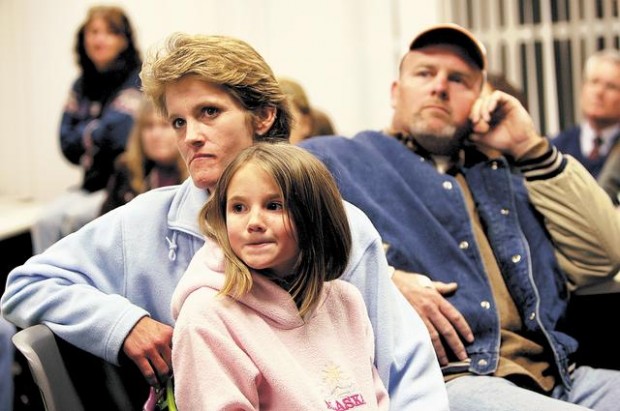
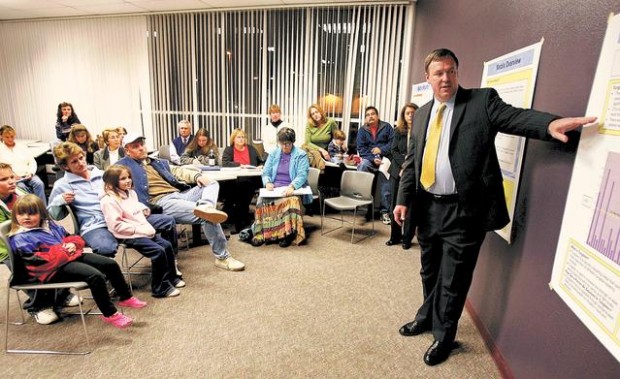
The final results were disclosed first to the tested families, in private meetings with CDC investigators and county health officials. That was followed by the contentious two-hour public meeting attended by about 25 people, most from affected families.
Several repeatedly questioned the low levels of benzene found in the CDC study. Benzene is a main ingredient of the military jet fuel used at nearby Fort Huachuca, residents pointed out.
"The leukemia cluster in Sierra Vista really took off when the military switched to JP8 fuel about five years ago," said Dale Durkit, whose two daughters, Jessica, 8, and Kelly, 13, have been battling leukemia, although only Jessica has lived in Sierra Vista full time.
A two-year Department of Defense study of the military's new jet-fuel formula at six U.S. Air Force bases concluded in 2001 that exposed workers suffered no negative effects from it. However, critics have said that study didn't allow enough time to determine the health effects of the fuel.
Durkit didn't allow his family to participate in the probe by the CDC — which he calls "the Cluster Denial Coalition."
"I knew the findings would be 'inconclusive.' They were inconclusive in Fallon, which has 10 times the leukemia problem we do, so I knew they'd be inconclusive here," he said. "I just was not willing to put my family through all that poking and prodding for no reason."
Several family members of other leukemia victims also expressed concerns about the possible health effects of military jet fuel in Sierra Vista and Fallon, Nev., a town of 8,000 that has had at least 17 cases during this same period. Fallon also is home to a military installation, the U.S. Navy's "Top Gun" jet fighter training facility.
Although jet fuel has always been a suspect, at least among Sierra Vista residents, other theories surfaced after two University of Arizona researchers found elevated levels of the heavy metal tungsten in the Sierra Vista area, specifically in air and tree-ring samples there.
Those results are considered preliminary and unverified at this point, said UA tree-ring specialist Paul Sheppard, who conducted these tests with UA pediatric researcher Mark Witten.
The tungsten issue also surfaced in Fallon, when CDC investigators found extremely high levels of it in the bodies of Fallon children, combined with very high levels of arsenic, a known carcinogen, in Fallon's water. Even so, the CDC concluded in a 2003 report that neither was a factor in the leukemia outbreak there.
"So here you have two towns with leukemia clusters that both have tungsten, mining and the military, and this is just a coincidence? That means nothing?" asked Karen Taylor, whose 14-year-old daughter, Susan, died of leukemia in 2004 after living in Sierra Vista for eight years.
"That's too much. There has to be a connection," she said. "I know the CDC does not want to put Sierra Vista in a panic mode. But if there is something we can clean up, my goodness, let's do it."
On StarNet: Find stories on more health-related issues at azstarnet.com/health


