

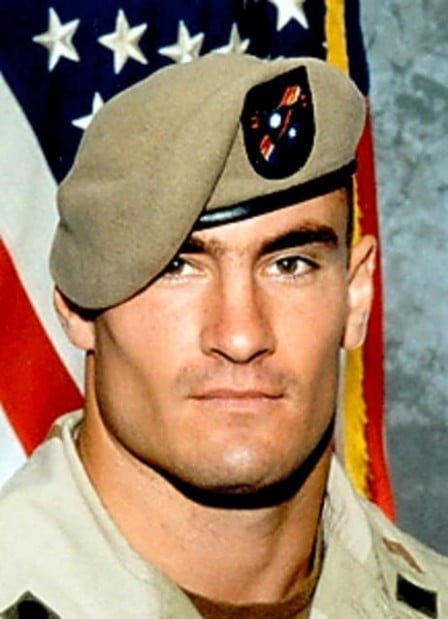
SAN JOSE, Calif. — Patrick K. Tillman stood outside his law office here, staring intently at a yellow house across the street, just over 70 yards away. That, he recalled, is how far away his eldest son, Pat, who gave up a successful NFL career to become an Army Ranger, was standing from his fellow Rangers when they shot him dead in Afghanistan.
"I could hit that house with a rock," Tillman said. "You can see every last detail on that place, everything, and you're telling me they couldn't see Pat?"
Tillman, 51, is a grieving father who refuses to give up on his son. While fiercely shunning the public spotlight that has followed Cpl. Pat Tillman's death, Tillman has spent untold hours behind the scenes considering measurements like the 70 yards.
He has drafted lengthy, sometimes raw, letters to military leaders, demanding answers about the shooting. And he has studied — and challenged — Army PowerPoint presentations meant to explain how his son, who had called out his own name and waved his arms, wound up dead anyway, shot three times in the head by his own unit, which said it mistook him for the enemy.
People are also reading…
"All I asked for is what happened to my son, and it has been lie after lie after lie," said Tillman, explaining that he believed the matter should remain "between me and the military" but that he had grown too troubled to keep silent.
As the second anniversary of the death of Pat Tillman, once a confident, popular Arizona Cardinals safety, approaches, Tillman, his former wife, Mary, and other family members remain frustrated by the Army's handling of the killing but for the first time might be close to getting some of the answers they so desperately seek.
Highly unusual inquiry
After repeated complaints from the Tillmans and members of Congress contacted by them, the Army is immersed in a highly unusual criminal investigation of the killing, and the Defense Department's inspector general, which called for the investigation this month, is looking separately into the Army's conduct in its aftermath.
Senior military officials said Defense Secretary Donald H. Rumsfeld has expressed outrage and fury to top aides that the Army is having to conduct yet another inquiry into the shooting, prolonging the family's anguish and underscoring the failure of the Army's investigative processes to bring closure.
Gary Comerford, a spokes-man for the inspector general, said the Army Criminal Investigation Command was "dealing with events leading up to the death and we're looking at anything after that." Though Comerford did not say so, that could include the possibility of a cover-up, the Tillmans said they were told by the Inspector General's Office.
No one wants answers more than the Tillmans. But by now, they said, they have lost patience and faith that any Army entity, even the Army Criminal Investigation Command, can be trusted to find the truth.
"I am sitting here on my own, going over and over and over this for two years," Mary Tillman, 50, said in a telephone interview. "The whole thing is such a debacle. I am beyond tears. It's killing me."
Like her former husband, she has spent days reading the files, researching the incident, calling members of Congress, even trying to contact some of the soldiers involved. She criticized the military, as well as the news media, for failing to get to the bottom of what occurred, leaving her family, in essence, to figure it out themselves.
All of it, her former husband said, has even left him suspicious of the military's central finding in their son's case so far — that the killing was a terrible, but unintentional, accident.
"There is so much nonstandard conduct, both before and after Pat was killed, that you have to start to wonder," Patrick Tillman said. "How much effort would you put into hiding an accident? Why do you need to hide an accident?"
Destruction of evidence
An examination by The New York Times of more than 2,000 pages of documents from three reviews by the Army reveals shifting testimony, destruction of obvious evidence, and a series of contradictions about the distances, lighting and other details surrounding the shooting.
Seven Rangers have received administrative disciplines but the criminal inquiry is for the first time examining whether the soldiers broke military law when they failed to identify their targets before firing at Tillman's position.


