Maria Elena Coronado was a 19-year-old student at Arizona State University the first time she met Dolores Huerta in 1990.
Huerta, the co-founder of the United Farm Workers with Cesar Chavez, was on the ASU campus to meet students and recruit them to work for the farmworker movement.
Coronado grew up reading about the pioneering labor and civil rights icon in books and newspapers. Now she found herself standing in the same room with Huerta.
"I was completely intimidated by this very small women," Coronado, 55, recalled.

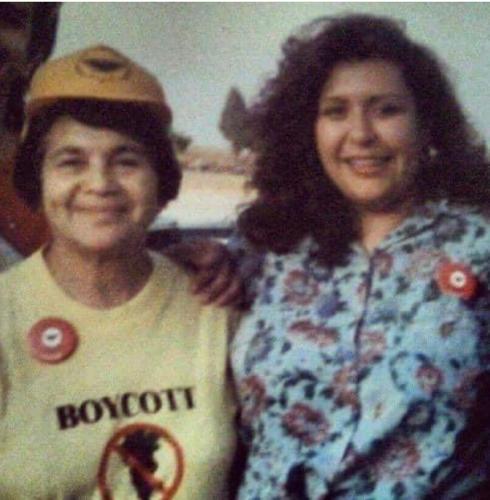
Maria Elena Coronado, right, with Dolores Huerta in the 1990s, when Coronado worked closely with Huerta at the United Farm Workers.
"I knew what she stood for and that she had so much determination," Coronado said. "She really knew how to organize and get her message across and being in that small room within her presence was just awe inspiring. But also very intimidating."
Huerta died Oct. 28 at age 96, prompting Coronado and others to recall memories of Huerta and her deep ties to Arizona, including coining the iconic phrase "Sí, Se Puede" in Phoenix, which became a rallying cry for the farmworker and civil rights movements during times of seemingly insurmountable odds.
People are also reading…
During her years at ASU, Coronado continued to attend student meetings with Huerta. In 1993, Coronado accepted Huerta's request to work for the summer as a volunteer for the UFW's national constitutional convention, a pivotal year after Chavez's death on April 23, 1993.
"She was looking for people to come out and volunteer and so I was like, I've got nothing to do. I can go and help out. I've got time to spare," Coronado said.
Coronado drove to the UFW's headquarters in Delano, California, where she was shown a stack of documents sitting on a desk and told to type them into a computer.
"I didn't actually know what the documents were but they were definitely important documents that were going to change the direction of the leadership of the United Farm Workers," Coronado said.

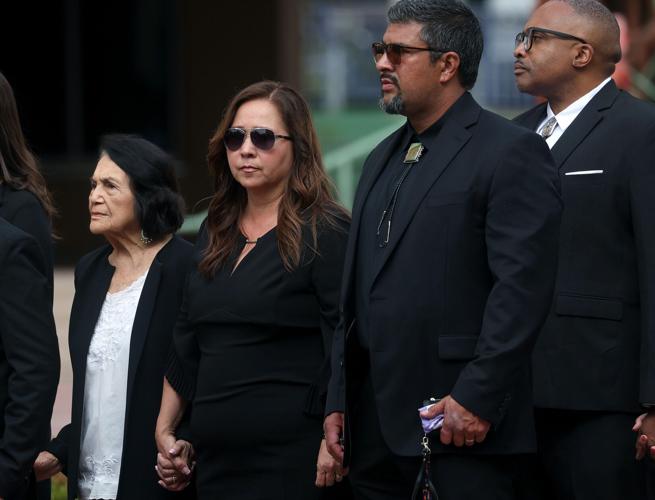
Adelita Grijalva, second from left, holds hands with Dolores Huerta, far left, as they walk in for the funeral mass of Grijalva's father, U.S. Rep. Raúl Grijalva, at St. Augustine Cathedral in Tucson on March 26, 2025.
'She was like another Tia'
Coronado ended up working for the UFW for three years, shuttling back and forth between California and Arizona. During that time, Coronado worked closely with Huerta.
Huerta was full of energy and demanded a lot from her workers. She gave Coronado loads of responsibility right from the start and expected loyalty. But she was also kind and warm, Coronado said.
"Once you got to know her, she was like another Tia," Coronado said. "She got to know you. She was interested in you."
Huerta sent Coronado and other volunteers to farmworker communities during the grape boycotts of the 1990s to find workers to talk publicly about the conditions they faced in the fields.
"The United Farm Workers union was trying to make a case for the pesticide usage on grapes and how they were affecting farmworkers and the amount of chemicals that were going into the local water system that were affecting not only farmworkers, but the entire farming community," Coronado said.
In Phoenix, Huerta depended on Coronado to pick her up at the airport and drive her to meetings and events. Huerta often asked Coronado to accompany her to negotiations between the UFW and agribusiness lawyers, including during meetings with the Agricultural Employment Relations Board of Arizona.
Coronado was struck by how she and Huerta were often the only women in the room, Coronado said.
"She'd invite me into these meetings where I as a 20-something didn't feel like I belonged," Coronado said. "These were meetings with attorneys and discussing what were the outcomes that the United Farm Workers was looking for" to give farm workers "a better compensation, a better work environment, a safer work environment and we were usually the only two women in the room. "
Coronado realizes now Huerta was developing her as a leader.
"I think she always knew that I could do it but she needed for me to get out of my own way by just continually giving you more responsibility," Coronado said. "Sometimes I felt like it was stuff that I'd never done before, things that people with law degrees would do or people with a master's degree were expected to know and she didn't care about that. She just needed to know if you could do it. A lot of mistakes were made, but she was OK with that because it was a learning situation."
Coronado now runs her own consulting firm after a two-decade career at ASU focused on the success of first-generation and multicultural students.

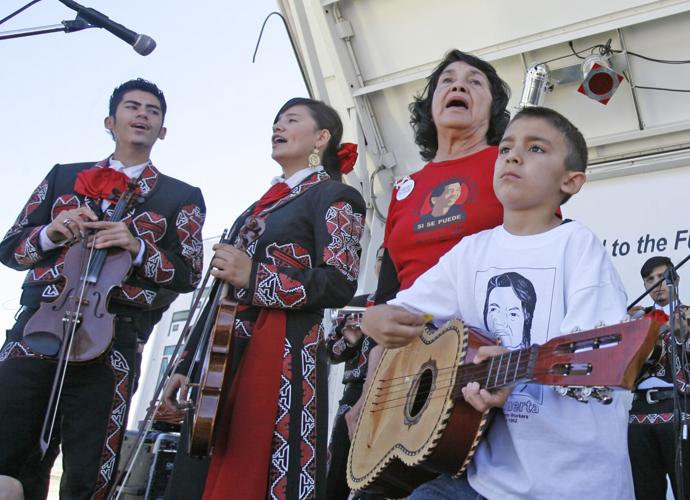
Dolores Huerta, second from right, sings Las Mananitas, a traditional Spanish birthday song, with Salvador Martinez, far right, and the members of the group Mariachi Las Aguilas de Aztlan at Rudy Garcia Park in Tucson on March 31, 2007.
Huerta created rallying cry in Arizona
Huerta was born in 1930 in Dawson, a coal-mining town in New Mexico, but in the 1950s became involved in the farmworker movement in California, where she later partnered with Chavez and co-founded the National Farm Workers Association, which became the United Farm Workers union.
Huerta began coming to Arizona in the early 1970s to help mobilize workers against legislation that restricted farmworkers' rights to organize, strike and boycott.
She continued to travel here regularly for decades in support of various political causes and candidates.
In April 2010, Huerta came to Arizona to denounce Senate Bill 1070, Arizona's sweeping immigration enforcement law.
In 2014, Huerta also came to Arizona to show her support for Ruben Gallego, who is now a U.S. senator. At the time, Gallego, an Arizona Democrat, was running for a House seat in Congress.
In 2018, Huerta came to Arizona to oppose former Maricopa County Sheriff Joe Arpaio's bid for a U.S. Senate seat representing Arizona.
In 2024, Huerta attended a rally in Arizona to demonstrate her support of Kamala Harris for president.
More recently, Huerta spoke during a celebration of life gathering in March 25, 2025, in Tucson for U.S. Rep. Raúl Grijalva, a progressive Democrat who had died earlier that month.
U.S. Rep. Adelita Grijalva, D-Arizona, Grijalva's daughter, said she was "heartbroken" by Huerta's passing, calling her "an American icon, and a trailblazer whose courage, conviction, and lifelong fight for justice changed the world."
"Generations of Latinas, including myself, stand on Dolores’s shoulders and have had doors opened to them because of the glass ceilings she shattered," Grijalva said.
Former Phoenix City Council member Carlos Galindo-Elvira met Huerta numerous times during her visits to Arizona, but he'll never forget the first time during an event at Valle del Sol, the nonprofit community health organization where Galindo-Elvira worked.
"It was like shaking the hand of history," Galindo-Elvira said.
"There's no doubt that she leaves an immeasurable void within our communities across the nation because she had this unshakable belief about people power and the idea that people joining forces could move mountains, could change policy, and could make life better for everyone," he said.
In May 2022, Huerta returned to Santa Rita Hall in the Campito barrio in central Phoenix to recount the circumstances that led her to declare the phrase that became a rallying cry for the farmworker movement, Sí, Se Puede.
The farmworker movement was facing one of its most significant battles in Arizona against a state law that restricted the ability of agricultural workers to organize into unions.
At that time, Chávez began a protest fast at Santa Rita Hall, while Huerta sought support from community leaders to challenge the legislation. During a meeting, some of the leaders responded that the changes she was proposing could not be achieved in Arizona, a state known for its staunch anti-union policies.
“No, it can’t be done in Arizona,” they told her.
Huerta refused to accept the answer. “Sí se puede en Arizona," Huerta responded. Yes, it can be done in Arizona.
When Huerta returned to Santa Rita Hall that night and recounted what had happened earlier, "Everybody stood up and they started clapping. They started clapping Sí Se. Puede."