Construction has just begun nearly four years after plans for a massive $1.2 billion battery manufacturing plant were approved in 2022 for nearly 300 acres of desert south of Tucson's airport.
American Battery Factory held a groundbreaking ceremony in October 2023 for a massive 267-acre “gigafactory” that included Gov. Katie Hobbs and Tucson Mayor Regina Romero donning hard hats and smiles. The project promised hundreds of local jobs making lithium iron phosphate battery cells, or LFPs. Since then, the Pima County Board of Supervisors has amended its lease agreement with ABF every year to extend the estimated completion date, now pushed to 2028.
The company faced challenges securing funding to cover an estimated $525 million for the plant’s first phase, ABF President John Kem said in an email interview.
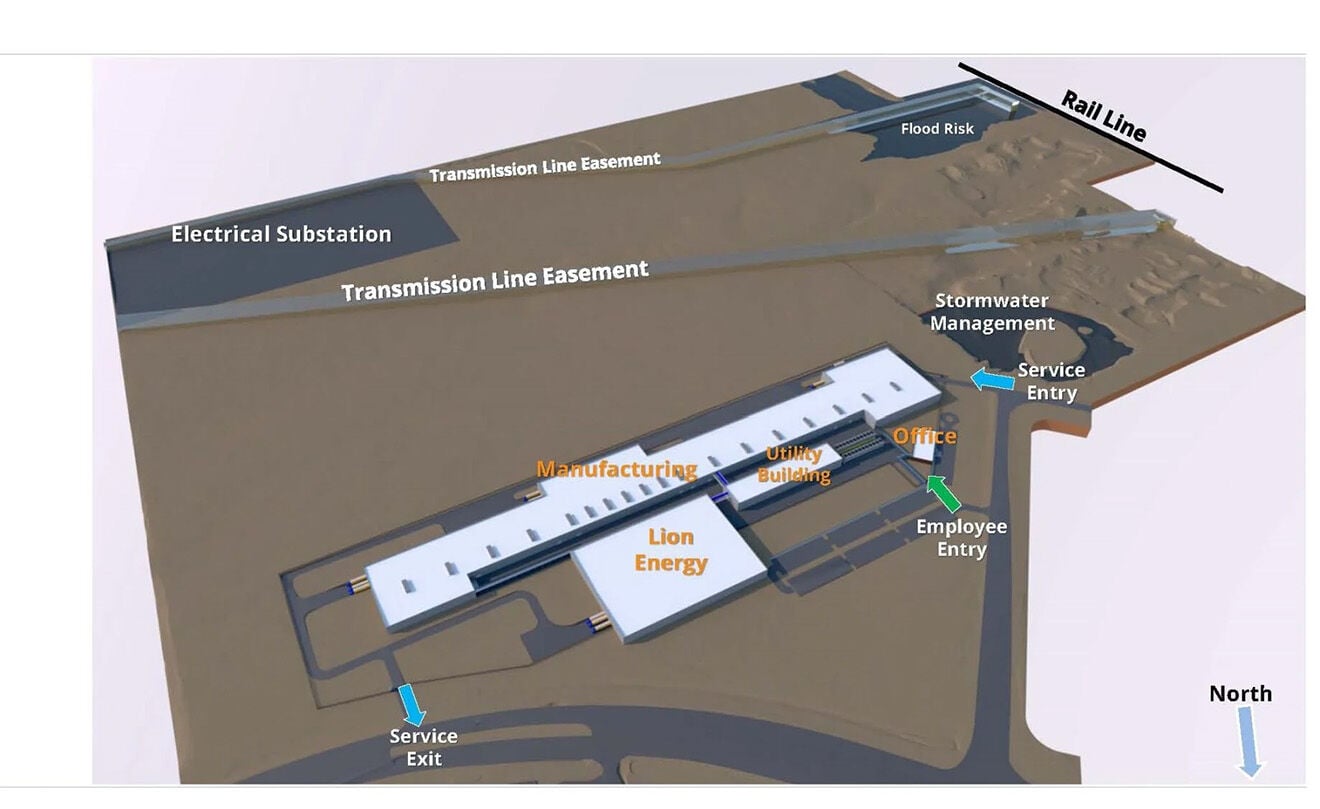
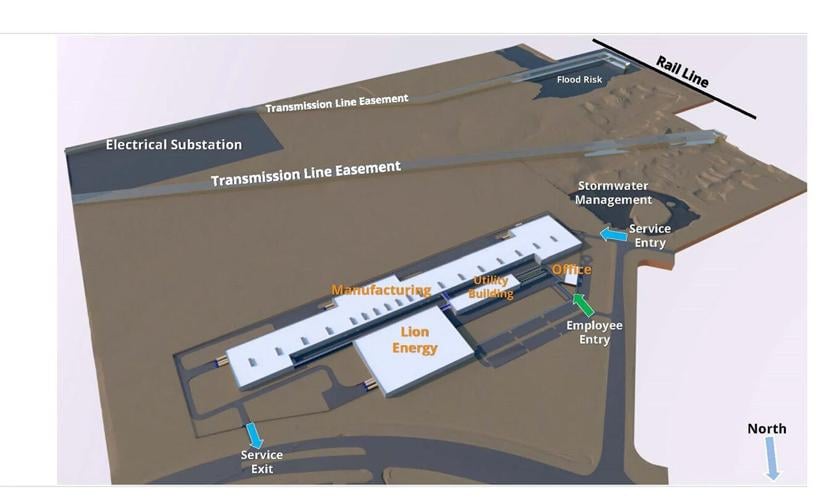
A site layout illustration of the American Battery Factory lithium ion battery manufacturing plant south of the Tucson International Airport. The project was approved in late 2022 and has faced a series of funding challenges, delaying construction until late this year.
Securing funding was difficult partly due to increased scrutiny from lenders, when two similar battery manufacturing startups folded in the last two years, Kem wrote in a Nov. 16 update to the Board. Swedish startup Northvolt declared bankruptcy in 2025, and Idaho-based Kore Power canceled plans last year to build a similar battery manufacturing facility in Buckeye, after raising money for nearly as long as ABF, Canary Media reported.
People are also reading…
Kem said the Pima County project is still happening, and he expects a final deal to close in “late November,” he wrote to the Board.
“It is absolutely attainable and sustainable,” he said.
The lender’s hesitancy is because LFP manufacturing has not been done at this scale in the U.S., and their scrutiny should build public confidence, Kern said.
“It makes us better for having worked through hard questions,” he said.
What will ABF produce?
LFP batteries are mainly used in energy storage and electric vehicles, said Drew Tyger, a Tucson resident who sells equipment to other battery manufacturers and is familiar with the industry.
The type of batteries ABF wants to produce will contain iron and phosphorus instead of cobalt and manganese, Tyger said. Companies can avoid the human rights concerns and environmental risks associated with these minerals, with only slight compromises on capacity.
“You can't store as much energy in it, but it's still good and it's cheaper,” Tyger said.
Kem said the iron and phosphorus combination is also safer than other batteries, because it has a higher burn temperature.
The final battery cells look similar to a desktop computer, and are stacked horizontally in cabinet-like structures when used to store energy, said Supervisor Matt Heinz, who represents the project area. Tucson Electric Power’s Roadrunner Reserve facility stores energy using this technology, as a local example.
As large-scale infrastructure continues to face scrutiny in Pima County, Heinz and Kem said battery manufacturing is less-resource intensive than similar projects like data centers and chip manufacturing plants.
“In terms of power, we are nothing like the demand that a data center uses, easily 10 fold less than a data center or more,” Kem said.
The facility’s water use estimates are mostly for cleaning and domestic water use needs, Kem said.
More U.S. batteries, officials agree
One official at the 2023 groundbreaking said the event made southern Arizona “a player in the clean energy revolution.”
Battery manufacturing was one focus of the Biden administration’s massive investment in clean energy, in an effort to compete with China, which has dominated the market for these types of batteries.
However, within days of his second term, Trump paused or canceled billions of dollars in federal funding authorized under the previous administration, including $850 million for Kore Power’s now-canceled Buckeye plant.
Kem said ABF applied for Department of Energy funding under Biden, but didn’t receive one despite some positive feedback.
“We heard indirectly that the priority was on early raw materials supply and recyclers, with very little focus on actual scale production, which is still lacking in the U.S.,” he said.
Kem said both administrations have benefited his company and has not experienced rollbacks like Kore Power’s. He credits the technology as bipartisan.
“Both Democrats and Republicans are for a better, more resilient, reliable grid, so it transcends politics at the very foundation. U.S.-made battery cells reinforce that and are essential,” he said.
The Trump administration has “reinforced” Biden’s incentives for increasing U.S.-made batteries, Kem said. Just over a month ago, the Trump administration announced new lofty goals under the Department of Energy’s Strategy for American Leadership in Batteries. The plan aims to build the U.S.’s battery supply chain by 2030, and make the U.S. a leader in manufacturing by 2035, according to an DOE news release.

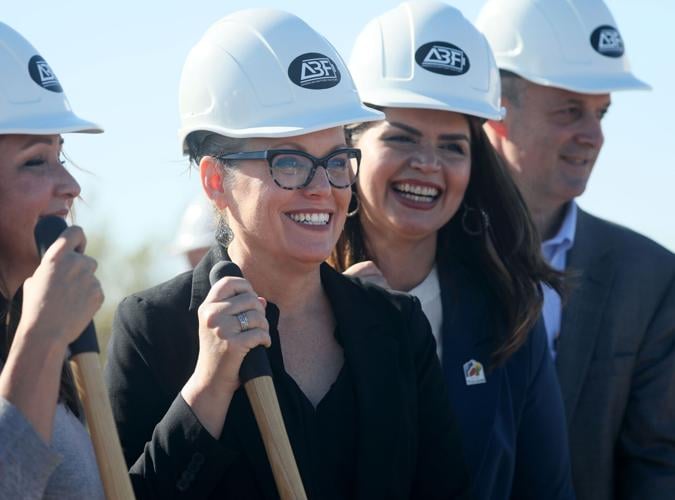
This October 2023 file photo shows, from left, Rep. Adelita Grijalva, then a Pima County supervisor, Gov. Katie Hobbs, Mayor Regina Romero and John Kem, the company president, sharing a laugh during a groundbreaking ceremony for the American Battery Factory that's still set to be built south of the Tucson International Airport.
What's next
Heinz said he has been in communication with Kem and ABF officials, and is still excited for the projected 1,000 jobs the fully built factory is expected to bring to Pima County despite the delays.
“We have a pretty solid explanation as to what's been going on,” Heinz said. “The three-plus year delay, not a fan of that, but really, really pleased that it is now coming to fruition.”
Kem said erosion control and constructing roads for the build will be starting in December.
Heinz also expressed an interest in potentially connecting ABF with Beale Infrastructure, currently building the Project Blue data center a few miles away, although no official plans have been confirmed.
“If Beale is going to do a lot of on-site storage, they should just buy the batteries from the place producing them down the road,” he said
Hannah Cree covers local government for the Star. Reach her at hcree@tucson.com.

Hannah Cree
Government Reporter