

On the warm, parched evening of July 20, 2019, a forest thinning project in the Dry Lake Hills in Flagstaff became ground zero for a $9-million wildfire.
An excavator struck rock and threw sparks, but the operator failed to detect the smolders. By next morning, flames were licking across the forest floor, devouring the grass turned to tinder by a late and reticent monsoon. Within 24 hours, the flames would balloon 1,000 acres into what became the Museum Fire.
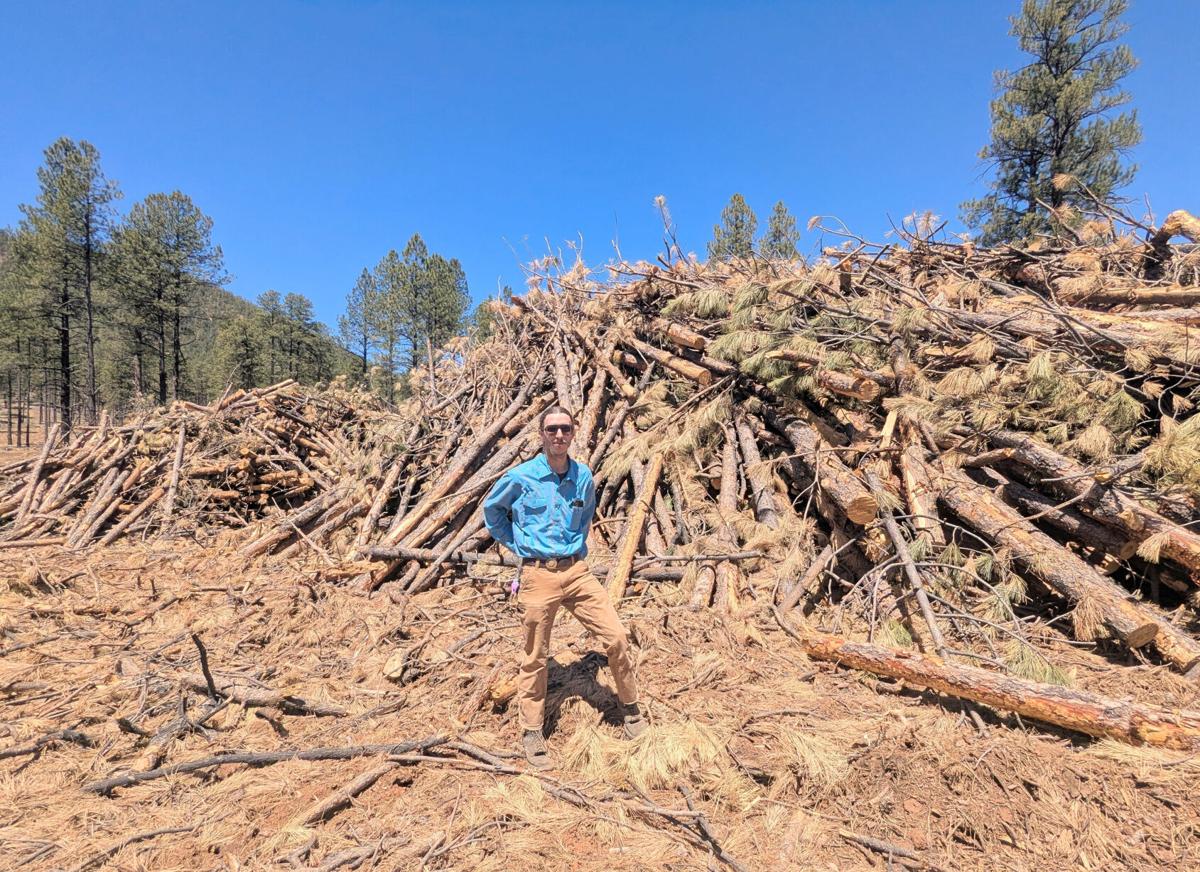
But the problem began long before the first spark flew. In thinning operations that started weeks before, managers didn't have enough money for removing all the wood that the workers sawed up. Piles of logs and branches sat among the uncut pines, a fire hazard on a fire-prone landscape, pyres waiting to burn.
“You had all this biomass just laying there in the forest,” said Jay Smith, the forest restoration director for Coconino County. It “created even more of a problem” once the flames encroached.
People are also reading…
Treating forests to mitigate future fires is only as effective as getting rid of the detritus it generates. But dealing with this leftover wood, whether as trash or a salvageable commodity, isn’t as simple as it sounds, and is often expensive.
At the heart is a waste management issue, involving a flammable kind of byproduct that’s generated far from urban centers.
But a new company aims to make something valuable out of this woody waste. The Arkansas-based startup Graphyte has entered agreements with Coconino County to squeeze forest thinnings into dense pellets, then stash them underground.
Not only would such a move ease the biomass oversupply issue, it’s also a potential climate solution. Locking up the organic carbon underground and stalling its natural decay, in theory, would keep carbon from returning into the atmosphere.
Still, so nascent is the idea behind the technology that its climate and wildfire benefits remain to be seen. Plus, uncertainty surrounds whether the project’s funding mechanism, which is through the carbon market, is sustainable in the long term.
To answer all these questions in one swoop, Project Ponderosa in the Coconino National Forest will be Graphyte’s first trial by fire.
Currently, the company is awaiting permits from the Arizona Department of Environmental Quality and looking for a suitable location to park its machinery. Intake of wood fiber from Arizona’s forests is expected to commence in early 2027.
What do you do with leftover forest debris?
The work of mitigating fire risk in forests presents a major problem: Pruning forests produces too much biomass with no place to put it.
It's a major bottleneck in the much-needed effort to restore the West’s overgrown forests in the age of drought and megafire. Commercial logging churns out marketable timber, but thinning operations target younger trees and leave the mature ones intact, so they result in skinnier wood with little value and few uses.
The go-to disposal method is to burn slash piles on site. But the practice generates air and water pollution, disrupts forest ecology and comes with the risk of triggering new fires. Such was the case for the 2022 Calf Canyon Fire in New Mexico, which merged with another inferno to become the largest in state history. The wildfire started from an improperly extinguished pile burn that smoldered under the snow all through winter.
As dangerous as slash pile burning can be, it’s a necessary part of forest thinning operations. Already, that’s falling behind the pace of cutting needed on a fire-starved, climate-ravaged landscape of the West. In pine forests across the region, bark beetle infestations have forced managers to fell swaths of dead trees in a hurry to contain the arboreal contagion. In northern Colorado where forests have been hard hit, over 140,000 bus-sized slash piles wait to be purged for good.
“With warming temperatures, pile burning becomes more risky,” Smith said. "We have decided it's worth it to pay a little bit more to make sure we do get rid of the biomass.”
He’s referring to the alternative of trucking the woody scrap out. Two options follow: The debris often ends up in a wood-burning power plant in Snowflake, or a landscaping factory that repurposes barks and chips into gardening supplies. Both processing plants are 150 miles away from Flagstaff — quite the hassle to get to from the middle of the forest. Plus, those plants impose dimensional and quality restrictions on the wood that they can accept.
Graphyte’s service belongs to the emerging field of carbon biomass removal, originally conceived as a solution to the climate crisis. Plants are nature’s best tool for pulling carbon from the atmosphere. Where companies like Graphyte come in is to devise processing techniques to freeze decomposition of that organic matter so that the carbon in the deadwood can be sequestered in perpetuity.
The final carbonaceous product takes various forms, usually unrecognizable from their biological origins. Graphyte fashions plant material into bricks or pellets using a method it calls “carbon casting.” Other high-temperature, low-oxygen techniques transform organic waste into a kind of charcoal called biochar that can be used as a soil amendment.
In another instance, the company Charm Industrial turns leftover corn stalks into an inky goo it calls a bio-oil that can be injected underground for long-term storage.
When Coconino County officials came across Graphyte, they recognized its methods could come in handy for a different reason. It presented a relief valve for the vast surplus of wood fiber from forest treatment, thereby allowing forest managers to speed up thinning operations to match the urgency of mitigating climate-driven wildfires. The climate benefits were a bonus.
How the new tech works
Graphyte’s method promises the rapid removal of flammable material with little-to-no pollutive blowbacks. The process hinges on wringing every last drop of water from the debris to halt decomposition. First, the wood pieces are desiccated at a relatively low temperature — just above the boiling temperature of water — then squeezed into slabs.
The resulting bricks or pellets are then sealed underground. Sensors will monitor the vault for any greenhouse gas leakage.
The nemesis of Graphyte’s carbon solution is humidity. In the presence of moisture, microbial decomposers such as fungi and bacteria feast on the dead material and liberate organic carbon as carbon dioxide and methane. Fortunately, Arizona is quite the arid place to begin with. As an extra layer of protection, Graphyte’s pellets will be encased in several layers of polymer to keep out any water.
“The site is all designed for a thousand years of durability,” said Hannah Murnen, Graphyte’s chief technological officer. Another advantage is that it can take in any kind organic waste, and in any size.
The longevity of Graphyte’s subterranean stash boils down to careful site selection and drainage design for its burial chamber, Murnen added. Ideally, the burial place needs to be in a seismically quiet location, outside a flood plain and above the water table to prevent the intrusion of groundwater.
Graphyte has already identified a site that checks all these boxes. In what will be the first trial in Arizona, Graphyte’s pellets will fill in a 50-foot-deep hole that was a former cement aggregate mine on Babbitt Ranches in Flagstaff. The 100-acre parcel of land will then be rehabilitated into a bat conservation site.
Graphyte’s burial method can intake anywhere between 3,000 to 5,000 acres of cuttings per year. The mine site has a storage capacity for thinnings of up to 200,000 treated forest acres.
Back-of-the-envelope calculations suggest that burying biomass can eliminate millions of dollars in transportation costs for lugging the waste out. According to Smith, it costs up to $14 per mile to haul one ton of branches, twigs, pine needles and other brush material away. In comparison, on-site pile burning costs only $4-6 per ton, mostly for the labor of monitoring a burning heap.
Coconino County aims to ramp up forest restoration to a clip of 40,000 acres treated annually. So Graphyte’s technology is necessary but far from sufficient for eliminating the demand-supply imbalance of forest residue. Nevertheless, the process would free up funding for other avenues of wood removal, since Graphyte’s operations come self-funded.
“It could really help us,” Smith said. “We wish they were here right now.”
Meanwhile, the county — still far from its target pace — is also looking for other solutions to get rid of the vast quantities of wood from all the treatment.
“We'll bring in any company that's willing to come in and invest if they can create a product that has value,” Smith said. “We'd love to have multiple Graphytes here.”
Is it too simple to be true?
Biomass burial is an efficient way to remove carbon from the atmosphere, according to Joe Sagues, a researcher in biological and agricultural engineering at North Carolina State University. Processing is often minimal, so in theory it typically requires little energy to transform raw wood into its final resting form.
“We sometimes get the question, ‘this seems too simple, shouldn't we be doing something different?’” Murnen said. “But I think the strength of that is, because it is so simple, we can scale now.” She points to the lack of technical risk as a major selling point.
Graphyte claims that its carbon efficiency, the emissions savings after accounting for the plastic use and energy consumption from heating and compacting, is 90%. The figure is plausible, Sagues said, if one elephant-sized assumption proves true: that no chemical reversal happens.
That in turn depends on how long Graphyte can waterproof its burial chambers and keep its pellets bone dry. The company’s website touts its carbon sequestration as “permanent.” But whether the claim holds up may only come to bear after decades of scientists monitoring the underground carbon stocks.
Uncertainties surround the credibility of carbon biomass burial’s sales pitch. The newfangled field only cropped up in the last decade — the official term was coined in 2021 — and its bedrock ideas went straight to scale in the tech startup world without passing through the full scrutiny of institutional research and peer review.
“I do think it warrants some caution, because of just how quickly it's moving,” Sagues said.
Moreover, Graphyte’s success also rests on the consistency of landownership. Should the Babbit Ranch burial site switch owners — highly possible with a 1,000-year lifecycle — there’s no guarantee that the new stewards will maintain the site to ensure that the carbon cache remains sealed. Any disturbance to the chambers, especially if it perforates the walls, and the climate benefits that Graphyte promises will go up in smoke.
Questions about using the carbon market
Graphyte plans to fund the project through the voluntary carbon market. On this platform, big emitters such as airline companies, energy intensive manufacturers and venture capital firms can buy a virtual currency called carbon credits from sellers carrying out purportedly carbon-negative enterprises. In this roundabout way, buyers can neutralize their carbon footprint to fulfil emission reduction targets.
In early April, Graphyte announced that the first customer for its Arizona trial was JPMorgan Chase. The company will fund up to 60,000 tons of biomass burial.
Graphyte has already leveraged the carbon market to finance a similar venture in Arkansas, the top rice-producing state in the country with a different flavor of the same biomass excess problem. Since 2024, the startup has been entombing rice-hulls-turned-bricks from agricultural mills to convert a former gravel mine into a community park.
Like the emissions-busting techniques behind biomass burial, the carbon market is also a recent invention, one that brings in funding for climate projects that lack an obvious pathway toward profit. But the market is often volatile. Investor confidence is subject to the whims of government policy and geopolitics that alter corporate appetites for bankrolling ambitious climate fixes.
In 2023, due to negative press and growing doubts about the climate impacts, investment in the carbon trade slumped, wiping millions of dollars off the market.
“Our biggest concern would be that the carbon market stays healthy enough,” Smith said. “If that somehow went away, then (Graphyte) will have lost their way of making the money they need to be here.”
Other criticisms of carbon markets abound, especially in how carbon offsets are tallied. Research has shown that sellers frequently exaggerate the climate benefits of projects, sometimes to the point of fraud. Opponents also argue that carbon trading gives spewers the license to pollute under a greenwashed façade, a way to wriggle out of revamping their emissive practices in the first place.
The carbon market is far from perfect, but efforts are underway to improve transparency, regulation and carbon accounting metrics. In the meantime, it’s one of the few financing mechanisms that runs on the world’s capitalistic gears, a penance of sorts for its push for infinite growth that’s often at odds with the environment.
For all the dubious projects that garnered funding, the carbon market has also notched some genuine wins, unlocking cash from the private sector for urgent undertakings that would otherwise not see any money at all. Including wildfire mitigation.
In drought-stricken, flammable Arizona is already behind on forest treatment, so it can’t afford to wait.


