PHOENIX — A new state law is designed to make it difficult, if not impossible, for those who commit domestic violence to get custody of their children or to have unsupervised visits.
It expands what is considered domestic violence to include someone exercising "coercive control'' over the other.
This sea change in state law can be traced to the advocacy of Hope Hooton, a Surprise woman whose ex-husband killed their two children during an unsupervised visit and then killed himself.
There are already laws that instruct judges how to make decisions about what happens to children when couples divorce. They require judges to prioritize the best interests of the child in determining whether there is joint custody, under what conditions visitation times can occur, and which parent gets to make decisions.
But it left too much in a gray area, said Glendale Republican Rep. Lisa Fink.
People are also reading…

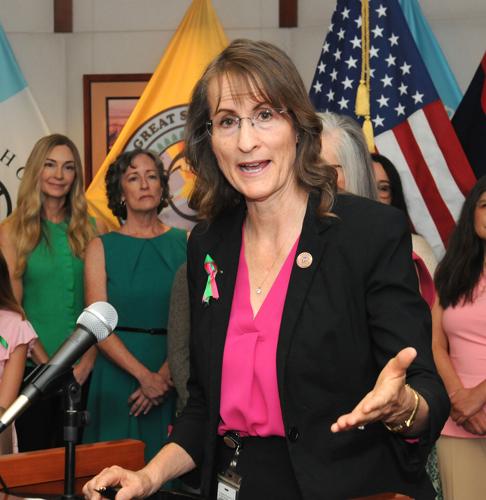
State Rep. Lisa Fink answers questions Thursday about a new law designed to expand the definition of domestic violence in a way designed to protect children.
Consider, she said, prior law that said a judge needed to determine if there was "significant domestic violence.'' Even the judges said that language is problematic, she said.
"What is 'significant domestic violence?' '' Fink said. "Is it two black eyes is 'significant' when one black eye is not?''
The new law removes the word "significant.''
There's also much more in the first significant overhaul in years of laws governing family court.
It starts with the premise that decisions about custody and visitation and the like are supposed to be made in the child's best interests.
But it adds to that a presumption that any history of domestic violence by one parent against another is, by definition, not in the child's best interests. That is true even if the child doesn't know what one has done to the other, it says.
Under the new law, judges also are required to consider evidence from various sources including law enforcement, medical records, witness testimony and records from domestic violence shelters.
It also prohibits a court that has determined there has been domestic violence from requiring the victims to prove that it was "severe or frequent enough'' to justify restricting the assailant's decision-making or parenting time.
And it specifically says a parent who committed domestic violence cannot get unsupervised — or, in some cases, supervised — parenting time unless that person presents "clear and convincing evidence'' such restrictions are unnecessary.
Abuse of mother indicates danger to children
The big push behind the bill came from Hooton.

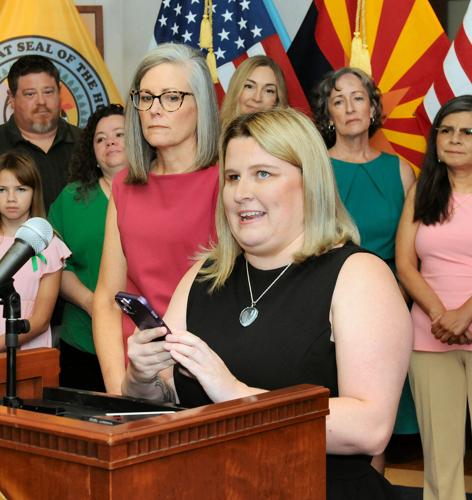
Hope Hooton talks Thursday about a new domestic violence law in Arizona, named the "Alec and Lydia Act'' in honor of her two children, who were killed by her ex-husband. "While nothing can take away my pain and nothing can bring them back, this law ensures that their light will never go out,'' she said. "Their names and their love and their sweet spirits will live on for generations to come through every child that is saved through the Alec and Lydia Act here in Arizona."
During hearings on the measure, she detailed for lawmakers her ex-husband's history of mental and physical violence, including strangling her and stabbing her in the leg.
"He controlled our finances, what I ate, and how I exercised,'' she testified. "He called me degrading names and threw objects at me.''
But Hooton said there was never any abuse directed at the children.
All that came crashing down when Brock Mater, her ex-husband, had the children in 2024 for an unsupervised visit, and shot and killed 7-year-old Alec and 4-year-old Lydia, then took his own life.
Fink said Thursday that the facts of that case form much of the basis for the new law, linking violence by one partner against the other to that assailant's potential danger in the future to the children.
"That's something that we have seen over and over again: When there has been domestic violence that it does put the children at risk,'' she said.
In Hooton's case, she told lawmakers that after she filed for divorce, she obtained an order of protection against her husband — an order that did not include Alec and Lydia.
"The court did not fully evaluate strangulation, coercive control, suicidal or filicidal ideation (recurring thoughts about harming or killing one's child), and acute psychiatric instability before granting unsupervised parenting time,'' Hooton said.
"In family court, mothers are often told, 'He was abusive to you, not the children,' '' she said. "This bill recognizes that the research already tells us that abuse of a mother is a warning sign of danger to the children.''
'Coercive control'
The other significant change is the expansion of what is considered domestic violence to include "coercive control.''
Patricia Madsen, managing attorney for the family law practice at Community Legal Services, said that is a key part of domestic violence.
She said people understand the concept of physical violence.
"But coercive control is that thing that keeps victims and survivors in that relationship,'' Madsen said.
"It cuts off their access to financial ability to leave a situation, isolation from friends and family,'' she said. "So when people ask the question, 'Why don't they leave?' coercive control is the answer.''
At a ceremonial bill signing Thursday — the actual law took effect in June when it was officially signed by Gov. Katie Hobbs — Hooton said she hopes the legislation, named the "Alec and Lydia Act,'' will make a difference.
"While nothing can take away my pain and nothing can bring them back, this law ensures that their light will never go out,'' she said.
"Their names and their love and their sweet spirits will live on for generations to come through every child that is saved through the Alec and Lydia Act here in Arizona,'' Hooton said. "I can make sure that other Arizona families and children are safe and nobody goes through the unimaginable loss of losing children in this way.''
Howard Fischer is a veteran journalist who has been reporting since 1970 and covering state politics and the Legislature since 1982. Follow him on X, Bluesky and Threads at @azcapmedia or email azcapmedia@gmail.com.