PHOENIX — Attorney General Kris Mayes will not bring charges against Gov. Katie Hobbs in connection with an alleged pay-to-play scheme.
In a new report Friday, the attorney general acknowledged that the state awarded a pair of large increases in payments to Sunshine Residential, a company that provides beds for children in foster care.
She also said records show the company had given $400,000 to the governor's inaugural fund and the Arizona Democratic Party and that Hobbs herself had been friends with company owner Simon Kottoor.
But Mayes, a Democrat like the governor, said her investigation found no evidence that there was any bribery or that the Department of Child Safety gave the extra money to Sunshine Residential because of the company's links to the governor.
"After two years of investigation, consisting of multiple interviews, reviews of campaign-finance records, procurement records, bank documents, and state emails and chats, totaling over one terabyte of data, including more than 100,000 documents, the investigation has not uncovered any evidence of the necessary quid pro quo to support a bribery charge,'' Mayes said.
People are also reading…
She said that is backed by a report prepared by Nick Klingerman, chief of the attorney general's criminal division.
The report also says there is no evidence Kottoor or anyone from Sunshine offered any kind of bribe.
"Sunshine's political contributions and Kottoor's close relationship with Gov. Hobbs, as discussed in various news articles, is insufficient to support charging an offense without a quid pro quo,'' he wrote. That's a legal reference that means "this for that" or "something for something."
"Rather than the result of a bribe, the investigation has found that Sunshine's rate increases appear as a result of its outsized leverage over DCS's congregate care program,'' Klingerman wrote.
Specifically, he said, Sunshine provided services the state needed, including space DCS needed as well as housing for brothers and sisters together.
Also, Sunshine had told DCS that without a significant increase in what the state was willing to pay, it would reduce the number of beds it would make available to the agency and instead contract with the U.S. Department of Homeland Security, which was willing to pay more.
'A need for legislative reform'
But Mayes said that what happened here shows there are problems with the system of awarding contracts.
"Declining prosecution is a conclusion about the legal standard for charging a case, but this case shows there is a need for legislative reform,'' she said.
"The Legislature and the governor have the power to ensure greater transparency with regard to political donations made by state contractors,'' Mayes said. "I am urging them to work together and try again to pass legislation that does so.''
What Mayes did not mention is that Hobbs twice vetoed a measure approved by the Republican-controlled Legislature that would have required anyone bidding on a state contract to disclose all donations made in the prior five years to the governor, anyone running for the office, and all of their political committees.
In her latest veto, Hobbs called the measure written by Sen. T.J. Shope, a Coolidge Republican, a "political stunt that applies only to one elected official.'' Shope said that was just an excuse, particularly as it is the governor's office and agencies under its control that have sole authority to decide who gets state contracts.
In a prepared statement Friday, gubernatorial press aide Christian Slater said Mayes' report confirms that "Hobbs was not involved in, did not direct, and did not instruct any member of her administration regarding the rate increases the Department of Child Safety approved.''

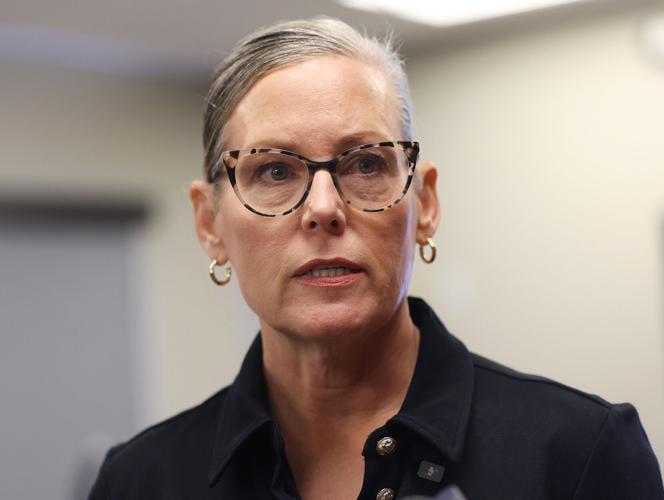
Hobbs
At least part of the reason the investigation took so long is that Hobbs refused to submit to a personal interview about her role. Instead, she provided two written statements through attorneys on Monday denying any involvement in the decision to give Sunshine more money.
Friday's findings do not end the questions.
The state Auditor General's Office has its own probe, assisted by Maricopa County Attorney Rachel Mitchell, who is a Republican.
There is no word on when that will be completed. And Mayes, at Klingerman's suggestion, said she is keeping her own investigation open "to assist as necessary.''
The timeline
Capitol Media Services discovered the first link between Hobbs and Sunshine with a finding that the company had given $100,000 in 2023 to the newly elected governor's inaugural fund. Only Arizona Public Service had contributed more.
That was significant because the inaugural event cost a reported $207,000, but the balance of the cash raised — close to $1.7 million — could be used under then-existing law by the governor for political purposes.
It was later discovered that before the 2022 election, Sunshine contributed $200,000 directly to the Arizona Democratic Party. There was another $100,000 donation in 2023.
That is relevant because the state was deciding in 2023 whether to increase the amount of money the Department of Child Safety was paying Sunshine for housing of foster children.
Sunshine had made an initial request to DCS in early 2023 for more money. That was rejected by Matthew Stewart, who had been the governor's first pick to head the agency.
Hobbs withdrew his nomination after it became clear he would not be confirmed by the Senate.
In May 2023, DCS, now run by former state lawmaker David Lujan, agreed to raise the standard rate from $140 per bed to $195, a 30% increase.
Agency spokesman Darren DaRonco said Sunshine said unless it got more money, it would make more of its beds available to the federal government, which was looking for places for immigrant children. He said such a move — the feds were paying $225 — would have meant fewer places for DCS to place foster children.
Then Sunshine got a new contract boosting its rate to $234.
Discussion among DCS employees
Klingerman said the question of the governor's links to Kottoor did come up during discussions about whether to give the company more money — but only among DCS employees.
Lujan told investigators that Robert Navarro, the DCS assistant director, volunteered, unprompted, during a meeting in February 2023 that Sunshine was "probably'' going to seek a rate increase, "and by the way they're donors to the governor.'' Navarro himself confirmed he briefed Lujan about Sunshine's donations.
There also were discussions in a Teams online chat between Navarro and Alex Ong, DCS' assistant director of support services, about the governor's campaign and inaugural fund.
"Ong characterized those discussions as 'free banter' between friends, calling one comment, 'flippant,' '' the report says. "While Navarro claimed that Sunshine's donations 'put pressure on, I think, everybody,' the investigation has shown that any perceived pressure was the result of Navarro's own knowledge of Sunshine's contributions.''
Klingerman said Ong told investigators there were never any conversations with the Governor's Office about the donations and the contract.
Michael Faust, who had been DCS director when Hobbs took office, also said he did not believe the governor had exerted any pressure on the agency. Lujan said he alerted the Governor's Office about the contract changes only after the rate increase occurred.
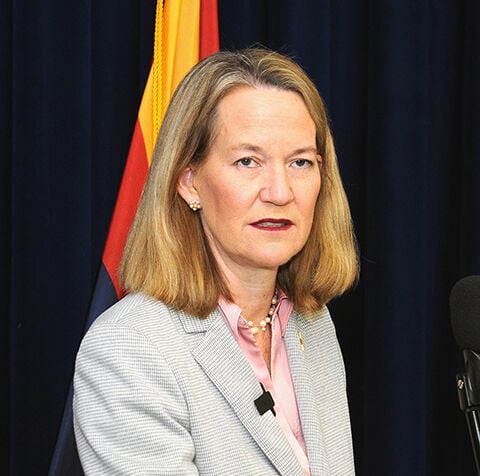
Mayes
The report did reveal some new information.
Sunshine gave another $150,000 late in 2023 and in 2024 — long after the new contracts were approved — to a legal defense fund operated by the governor. She had set it up to help defend against litigation over the 2022 election brought by Republican Kari Lake, who went to court to unsuccessfully challenge her loss in the governor's race to Hobbs.
Hobbs has repeatedly refused to comment about her legal defense fund. There is no requirement in Arizona law to disclose donors.
In fact, its existence was discovered by Capitol Media Services in 2025 only because APS — the company that provided $250,000 for the inaugural fund — was forced by the Arizona Corporation Commission to disclose it had donated another $100,000 to the defense fund.
Hobbs also hired a private law firm to deal with the latest investigation. No one from the Governor's Office would disclose how much it has been paid and who provided the money.
'Political talking points'
There's also something else behind the decision to end the inquiry.
Klingerman said in the absence of any quid pro quo, anyone could argue that charges were being brought for political purposes in violation of Arizona's Strategic Litigation Against Public Participation law. That law allows defendants to claim the only purpose of a prosecution was to punish them for exercising their First Amendment rights, including speech and petition.
He noted that political contributions are considered "core political speech.'' Plus there's the fact that the request for Mayes to investigate came from the Legislature, with some politicians using the fact that there was an investigation for "political talking points.''
And Andy Biggs, the governor's Republican foe in her reelection bid this year, has mentioned the probe in campaign ads.
Biggs claimed Mayes' report was "whitewashing obvious corruption,'' but, other than pointing out the governor's refusal to sit for an interview, provided no facts to undermine that contention.
Howard Fischer is a veteran journalist who has been reporting since 1970 and covering state politics and the Legislature since 1982. Follow him on X, Bluesky and Threads at @azcapmedia or email azcapmedia@gmail.com.