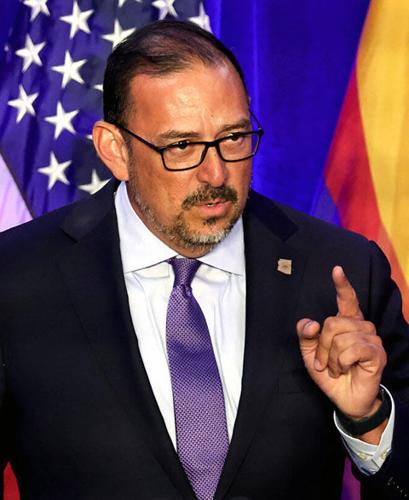
Arizona Secretary of State Adrian Fontes lashed out at the U.S. Supreme Court's decision Monday to allow the Trump administration to advance the president's plan to implement restrictions for mail-in ballots.
He said the justices issued a "convoluted order'' overturning a lower court injunction that had blocked President Donald Trump's executive order directing the U.S. Postal Service to set up new rules about voting by mail.
The majority in the 6-3 decision Monday said it was too early for the states that brought that action to sue, despite comments from Justice Ketanji Brown Jackson that moving ahead now "needlessly injects chaos and uncertainty into the upcoming midterm elections.''
At the same time, Fontes noted, there is a separate order in a case brought by the League of Women Voters and others enjoining the U.S. Postal Service from implementing the rules it enacted to put the president's directive into force — an injunction that was issued before the agency formally adopted those rules.
People are also reading…
But despite the urging of the U.S. Department of Justice on behalf of Trump, the high court's majority did not overturn that injunction.
Fontes said that leaves states and elected officials without clear guidance on what will — or won't — be required for the upcoming general election.
"It's unfortunate that the United States Supreme Court doesn't know how elections get run,'' said Fontes, an elected Democrat.
All this comes as Arizona is preparing for the Nov. 3 election.
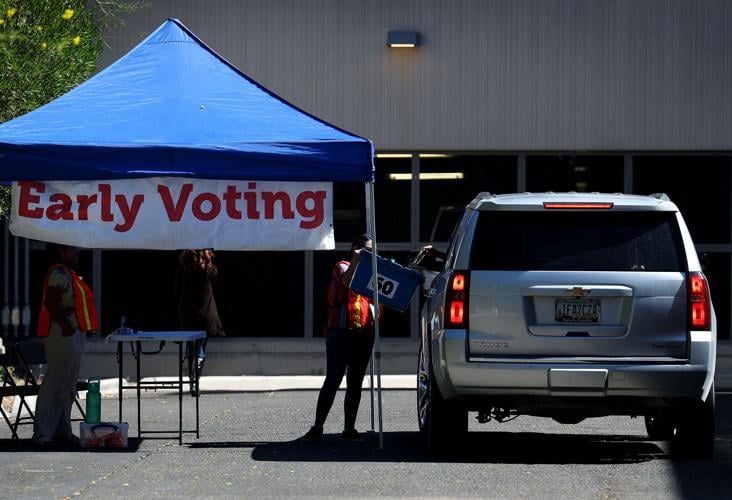
Early ballots go out on Oct. 7.
And the deadline is Sept. 19 for sending ballots to voters who are in the military or overseas.
Tied up in all of that, Fontes said, is the plan by the Trump administration to have the U.S. Department of Homeland Security make a list available to the states of who the federal agency considers to be a citizen eligible to vote.
"Now, we know they are notoriously bad with their data,'' he said. "So the question is, would those lists be accurate in the first place?''
If there are people who are registered who do not show up as citizens according to Homeland Security, Arizona law requires notices to be sent to them "so that they can provide proof of citizenship so that they can vote.''
They then have to respond within 35 days — meaning the time for them to respond is after the date to send out the military and overseas ballots. And there is a crunch with other deadlines, too, including mailing the early ballots, and the timing of the election itself.

Fontes
"So it's unrealistic and unreasonable to expect that any of these rules are going to be in place for the 2026 election,'' Fontes said, even as the Supreme Court is keeping alive Trump's efforts to make the changes this year. "I just don't know how, from a practitioner's perspective, how this is going to work.''
The justices also ignored what's known as the "Purcell principle," he said.
Named after a case involving former Maricopa County Recorder Helen Purcell, it comes from a 2006 Supreme Court ruling in which the justices said making changes in law too close to an election causes unnecessary — and illegal — confusion for both voters and election administrators.
The court has never drawn a bright line, however, in terms of what timing is considered too close.
But Fontes said as far as he's concerned, Arizona is "already well past that, especially when you're talking about things that are as important and as critical to the voters as these voter lists.''
Still, Fontes said he isn't sitting around waiting for the justices to figure out, on their own time, what changes they will allow for the November election.
"We're working with a multi-state group to explore the possibility of a possible injunction against the USPS rule that was issued on Friday,'' he said.
Trump, who votes by mail himself, has been claiming for years, without providing any proof, that there is widespread fraud in voting by mail.
Fontes has said there is no such evidence. But, regardless of the merits of what the president is trying to do, he said that seeking to make such changes now leads to unnecessary confusion.
"The uncertainty is exacerbated by the fact that this administration seems hell-bent on throwing us all into chaos,'' Fontes said.
And while the secretary is upset with the administration and weighing legal action, he sought to reassure Arizonans that they should not change how they plan to vote.
"Nothing has changed,'' Fontes said. "You can still vote by mail in Arizona. Our election officials are preparing for the election, and voters should continue making their plans to participate just as they normally would.''
He said, though, if there is any evidence presented that someone who is registered to vote is not a citizen, the state will follow the law and send out those 35-day notices asking people to provide the proof they need.
Howard Fischer is a veteran journalist who has been reporting since 1970 and covering state politics and the Legislature since 1982. Follow him on X, Bluesky and Threads at @azcapmedia or email azcapmedia@gmail.com.